
Comparisons7-minute readFor medtechs studying from review books and PDFs
ASCPi reviewer PDFs vs a simulator: which one moves your score
Compare an ASCPi reviewer, review book or PDF with a simulator. See what each builds, where each stops and how to use both before your exam.
If you are studying for the ASCPi from review books and PDFs, you probably wonder whether you also need a simulator. Short version: an ASCPi reviewer teaches you content, a simulator tests whether you can use it under the clock, and the two do different jobs.
TerumoEdge, which publishes this blog, makes a simulator, so we have a stake in this comparison. We name no books or files here. What we offer instead are criteria you can apply to anything on your desk.
What is the short answer?
Use a reviewer to learn and a simulator to check. A reviewer, whether a printed book or a PDF, organises the material across Blood Banking, Chemistry, Hematology, Microbiology, Urinalysis and Other Body Fluids, Immunology and Laboratory Operations. A simulator then asks whether you can answer, in four-option form, with 90 seconds on average per question.
That average comes from the exam itself: the ASCP content guideline describes 100 questions in 2 hours 30 minutes. ASCP also says the MLS(ASCP) and MLS(ASCPi) use the same question pool for each credential category, so a reviewer aimed at either is relevant (ASCP BOC).
Reading is not the same as retrieving. Many reviewees finish a chapter feeling certain, then miss the matching question because the question asks for application, not recall. ASCP says its questions sit at application or analysis, comprehension and knowledge levels. A book mostly trains the last two.
What does an ASCPi reviewer do well?
Reviewers and PDFs do well at ordered, portable, low-cost coverage. They give you a table of contents to follow, a way to see the whole subject and a document you can annotate. A good one condenses years of coursework into something you can read in weeks.
They are also easy to carry. A PDF on a phone works on a jeepney or in a break room, and a printed book needs no battery. For a medtech returning to the content after years of routine bench work, a reviewer rebuilds the framework that practice questions then hang on.
Free compilations of past-style questions have their place too. They can give you volume at no cost. Their weakness is not the questions but the missing context: no clock, often no explanation of why the other options fail and no way of knowing how current they are.
How can you check a reviewer's age in five minutes?
Check a reviewer's age by looking for four things: a date, the area list, the regulatory framing and the question style. Each takes a minute or two, and together they tell you whether to trust it as your main source.
- The date. Look on the cover, the footer or the file properties. No date at all is a warning in itself.
- The area list. Compare its contents page with the seven areas in the ASCP guideline. Missing Immunology or Laboratory Operations means you need another source for them.
- The regulatory framing. Open its blood bank chapter. If donor eligibility is described by local practice, or by rules the guideline does not name, treat that chapter as background only.
- The question style. ASCP questions are four options and one best answer, at application or analysis, comprehension and knowledge levels. A reviewer full of true-or-false recall lines trains only the lowest level.
Remember that a reviewer written for the Philippine licensure exam under RA 5527 was built for a different body and a different exam. Much of its science will transfer; its regulatory framing may not.
Where do reviewers stop?
Reviewers stop at age, regulatory currency and the clock. Each is a quick check you can run on any file or book.
Age. ASCP revised the content guideline on September 25, 2025. A reviewer written before that date may weight areas differently. Check whether it names Immunology and Laboratory Operations as areas, since a five-subject reviewer leaves real weight uncovered.
Regulatory currency. The guideline says donor-eligibility questions are based on regulations as of June 2023, and regulatory questions use US sources such as AABB, FDA and CLIA. A reviewer written around local practice, or around older US rules, can mislead you.
No clock. A book cannot enforce 90 seconds a question or the rule that you answer before moving on. ASCP's About the Examination page says questions cannot be skipped, and the 2021 candidate procedures say a break does not stop the exam clock.
What does a simulator add?
A simulator adds timed retrieval, the exam's format and instant explanations. You see a four-option item, commit to an answer and then read why it was right or wrong while the reasoning is fresh.
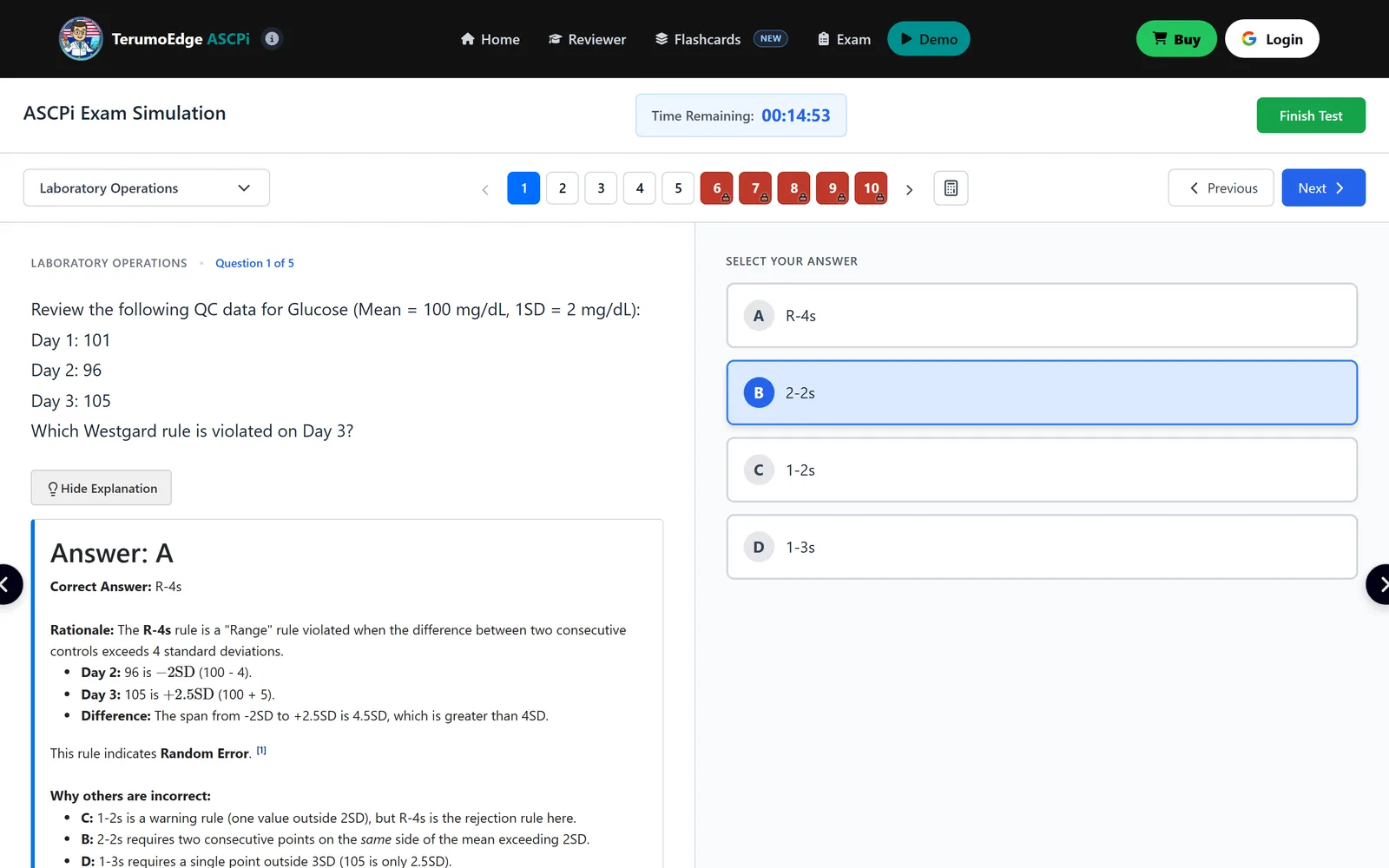
TerumoEdge has 2,800 items across seven areas, with an English explanation for every item. Nearly all of them also say why the other options are wrong. The 100-item mock runs on a 150-minute clock.
Be clear about the limits. The mock is a fixed-length random draw and lets you go back, so it does not copy ASCP's adaptive algorithm. It gives no scaled score either, because that comes from ASCP's calibrated question bank. The longer discussion is in what an ASCPi simulator can and cannot rehearse.
How do the two compare?
The table below compares a reviewer PDF with a simulator on the criteria that matter for a working medtech.
| Criterion | Reviewer or PDF | Simulator |
|---|---|---|
| Teaches content in order | Strong | Weak; it assumes you studied |
| Timed 100-question practice | None | Yes, in a mock mode |
| Explains wrong options | Varies | Yes, for nearly every item in TerumoEdge |
| Easy to update after a guideline revision | Slow | Depends on the publisher |
| Works offline | Usually | Usually needs a connection |
| Gives you a scaled score | No | No, and be wary of any tool that claims to |
| Best stage | Early and middle review | Middle review through the final weeks |
Which should you use, and when?
Use a reviewer first for areas you have not seen in years, then switch to a simulator for those areas as soon as you can read the content without strain. Alternating works better than finishing one before the other, because questions reveal which chapters to re-read.
A simple weekly pattern: read one area in your reviewer, do a fixed set of 100 items from that area untimed, read every explanation, then redo the missed topics in the reviewer. Add the clock to later sets, and keep a short log of which topics keep returning. A topic that you miss three times is telling you the reviewer did not fix it, and a different explanation or a flashcard deck may. In the last weeks, sit full mocks and use the reviewer only for the gaps they expose.
TerumoEdge also has a laboratory science reviewer at /learn/ and 1,000 flashcards, so the two jobs can sit in one place. The free demo lets you test the questions first. For how the seven areas weigh against each other, see the content areas and weights guide, and for a schedule, the 12-week study plan.
Frequently asked questions
Are old ASCPi reviewers still useful?
Often yes for core science, which changes slowly. The risk lies in weighting and regulation. Check an older reviewer against the seven areas in the guideline revised September 25, 2025, and treat any donor-eligibility content with care, since the guideline ties those questions to regulations as of June 2023.
Should I start with a reviewer or with questions?
Start with a short diagnostic set of questions to see where you stand, then use a reviewer for the areas you miss. Questions first make reading purposeful. If an area is entirely unfamiliar, read the reviewer first so the questions teach instead of frustrate.
Are free ASCPi PDFs reliable?
We make no claim about any specific file. Judge a free PDF by criteria: does it cover all seven content areas, does it state its date, does it ground regulatory content in US sources and does it explain why wrong options are wrong? A file that fails two or more of these needs a second source.
Sources
- MLS(ASCP) and MLS(ASCPi) Examination Content Guideline — ASCP Board of Certification
- About the Examination — ASCP Board of Certification
- Understanding the Similarities and Differences Between ASCP & ASCPi Certification — ASCP Board of Certification
- ASCP BOC/Pearson VUE Candidate Test Center Procedures — ASCP BOC and Pearson VUE, August 2021
- Republic Act No. 5527 (Philippine Medical Technology Act) — Lawphil
From the publisher
Meet the ASCPi format here first.
TerumoEdge ASCPi is an ASCPi practice simulator: board-length sets and a timed 100-item mock across all seven content areas, with an English explanation for every item instead of a bare answer key. It is a fixed-length practice draw, not ASCP's adaptive test.
- 2,800 items across seven content areas, 400 in each
- Four fixed sets of 100 items per area, and a 100-item full mock in 150 minutes
- An English explanation for every item, not a bare answer key
- A laboratory science reviewer and flashcards beside the question bank
Try the free ASCPi simulator demo Five real items in each of the seven content areas. No account needed.
About this article
Written by the TerumoEdge ASCPi editorial team, who build the TerumoEdge ASCPi Exam Simulator. Exam facts are checked against the ASCP Board of Certification content guideline, its eligibility and exam pages, and the ASCP BOC and Pearson VUE test center procedures, and every article lists its sources. How we write and check our articles.
First published .