Guides7-minute readFor registered medtechs preparing for the ASCPi
What an ASCPi simulator is, and what it can and cannot rehearse
An ASCPi simulator rehearses the clock, the format and the content mix. Here is what it cannot copy from the real exam, and how to use one well.
You are a registered medtech with a hospital shift schedule, and you want to know whether an ASCPi simulator is worth your limited review hours. It is, for specific jobs. It is not a copy of the real exam, and a good one will tell you so.
This guide settles three things: what the real MLS(ASCPi) asks of you, which parts a simulator can rehearse, and which part nobody outside ASCP can reproduce. TerumoEdge publishes the simulator discussed below, so weigh our view accordingly. We keep every exam fact tied to a source at the end. The Philippine licence you already hold under RA 5527 is a separate credential from the one this exam awards.
What is an ASCPi simulator?
An ASCPi simulator is a practice environment that imitates the conditions of the MLS(ASCPi) exam so you can rehearse before the real sitting. It gives you questions in the same four-option format, a running clock, a spread across the same content areas and, in a good one, an explanation after each answer.
It is different from a review book, which teaches content, and different from a free list of past questions, which gives you items but no conditions. A simulator is where you find out whether what you studied survives 150 minutes of pressure.
What it is not: the exam itself. Only ASCP Board of Certification (ASCP BOC) delivers the scored test, through Pearson centres. A simulator is a rehearsal room, and the useful question is how close the rehearsal is on each feature that matters.
What does the real exam ask of you?
The real exam asks for 100 multiple-choice questions in 2 hours 30 minutes, each with four options and one best answer, delivered by computer adaptive testing (CAT). That wording comes from the ASCP BOC content guideline and from the About the Examination page.
Three rules shape how you behave on the day. You must answer each question before moving on, so nothing can be skipped. You can flag questions and review them only if time remains after all are answered. An onscreen calculator is available.
Scores run from 100 to 999, and the minimum passing score is 400. ASCP states there is no set number or percentage of correct answers needed to pass, so 400 is not a percentage and should never be treated as one.
The guideline also says regulatory questions rest on US sources such as AABB, FDA and CLIA. For a Philippine-trained medtech, that is a content habit to build, not just a format to learn.
What can a simulator rehearse?
A simulator can rehearse five things well: pace, stamina, format, content mix and learning from explanations. Each one is something you control, and each one improves with repetition.
Pace. One hundred questions in 150 minutes averages 90 seconds each. Sitting a full-length mock shows you where your minutes go, and whether the fourth hour of a long shift has taught you to read too slowly.
Stamina. Two and a half hours of focused reading is its own skill. The first full mock is usually humbling, and that is the point of doing it before exam day.
Format. Four options, one best answer, a stem you read once carefully. Practising the elimination habit that ASCP itself recommends is easier on a screen that looks like the real one.
Content mix. The guideline spreads questions across seven areas, from Blood Banking to Laboratory Operations. A simulator that draws from all seven stops you from over-studying the subjects you enjoy.
Explanations. The learning happens after the answer. A rationale that also says why the other options fail is worth more than a bare key.
One thing a simulator cannot rehearse is the centre itself. The candidate procedures from ASCP BOC and Pearson VUE, dated 2021, describe a locker for your belongings and no studying at the centre, so confirm the current rules when you book.
What can no simulator copy?
No simulator can copy ASCP's adaptive algorithm, because the algorithm depends on a question bank only ASCP holds. ASCP describes drawing questions from "a bank containing previously validated and statistically calibrated questions" and selecting ones that give you about a 50% chance of answering correctly.
The exam begins near the minimum passing standard. A correct answer brings a slightly harder question, and a wrong answer brings a slightly easier one. Questions come from all content areas throughout, and scoring follows the overall pattern of responses, not a simple count of correct answers.
A practice tool can say it is "adaptive", but without ASCP's calibration data it cannot know how hard its own questions are in the way ASCP does. For the same reason, no simulator can honestly turn your practice results into a 100–999 score.
| Real-exam feature | Can practice rehearse it? | How TerumoEdge handles it |
|---|---|---|
| 100 questions in 2 h 30 | Yes | A 100-item mock on a 150-minute clock |
| Four options, one best answer | Yes | Every item is four-option with one keyed answer |
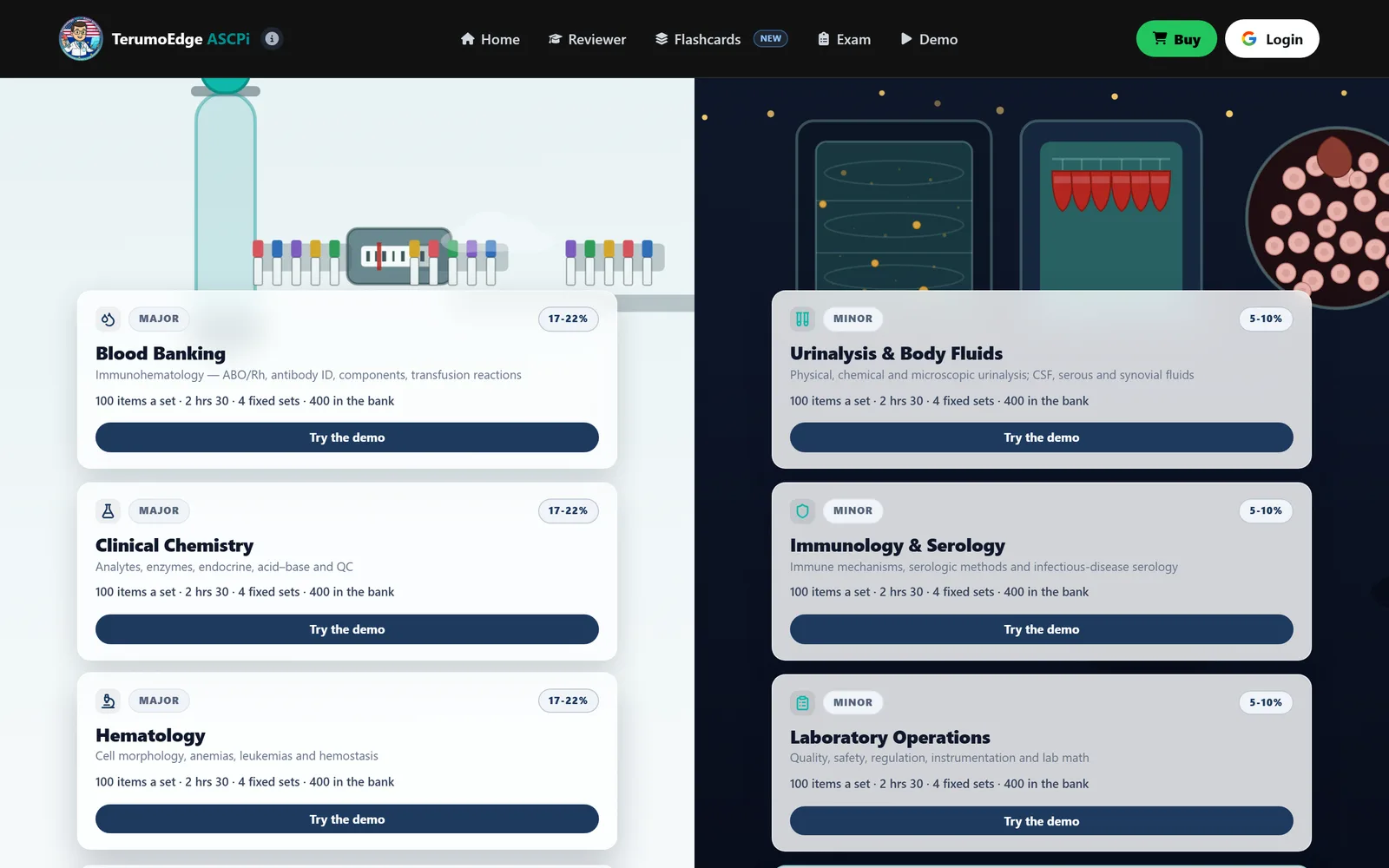
| Seven content areas | Yes | 400 items in each of seven areas |
| US-based regulatory questions | Partly | Items and explanations framed on AABB, FDA and CLIA |
| No skipping, forward-only | Not exactly | The mock allows Previous and Next |
| Adaptive difficulty | No | Not simulated: the mock is a fixed random draw |
| Scaled score of 100–999 | No | No score estimate is given |
What does TerumoEdge include?
TerumoEdge ASCPi has 2,800 items across all seven content areas in the ASCP guideline, at 400 per area. That includes Immunology and Laboratory Operations, the two smaller areas that many reviewers leave thin.
Each area has four fixed sets of 100 items (28 in all), plus a random 100-item draw from one area's bank. The full mock is 100 items in 150 minutes, drawn at fixed counts: 20 each from Blood Banking, Chemistry, Hematology and Microbiology, 7 from Urinalysis and Other Body Fluids, 7 from Immunology and 6 from Laboratory Operations.
Those counts are our design, set near the midpoint of ASCP's published ranges. ASCP publishes ranges, never counts, so do not read them as ASCP's.
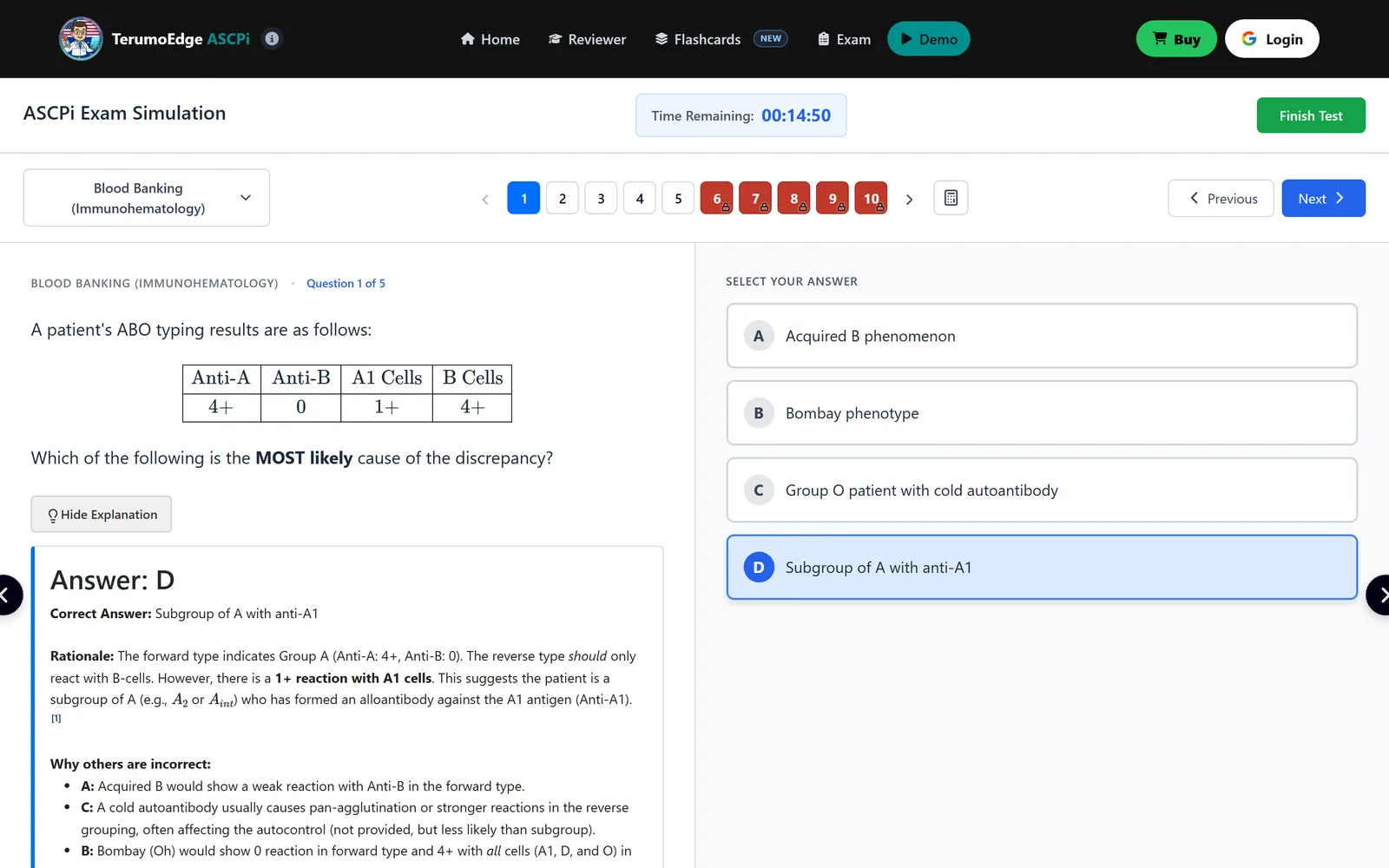
The mock is not adaptive. It is a fixed-length random draw, and the exam room lets you go back. It rehearses length, clock, four-option format and content mix, and nothing more than that.
How should you use a simulator across your review?
Use a simulator in three stages: untimed sets while you learn, timed sets once an area feels solid, and full mocks in the last weeks. Starting with full mocks too early only measures how much you have not yet studied.
In the learning stage, do one fixed set of 100 items in an area, then spend longer on the explanations than on the questions. Note which errors are knowledge gaps and which are reading slips. In the second stage, add the clock to those same sets.
In the final stage, sit the full 100-item mock on an off day, ideally at the hour of your booked sitting. Treat the first one as a diagnostic, not a verdict.
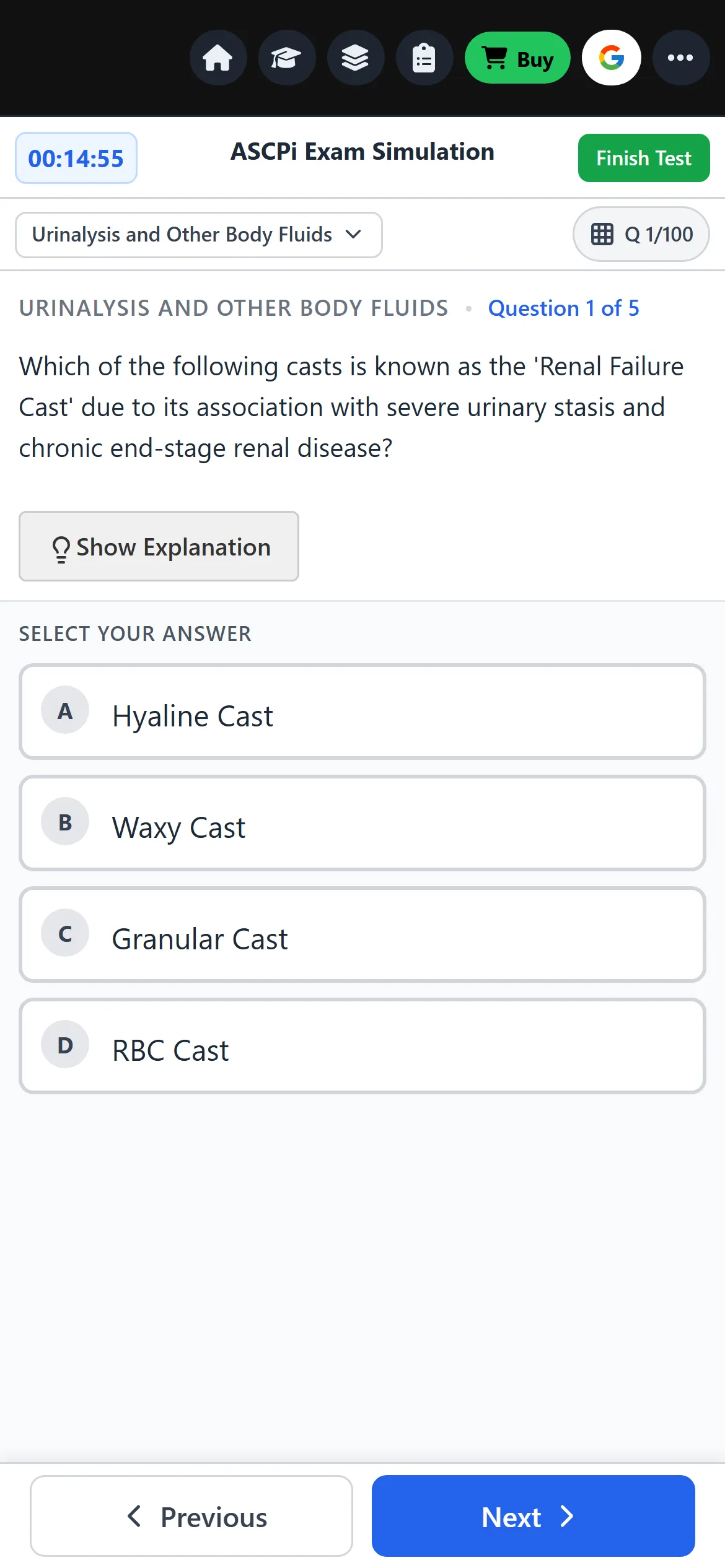
Pair the simulator with a laboratory science reviewer at /learn/ for content you need to relearn, and flashcards for short recall. If you want to try before committing, the free demo gives five items in each area, 35 in all. For how a simulator sits next to books, read reviewer PDFs vs a simulator, and for a schedule see the 12-week ASCPi study plan.
Frequently asked questions
Is there a free ASCPi simulator?
TerumoEdge offers a free demo with five items in each content area, 35 in all, and no account is needed. We make no claims about what other providers offer. Whatever you try, check it against the criteria in this guide: all seven areas, four options, a timed mode and honest explanations.
Is the TerumoEdge mock adaptive?
No. The mock is a fixed-length random draw of 100 items in 150 minutes, and the exam room lets you go back to earlier items. It rehearses the length, the clock, the four-option format and the content mix. It does not rehearse the adaptive algorithm, which only ASCP's calibrated bank can drive.
Can a simulator forecast my ASCP score?
No. The scaled score from 100 to 999 comes from ASCP's CAT, which scores the overall pattern of responses against a calibrated question bank. A practice percentage is not a scaled score, and 400 does not mean any particular percentage correct. Use practice results to find weak areas, not to guess a number.
Does the bank cover Immunology and Laboratory Operations?
Yes. The bank holds 400 items in each of the seven content areas, including Immunology and Laboratory Operations. That does not mean it reproduces every topic in the ASCP guideline. It means no official area is missing from the practice.
Sources
- MLS(ASCP) and MLS(ASCPi) Examination Content Guideline — ASCP Board of Certification
- About the Examination — ASCP Board of Certification
- Understanding the Similarities and Differences Between ASCP & ASCPi Certification — ASCP Board of Certification
- ASCP BOC/Pearson VUE Candidate Test Center Procedures — ASCP BOC and Pearson VUE, August 2021
- Republic Act No. 5527 (Philippine Medical Technology Act) — Lawphil
From the publisher
Meet the ASCPi format here first.
TerumoEdge ASCPi is an ASCPi practice simulator: board-length sets and a timed 100-item mock across all seven content areas, with an English explanation for every item instead of a bare answer key. It is a fixed-length practice draw, not ASCP's adaptive test.
- 2,800 items across seven content areas, 400 in each
- Four fixed sets of 100 items per area, and a 100-item full mock in 150 minutes
- An English explanation for every item, not a bare answer key
- A laboratory science reviewer and flashcards beside the question bank
Try the free ASCPi simulator demo Five real items in each of the seven content areas. No account needed.
About this article
Written by the TerumoEdge ASCPi editorial team, who build the TerumoEdge ASCPi Exam Simulator. Exam facts are checked against the ASCP Board of Certification content guideline, its eligibility and exam pages, and the ASCP BOC and Pearson VUE test center procedures, and every article lists its sources. How we write and check our articles.
First published .