
The ASCPi explained7-minute readFor medtechs facing their first computer adaptive test
How the ASCPi computer adaptive test works: no skipping, flagging, and why it feels hard
How the ASCPi computer adaptive test picks your next question, why you cannot skip, what flagging allows, and why it feels hard even when you are doing well.
If you are a registered medtech sitting the MLS(ASCPi), the part that surprises most people is not the content. It is the ASCPi computer adaptive test itself: you cannot skip a question, you cannot go back at will, and the questions seem to get harder the better you do. This post explains how the test behaves, using what the ASCP Board of Certification (ASCP BOC) says on its own pages.
Every mechanic below comes from the BOC's About the Examination page, and the format itself from the content guideline. Where the sources say nothing, we say nothing.
What is the ASCPi computer adaptive test?
Computer adaptive testing (CAT) means the exam chooses each question after seeing how you answered the last one. The MLS(ASCPi) is delivered this way: according to the ASCP BOC content guideline, it has 100 questions in a 2-hour 30-minute time frame, all multiple choice with one best answer. The BOC's examination page adds that each question has four options.
The BOC calls its approach criterion-referenced computerized adaptive testing, and the MLS is not on its list of non-adaptive exams. "Criterion-referenced" means you are measured against a passing standard, not against other candidates on the day.
So there is no printed paper where everyone sees the same 100 questions. Two candidates in the same room can see different questions, and the exam is still scored on one common scale. We cover that scale in the ASCPi passing score post.
If you have heard that the ASCPi is "easier" or "harder" than the ASCP exam, the BOC's comparison of the two credentials says both use the same question pool for each credential category and are given at Pearson centres worldwide. The CAT you meet is the same kind of test. Only eligibility differs.
How does the next question get chosen?
The exam begins with a question near the minimum passing standard, then moves up or down depending on your answers. In the BOC's words, a correct answer brings a slightly higher level of difficulty. This continues until you answer incorrectly, and then a slightly easier question is presented.
The questions come from a bank of previously validated and statistically calibrated questions. The system selects questions that give you about a 50% chance of answering correctly. It also follows the examination content guideline percentages and your estimated ability, and it does not give you one content area at a time. Blood Banking, Chemistry and Hematology items can sit side by side.
That last point matters for review. You cannot "finish" Microbiology and relax. Our post on the seven content areas and their weights shows the ranges the algorithm draws on.
| CAT feature | What the BOC says | What to do about it |
|---|---|---|
| Starting point | Begins near the minimum passing standard | Treat the first questions as ordinary, not as a warm-up |
| After a correct answer | Next question is slightly harder | Expect to feel stretched when you are doing well |
| After a wrong answer | Next question is slightly easier | Do not read an easier question as a trap |
| Target difficulty | About a 50% chance of a correct answer | Accept that uncertainty is normal on every question |
| Content mix | All areas may appear throughout | Review all seven areas, not just the big ones |
| Skipping | Not allowed | Answer, then move on |
| Flagging | Allowed, review if time remains | Flag, but never plan on having review time |
| Field-test items | Unscored and indistinguishable | Give every question an honest answer |
Why can you not skip, and what does flagging allow?
You cannot skip a question because the CAT estimates your ability level each time you answer. The BOC states that you must answer each question before moving on. The algorithm needs your answer to pick what comes next.
You can flag questions, though. If time remains after you have answered all of them, you can review the flagged ones. The BOC also says that changing an answer does not affect the questions you have already been given. The difficulty path was already set by your original answers.
So flagging is a note to yourself, not a way out. In practice:
- Give your best answer first, every time.
- Flag only the questions where a second look might change your answer.
- Do not bank on the review time. If the clock runs short, the flag list is the first thing you lose.
Pacing is a skill of its own, and we give it a full treatment in ASCPi time management.
Why does it feel hard even when you are doing well?
The ASCPi computer adaptive test feels hard because it is built to keep you near a 50% chance of a correct answer. A candidate who answers well is served harder questions, so the exam rarely feels comfortable for anyone.
This is the single most useful thing to know before exam day. If you finish a stretch of questions feeling unsure, that tells you very little. The design pushes everybody toward that feeling. The BOC does not say a harder-feeling exam means a higher or lower result, and neither do we.
The BOC's own strategy advice is practical: read the stem and all four choices, eliminate the options you know are wrong, answer every question and manage your time. We go deeper on the emotional side in ASCPi anxiety.
Picture a stretch where you answer several questions in a row correctly. Each one is followed by something slightly harder, so your confidence drops even though you are doing well. Now picture a wrong answer: the next question is slightly easier, and relief creeps in. Neither feeling tells you your standing. They only tell you where the algorithm last placed you.
The practical habit is to stop reading the exam. Do not count how many questions felt easy. Do not guess your result at question 60. Answer the question in front of you, then the next one.
Are some questions unscored, and can you game the system?
Yes, some questions are unscored, and no, you cannot game it. The BOC says CAT examinations include field-test questions that are not used to determine your score. They are indistinguishable from the scored questions, so you cannot tell which is which.
The second myth is answering wrong on purpose to get easier questions. The BOC says this does not work and may lead to a lower ability estimate. Scoring is based on the overall pattern of responses, not simply the number of questions answered correctly, and not all questions contribute equally.
Two practical consequences follow. First, never spend energy guessing which question is a field-test item. Second, never "save" effort on a question that feels strange. Treat each one as if it counts, because you cannot know that it does not.
How do you practise for a CAT with fixed-form sets?
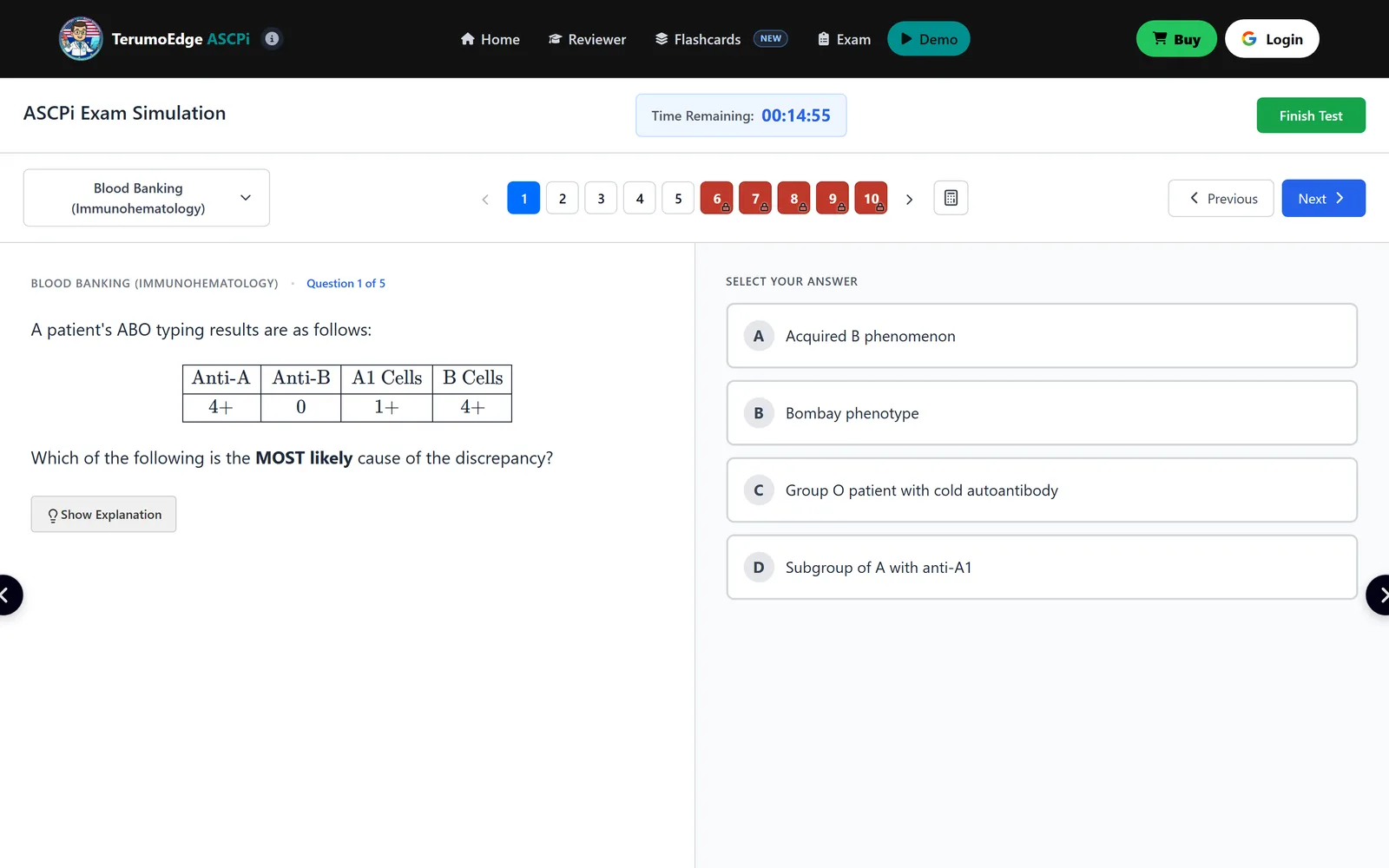
A fixed-form practice set trains the parts of the CAT that you can rehearse: the 100-question length, the 150-minute clock, the four-option format and the habit of answering before moving on. It cannot reproduce how the real exam picks questions, because ASCP draws from its own calibrated bank.
TerumoEdge is a simulator, and we publish this blog, so weigh our view accordingly. Our full mock is a fixed draw of 100 items in 150 minutes across all seven areas, and its exam room lets you go back to earlier items. It is not a computer adaptive test, and it does not estimate a 100 to 999 score.

Use the mock to build stamina and pace, then add one rule the real exam imposes: commit to an answer before moving on. You can try the format in the free demo, which has five items in each area.
Frequently asked questions
Can you go back on the ASCPi?
Not freely. You must answer each question before moving on and cannot skip. You can flag questions and review them after all have been answered, if time remains. The ASCP BOC adds that changing an answer does not affect the questions you were already given.
How many questions must I get right to pass?
The ASCP BOC sets no number or percentage of correct answers to pass. Scoring is based on the overall pattern of responses across the examination, and not all questions contribute equally. The passing standard is a minimum scaled score of 400 on a 100 to 999 scale.
Does the exam end early if I am doing well?
We cannot say. The sources we rely on describe the MLS exam as 100 questions in 2 hours 30 minutes and do not describe any early finish. Plan for the full 100 questions and the full time, and confirm anything else with the ASCP BOC.
Are some questions unscored?
Yes. The ASCP BOC says CAT examinations include field-test questions that are not used in determining your score. They are indistinguishable from scored questions, so answer every question as carefully as the last.
Sources
From the publisher
Meet the ASCPi format here first.
TerumoEdge ASCPi is an ASCPi practice simulator: board-length sets and a timed 100-item mock across all seven content areas, with an English explanation for every item instead of a bare answer key. It is a fixed-length practice draw, not ASCP's adaptive test.
- 2,800 items across seven content areas, 400 in each
- Four fixed sets of 100 items per area, and a 100-item full mock in 150 minutes
- An English explanation for every item, not a bare answer key
- A laboratory science reviewer and flashcards beside the question bank
Try the free ASCPi simulator demo Five real items in each of the seven content areas. No account needed.
About this article
Written by the TerumoEdge ASCPi editorial team, who build the TerumoEdge ASCPi Exam Simulator. Exam facts are checked against the ASCP Board of Certification content guideline, its eligibility and exam pages, and the ASCP BOC and Pearson VUE test center procedures, and every article lists its sources. How we write and check our articles.
First published .