The ASCPi explained7-minute readFor medtechs who want to know what passing means
The ASCPi passing score: what 400 on a 100–999 scale means, and how results arrive
The ASCPi passing score is 400 on a 100 to 999 scale. See why no percentage applies, how results arrive and what a failing report shows.
You finished a practice mock with a good percentage, and now you wonder what that means against the real ASCPi passing score. Short answer: not much, directly. The MLS(ASCPi) reports a scaled score, and the pass line is a scaled 400, not a percentage of questions.
This post explains the scale, how results reach you and what a failing report shows. All of it comes from the ASCP Board of Certification (ASCP BOC) About the Examination page, unless we say otherwise.
What is the ASCPi passing score, in one sentence?
The minimum passing score is 400 on a scale of 100 to 999. Those are the ASCP BOC's figures for its scaled scores, and they apply to the exam you take for the MLS(ASCPi).
The scaled score comes from a psychometric ability estimate. The BOC describes scaled scores as transformed onto the 100 to 999 scale from that estimate. You do not earn points per question, and you cannot add up your correct answers to find your scaled score.
Do not turn 400 into a percentage. Four hundred out of 999 is not "about 40%", because the scale does not work like a test mark. It is a position on a calibrated scale. We say this firmly because the arithmetic looks tempting and leads you to a wrong target.
Why is there no percentage to hit?
There is no percentage to hit because ASCP scores the pattern of your answers, not the count. The BOC states there is no set number of questions you must answer correctly to pass, nor a set percentage you must achieve.
Here is why. The exam is a computer adaptive test: each question you see depends on your earlier answers, and the questions are chosen to give you about a 50% chance of answering correctly. Two candidates who each answer 60 questions correctly may have faced very different questions. The BOC says CAT scoring is based on the overall pattern of responses across the examination rather than simply the number answered correctly. Not all questions contribute equally.
For the full mechanics, read how the ASCPi computer adaptive test works. It also explains why the test feels hard even when you are doing well.
How do results arrive?
Results come in two steps: a preliminary result on the screen, then official notice by email. At the end of the exam, a preliminary pass or fail shows on screen. The BOC says score reports cannot be printed at the Pearson test centre.
Notice of your official score comes by email within four business days, once transcripts are processed. The official report shows pass or fail and the scaled score.
The ASCP BOC and Pearson VUE test centre procedures, a document dated August 2021, describe the same pattern: a preliminary pass or fail briefly displays on screen, and official results can be accessed within four business days. Since that document is older, the current BOC page above is our primary reference for timing.
| Stage | What you see | When |
|---|---|---|
| End of the exam | Preliminary pass or fail on screen | Immediately after you finish |
| At the centre | No printed score report | Reports cannot be printed there |
| Official notice | Email notice of the official score | Within four business days, once transcripts are processed |
| Official report | Pass or fail and the scaled score | With the official notice |
What does a failing score report show?
A failing score report breaks your score down by subtest area, and a passing report does not. That is the BOC's wording. The report is useful mainly if you need to plan a retake.
The subtest breakdown follows the exam's content areas, which in the content guideline are seven: Blood Banking, Urinalysis and Other Body Fluids, Chemistry, Hematology, Immunology, Microbiology and Laboratory Operations. Our guide to the seven areas and their weights lists the ranges.
If you do not pass, the rules for trying again are separate. Under one eligibility route you may take the examination five times while you continue to meet current eligibility requirements, and your eligibility period begins no earlier than 30 days after your previous exam date, according to the BOC's After the Examination page. Each application carries a non-refundable fee, which we do not quote. We cover the whole retake picture in the ASCPi retaker strategy.
Why does this post quote no passing rate?
This post quotes no passing rate because we could not verify an official MLS(ASCPi) pass rate from a page we opened, and we do not repeat figures from third-party snippets. You may see percentages online, with a year attached and a confident tone. Treat them as unverified unless they cite ASCP BOC directly.
A pass rate also would not help you much. It describes a group of candidates, not you, and it says nothing about how the scaled score treats your answer pattern. What helps is knowing the rules: a scaled 400, no percentage and a clear route to retake if needed.
If ASCP BOC publishes official statistics, go to the source and check the year, the credential and whether the figure is for first-time takers. We would rather give you no number than a number we cannot stand behind.
Is your practice score a scaled score?
No. Your practice percentage is not a scaled score, and nothing we publish converts one to the other. A fixed-form mock counts correct answers. The real exam estimates ability from a pattern of answers on questions chosen for you.
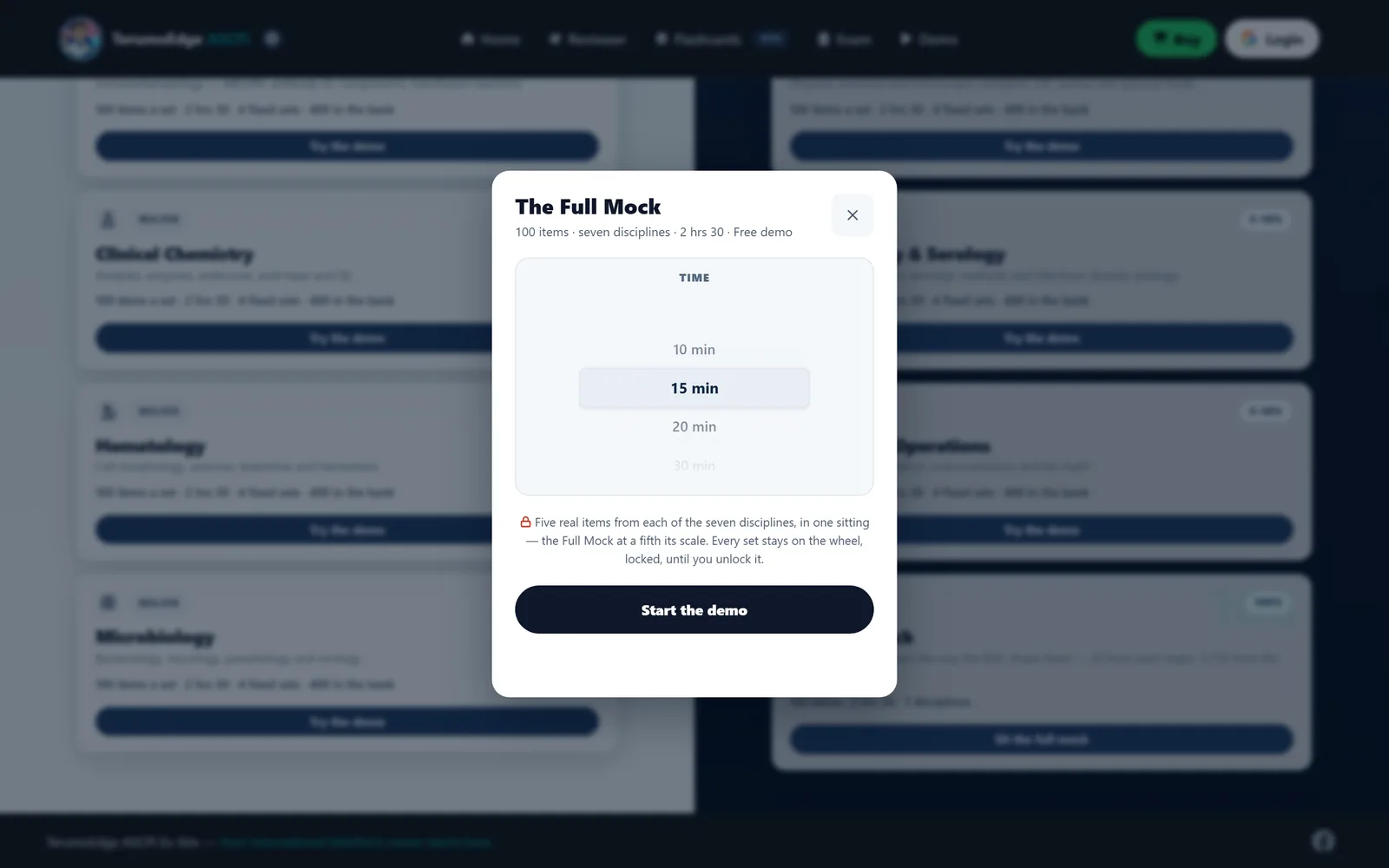
TerumoEdge is a simulator, and we publish this blog, so weigh that accordingly. Our 100-item mock runs 150 minutes and has a fixed draw across the seven areas. It does not estimate a 100 to 999 score. What it does give you is an English explanation for every item, with the correct answer and a rationale.
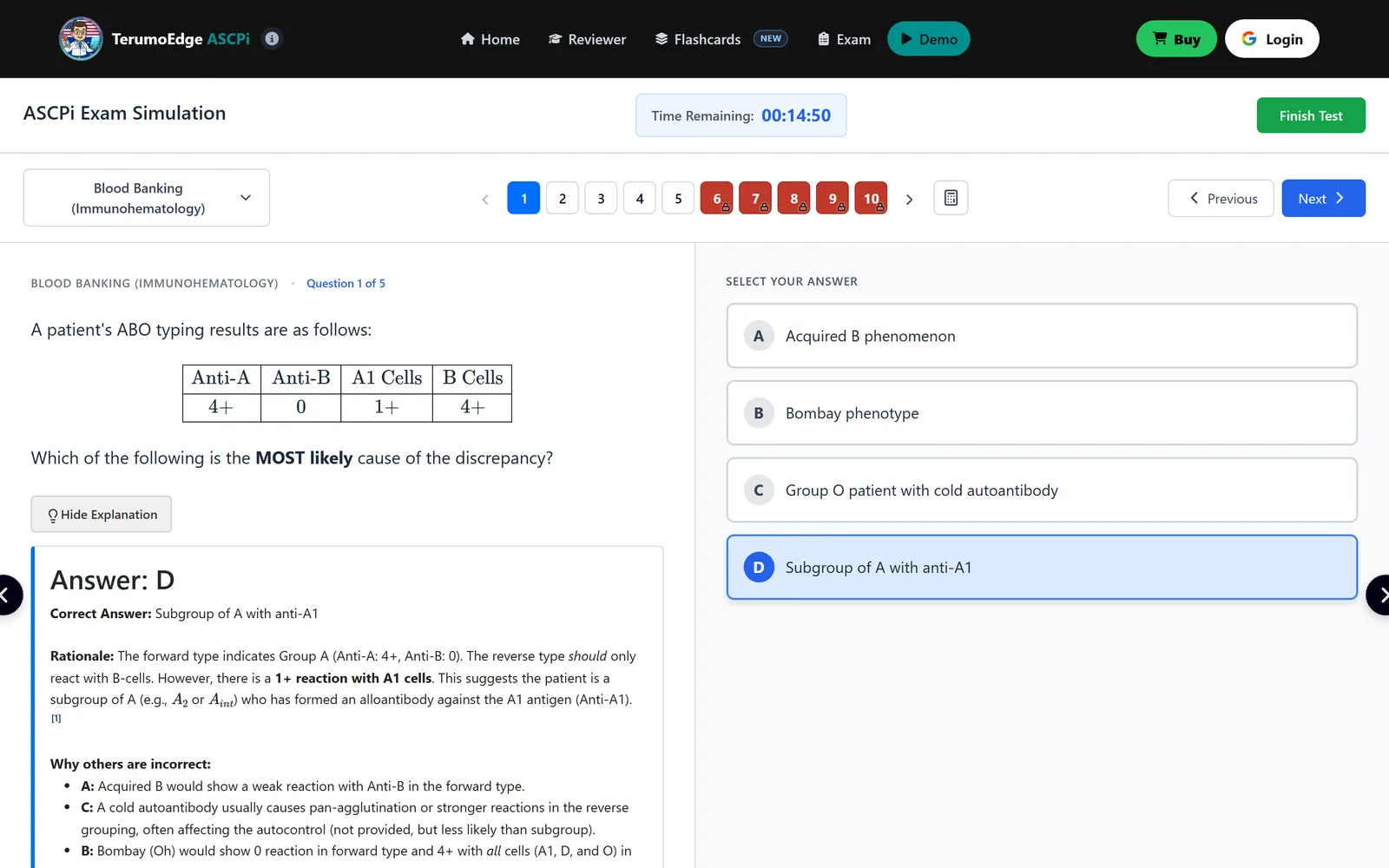
Use practice percentages as a trend for yourself: are you getting stronger across all seven areas? Try the free demo to see how the explanations work.
How should you use this when you prepare?
Aim at the skill the score rewards: consistent, careful answers across all seven content areas. Because the score comes from the pattern of your responses on questions pitched near your ability, the sensible target is not a magic percentage but steady accuracy as questions get harder.
Three habits follow from that. First, answer every question with a real attempt, because you cannot skip and a deliberate wrong answer may lower the ability estimate. Second, cover the small areas, since a failing report would show them as subtests. Third, rehearse the whole exam length so that your accuracy in the last 30 questions matches your accuracy in the first 30.
Keep your own log of practice results by area, not by total. A total hides a weak Immunology behind a strong Chemistry. For how questions are chosen, see the guide to how the CAT works, and for the seven areas see the content guideline post.
One more caution. A candidate who needs a retake should read the subtest breakdown as a map of where to spend the next weeks, not as a verdict on ability. The same report also belongs to someone who may be a few points from the line or far from it, and the official report itself shows which.
Frequently asked questions
What is the ASCPi passing score?
The minimum passing score is 400 on the ASCP BOC's scale of 100 to 999. It is a scaled score derived from a psychometric ability estimate, not a count or a percentage of correct answers.
What percentage do I need to pass?
None is set. The ASCP BOC states there is no set number of questions you must answer correctly to pass, nor a set percentage. Scoring uses the overall pattern of responses, and not all questions contribute equally.
When do ASCPi results come out?
A preliminary pass or fail shows on screen when you finish. Notice of your official score comes by email within four business days, once transcripts are processed. The test centre does not print score reports.
Is 400 out of 999 about 40%?
No. The 100 to 999 scale is a scaled score, not a percentage, so 400 does not mean 40% correct. Never convert it to a percentage or a raw score, because the scale does not work that way.
Sources
From the publisher
Meet the ASCPi format here first.
TerumoEdge ASCPi is an ASCPi practice simulator: board-length sets and a timed 100-item mock across all seven content areas, with an English explanation for every item instead of a bare answer key. It is a fixed-length practice draw, not ASCP's adaptive test.
- 2,800 items across seven content areas, 400 in each
- Four fixed sets of 100 items per area, and a 100-item full mock in 150 minutes
- An English explanation for every item, not a bare answer key
- A laboratory science reviewer and flashcards beside the question bank
Try the free ASCPi simulator demo Five real items in each of the seven content areas. No account needed.
About this article
Written by the TerumoEdge ASCPi editorial team, who build the TerumoEdge ASCPi Exam Simulator. Exam facts are checked against the ASCP Board of Certification content guideline, its eligibility and exam pages, and the ASCP BOC and Pearson VUE test center procedures, and every article lists its sources. How we write and check our articles.
First published .