ASCPi guides for Filipino medtechs
Straight answers for registered medtechs heading into the MLS(ASCPi): what the seven content areas weigh, how the computer adaptive test and the 100 to 999 score work, which eligibility route fits you, how to study around hospital shifts, and how a simulator compares with a review center, a PDF reviewer or a chatbot. Every exam fact is sourced.
 Start here
What an ASCPi simulator is, and what it can and cannot rehearse
An ASCPi simulator rehearses the clock, the format and the content mix. Here is what it cannot copy from the real exam, and how to use one well.Comparisons
-
Comparisons
ASCPi review center or self review? An honest comparison for working medtechs
An ASCPi review center gives structure and a cohort; self review gives flexibility around shifts. Compare both and see who should pick which. -
Comparisons
ASCPi reviewer PDFs vs a simulator: which one moves your score
Compare an ASCPi reviewer, review book or PDF with a simulator. See what each builds, where each stops and how to use both before your exam. -
Comparisons
ASCPi vs MTLE: what changes when you study for a US-style exam
ASCPi vs MTLE: two credentials from two bodies. See what is new on the ASCPi, the habits to rebuild and what your board-exam review can still do. -
Comparisons
ChatGPT for ASCPi review: where chatbots help and where they mislead
ChatGPT for ASCPi review can explain mechanisms and quiz you, but it can mislead on US regulation. Here is a safe workflow for medtechs. -
Comparisons
How to choose an ASCPi reviewer app: nine criteria that matter
Nine checkable criteria for choosing an ASCPi reviewer app, a 10-minute demo test, the red flags to avoid and an honest look at our own limits.
The ASCPi explained
-
The ASCPi explained
ASCP vs ASCPi: the same exam pool, different eligibility, and the road from one to the other
ASCP vs ASCPi explained for medtechs: one question pool, different eligibility, the MLS(ASCPi)-to-MLS(ASCP) transition and credential maintenance. -
The ASCPi explained
How the ASCPi computer adaptive test works: no skipping, flagging, and why it feels hard
How the ASCPi computer adaptive test picks your next question, why you cannot skip, what flagging allows, and why it feels hard even when you are doing well. -
The ASCPi explained
The ASCPi content guideline: seven areas, their weights, and what they mean for your hours
The ASCPi content guideline lists seven areas with percentage ranges. See each range, the arithmetic behind them and how to split your review hours. -
The ASCPi explained
ASCPi exam day at a Pearson centre: what happens, what to bring, and how breaks work
ASCPi exam day at a Pearson centre: the locker, the palm-vein image, the calculator, the note board, breaks and the running clock, and what you see at the end. -
The ASCPi explained
The ASCPi passing score: what 400 on a 100–999 scale means, and how results arrive
The ASCPi passing score is 400 on a 100 to 999 scale. See why no percentage applies, how results arrive and what a failing report shows. -
The ASCPi explained
MLS ASCPi eligibility: the four routes and the transcript evaluation, explained for Filipino medtechs
MLS ASCPi eligibility explained: the four routes, what counts as an acceptable laboratory and the transcript evaluation, with questions to confirm.
Study strategy
-
Study strategy
ASCPi major subjects: reviewing Blood Banking, Chemistry, Hematology and Microbiology, the four 17–22% areas
How to review the ASCPi major subjects: Blood Banking, Chemistry, Hematology and Microbiology, with a method and drill for each of the four 17–22% areas. -
Study strategy
ASCPi minor subjects: why Immunology, Urinalysis and Laboratory Operations still matter at 5–10%
ASCPi minor subjects explained: Immunology, Urinalysis and Other Body Fluids, and Laboratory Operations carry 15 to 30% together. Here is how to review them. -
Study strategy
A 12-week ASCPi study plan built around the content guideline and timed sets
A practical ASCPi study plan over 12 weeks: start the paperwork, review by content-area weight, sit timed mocks and taper. Adapt it to your shifts. -
Study strategy
ASCPi anxiety: why a computer adaptive test feels hard even when you are doing well
ASCPi anxiety is common because the adaptive test is built to feel hard. Learn why, plus a rehearsal ladder, a reset routine and when to ask for support. -
Study strategy
ASCPi time management: pacing 100 questions in two and a half hours when you cannot skip
ASCPi time management for 100 questions in 150 minutes: the 90-second average, checkpoints, the answer-flag-move rule and how to train your pace. -
Study strategy
ASCPi US regulations: how a Philippine-trained medtech studies AABB, FDA and CLIA questions
How to study ASCPi US regulations if you trained in the Philippines: spot the regulatory frame, build a US-basis habit and verify against primary sources. -
Study strategy
ASCPi tips for the last 30 days: a week-by-week plan
ASCPi tips for your final 30 days: rehearse the full 100 questions in 150 minutes, repair weak areas, refresh the US basis, then taper before exam day.
Your situation
-
Your situation
Failed the ASCPi? The ASCPi retake rules, the 30-day wait, and a plan built on your score report
An ASCPi retake strategy for medtechs who did not pass: the five-attempt rule, the 30-day wait, how to read your failing report and a 10-week plan. -
Your situation
How to review for the ASCPi while working night shifts in a hospital lab
How to review for the ASCPi while working night shifts: protect sleep, use short recall blocks, sit full mocks on off days, and check how your shifts count. -
Your situation
First-time ASCPi taker? What to do from eligibility check to exam day
A first time ASCPi taker guide for Filipino medtechs: find your route, get the transcript evaluation, learn the adaptive format, review by weight, then sit.
From the publisher
Meet the ASCPi format here first.
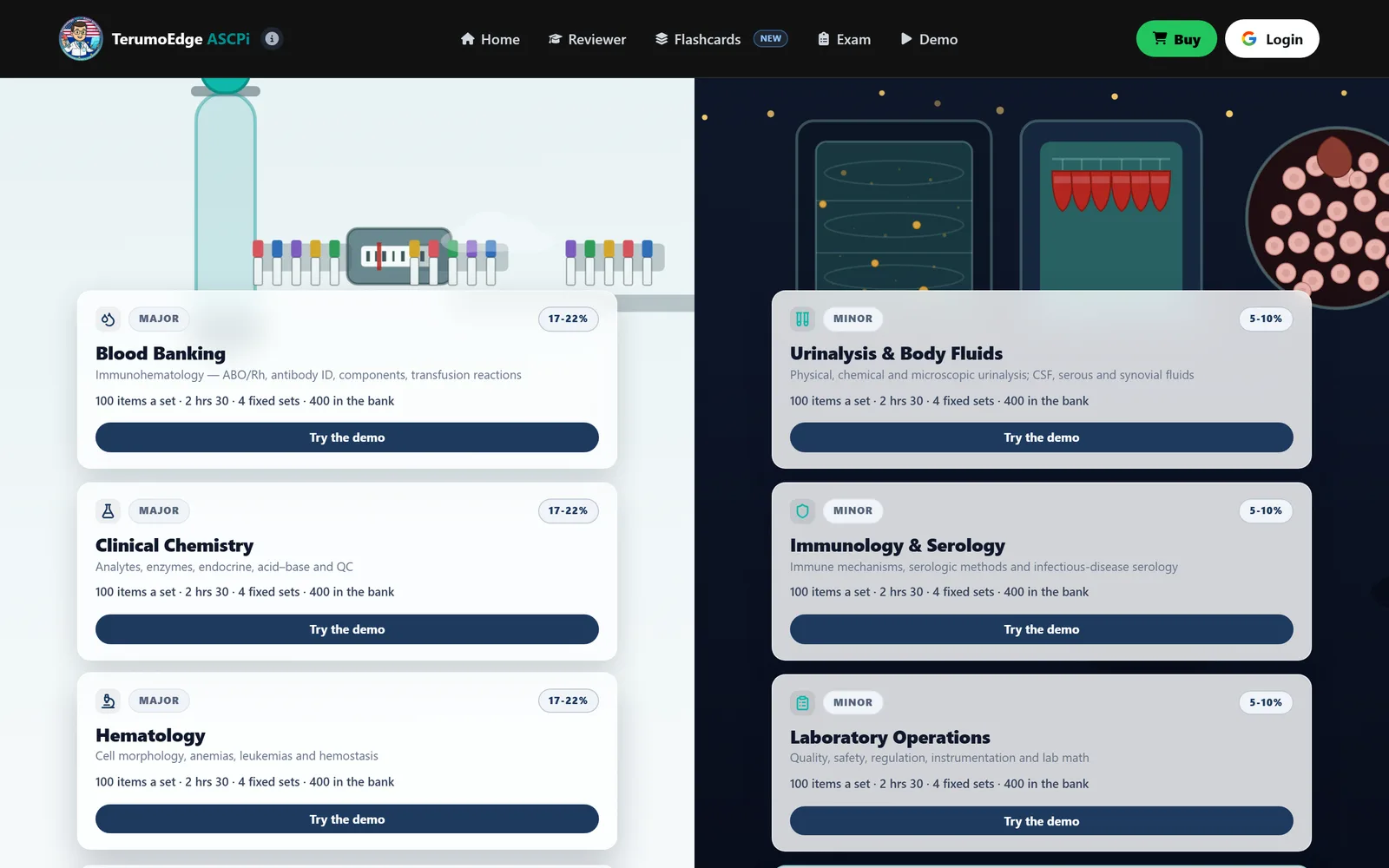
TerumoEdge ASCPi is an ASCPi practice simulator: board-length sets and a timed 100-item mock across all seven content areas, with an English explanation for every item instead of a bare answer key. It is a fixed-length practice draw, not ASCP's adaptive test.
- 2,800 items across seven content areas, 400 in each
- Four fixed sets of 100 items per area, and a 100-item full mock in 150 minutes
- An English explanation for every item, not a bare answer key
- A laboratory science reviewer and flashcards beside the question bank
Try the free ASCPi simulator demo Five real items in each of the seven content areas. No account needed.