
Study strategy7-minute readFor medtechs in the final month before the ASCPi
ASCPi tips for the last 30 days: a week-by-week plan
ASCPi tips for your final 30 days: rehearse the full 100 questions in 150 minutes, repair weak areas, refresh the US basis, then taper before exam day.
You have about 30 days before your MLS(ASCPi) sitting, and you want ASCPi tips that fit a month, not a semester. The honest answer is that this month is for rehearsal and repair. You already hold most of the knowledge you will use; the job now is to deliver it under a clock, in a format that will not let you skip.
This post gives you a week-by-week plan, a do and don't table, and a short routine for the night before. It assumes you have already been through the content at least once. If you have not, start with the 12-week ASCPi study plan and treat this page as the final stretch of it.
Which ASCPi tips matter most in the last 30 days?
The last 30 days are for three jobs: rehearsing the exam as it will be sat, repairing the weak areas your own results show, and removing surprises on the day. They are not for first-time coverage of whole subjects. A new topic learned in week one of the final month can still pay off, but one learned in the last three days rarely sticks.
The format you are rehearsing is fixed. The exam is 100 multiple-choice questions in 2 hours 30 minutes, and ASCP BOC gives it by computer adaptive testing. Each question has four options and one best answer, and you must answer before moving on.
Everything below follows from that format. If your practice differs from it, you are rehearsing a different exam.
What should each of the last four weeks look like?
Each week has one main purpose: baseline, repair, rehearse, then taper. The table is a suggested shape, not an ASCP rule, so shift it to fit your shifts and your booking date.
| Week out | Do | Don't |
|---|---|---|
| Four | Sit one full timed mock; log every miss by content area and by cause | Re-read whole textbooks from page one |
| Three | Repair the two or three weakest areas with short timed sets; refresh the US regulatory basis | Spend all your time on the area you already like |
| Two | Sit two full mocks at the hour of your booked sitting; practise answer, flag, move | Peek at earlier questions mid-mock and pretend it counts |
| Exam week | Light recall only; confirm the booking, ID and route to the centre; sleep | Start a new subject or take a late-night mock |
Read the table once now and again at the start of each week. The rest of this post explains each row.
Week four out: what do you do first?
Start week four with one full mock under real conditions, then spend the rest of the week reading what it tells you. Real conditions means 100 items in 150 minutes, one sitting, no pausing, and no notes. The TerumoEdge mock is built to that length and clock.
Then log every miss. For each wrong answer, write three things: the content area, the type of error (knowledge gap, misread stem, calculation, or second-guessing a correct first choice), and the one fact that would have fixed it. After 30 misses, patterns show up that no general feeling about "being weak in Micro" would reveal.
Keep the practice honest about what it is. A fixed-form mock rehearses the length, the clock, the four-option format and the content mix. It does not copy ASCP's adaptive algorithm, and a practice percentage is not a scaled score, so do not try to translate one into the other.
Week three out: how do you repair weak areas and the US basis?
Repair the two or three areas where your log shows the most misses caused by knowledge gaps, using short timed sets rather than long reading. ASCP weights the seven content areas in ranges: Blood Banking, Chemistry, Hematology and Microbiology at 17 to 22% each, Urinalysis and Other Body Fluids, Immunology and Laboratory Operations at 5 to 10% each. The small areas are not optional, because questions from all areas can appear throughout the exam.
This is also the week to refresh the regulatory frame. The guideline says regulatory questions are based on US sources such as AABB, FDA and CLIA, and that blood bank donor-eligibility questions follow regulations as of June 2023. If you were trained and work under Philippine rules, rebuild that frame on purpose. Our post on US regulations on the ASCPi shows how.
Use flashcards for fast recall between sets. They are a shared laboratory science deck, so treat them as recall practice, not a map of the exam.
Week two out: how do you rehearse under real conditions?
In week two, sit two full mocks, at the time of day of your booked sitting, and practise the habit the real exam forces on you: answer, flag, move. ASCP BOC states that you cannot skip questions because the algorithm estimates your ability after each answer. You can flag questions and review them if time remains after all are answered.
A fixed-form mock may let you press Previous, so impose the rule on yourself. Do not go back until you have answered all 100 items. Jot the numbers of questions you would flag on scratch paper, then use any leftover minutes to review them.
Watch your pace as well. One hundred questions in 150 minutes averages 90 seconds each, so check yourself against a few checkpoints, as laid out in ASCPi time management. Treat the average as a guide, because some items will take 30 seconds and others three minutes.
Between mocks, review the wrong answers' explanations the same day, while the reasoning is fresh.
Exam week: what logistics should you settle?
Settle the logistics early in exam week, so that nothing practical competes with sleep on the night before. Confirm your booking, the name on your ID, and your route and travel time to the centre. Do a trial journey if you can.
The rules you will meet are described in ASCP BOC and Pearson VUE's test center procedures: personal items go in a locker, studying is not allowed, a palm vein image may be taken, an erasable note board is provided, and the exam clock does not stop if you leave the workstation on a break. That document is dated 2021, so confirm the current rules with ASCP BOC before the day. Our exam day at a Pearson centre guide covers the sequence in full.
Study lightly. One short flashcard session a day, and one gentle set on a weak area, is enough. Skip full mocks in the last two days.
What about the night before and the morning of?
The night before, do very little studying and protect your sleep. This is our advice, not an ASCP requirement, and it rests on plain common sense: a rested head retrieves better than a tired one.
Lay out your ID and your travel plan. Eat a normal meal. If you cannot resist looking at something, keep it to a 20 to 30 minute flashcard pass on content you already know, and stop at a set time.
On the morning, eat something familiar, leave early, and arrive with time to spare for check-in and the locker. If your nerves spike, use the reset routine from our post on ASCPi anxiety. During the exam, remember that the test is designed so that questions feel hard: ASCP BOC says the system selects questions that give you about a 50% chance of answering correctly. A hard run of questions is not a verdict on you.
Frequently asked questions
Should I study the night before the ASCPi?
Keep it light or skip it. A short flashcard pass on material you already know, ending at a fixed time, is reasonable. New topics, a full mock or a late night are not. Sleep and calm arrival do more for your recall than another hour of reading, and you cannot study at the test centre anyway.
Can I fix a weak area in a month?
You can improve it, and nobody can promise how far. Use your miss log to find the specific facts and patterns behind the errors, then drill them in short timed sets and re-test a week later. Fixing three narrow gaps is realistic; relearning an entire subject from scratch in a month is a much bigger job.
How many full mocks in the last month?
We suggest two or three: one early as a baseline, and one or two in week two at the hour of your booked sitting. More than that tends to leave too little time to review the explanations, which is where most of the learning happens. This is a suggestion from us, not an ASCP rule.
Do I need to review everything again?
No. Prioritise by your own results and by the guideline weights. The four 17 to 22% areas carry most of the exam, but the three 5 to 10% areas still appear throughout. Spot-check each area briefly, then spend your time where your log shows repeated misses.
Sources
From the publisher
Meet the ASCPi format here first.
TerumoEdge ASCPi is an ASCPi practice simulator: board-length sets and a timed 100-item mock across all seven content areas, with an English explanation for every item instead of a bare answer key. It is a fixed-length practice draw, not ASCP's adaptive test.
- 2,800 items across seven content areas, 400 in each
- Four fixed sets of 100 items per area, and a 100-item full mock in 150 minutes
- An English explanation for every item, not a bare answer key
- A laboratory science reviewer and flashcards beside the question bank
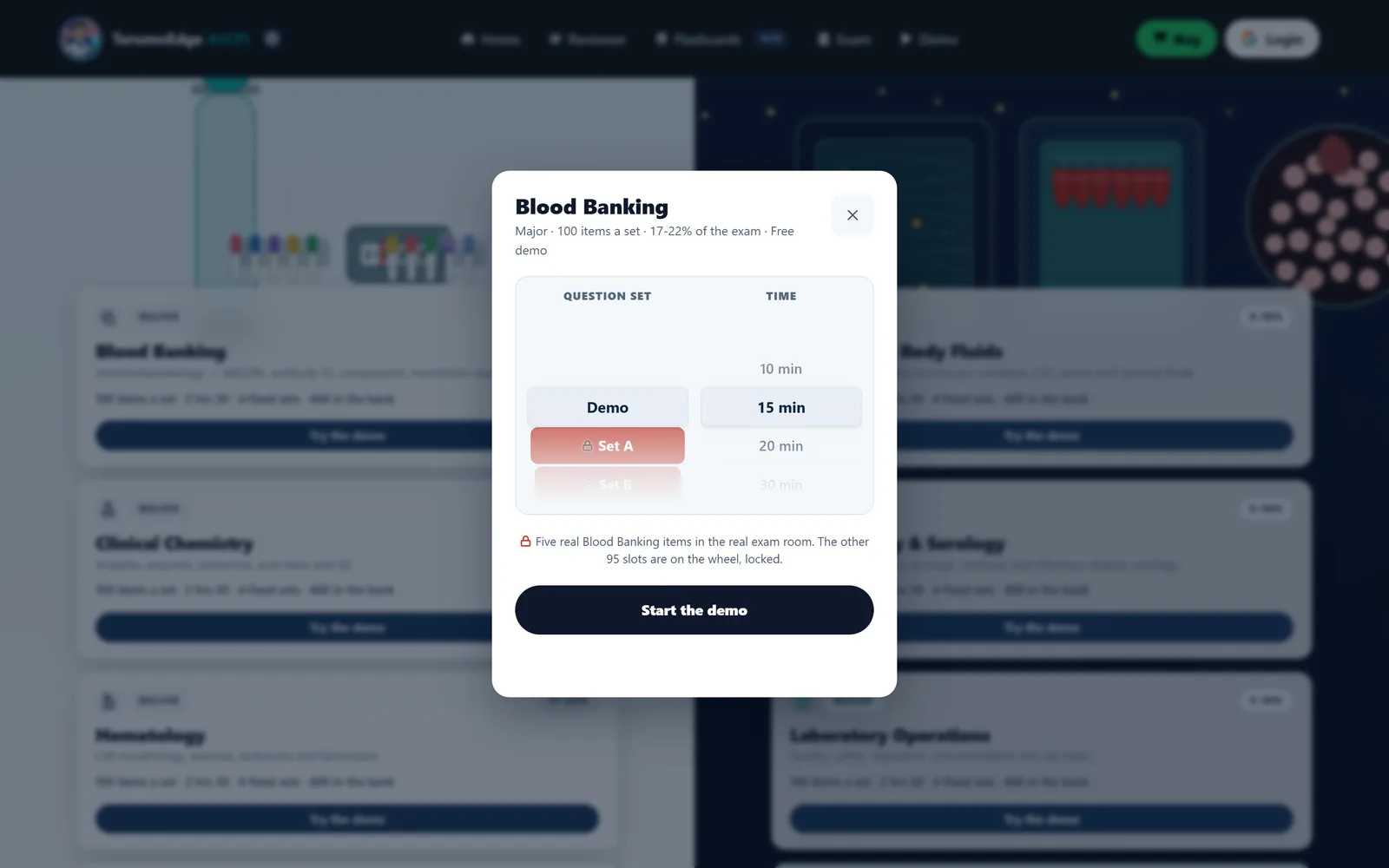
Try the free ASCPi simulator demo Five real items in each of the seven content areas. No account needed.
About this article
Written by the TerumoEdge ASCPi editorial team, who build the TerumoEdge ASCPi Exam Simulator. Exam facts are checked against the ASCP Board of Certification content guideline, its eligibility and exam pages, and the ASCP BOC and Pearson VUE test center procedures, and every article lists its sources. How we write and check our articles.
First published .