
Study strategy7-minute readFor medtechs who run out of time or overthink
ASCPi time management: pacing 100 questions in two and a half hours when you cannot skip
ASCPi time management for 100 questions in 150 minutes: the 90-second average, checkpoints, the answer-flag-move rule and how to train your pace.
If you tend to run out of time, or to stay on one hard question until the clock decides for you, ASCPi time management is a skill you can train. The exam gives 100 questions in 2 hours 30 minutes, and you have to answer each question before you see the next. That changes how pacing works, and this guide shows how.
We stay with what ASCP BOC publishes. It does not say how many items are scored, or which ones, so we do not build strategy on guesses about that.
What is the ASCPi time management arithmetic for 100 questions in 150 minutes?
The arithmetic is 90 seconds per question on average. The ASCP BOC content guideline describes 100 questions in a 2-hour 30-minute time frame, and 150 minutes is 9,000 seconds. Divided by 100 questions, that is 90 seconds each.
Treat 90 seconds as an average, not a limit for each item. A short recall question may take 30 seconds. A question with a data table and a calculation may take two minutes. What matters is the total: if the easy ones are quick, the hard ones can have more.
The average also has to cover everything you do: reading the stem, reading all four options, using the onscreen calculator when needed, and clicking your answer. ASCP BOC advises reading the stem and all four choices, eliminating options you know are wrong, answering every question and managing your time. Your pacing plan should leave a little over for the end.
Why does no-skip change how you pace?
No-skip changes pacing because you cannot defer a hard question. ASCP BOC states that questions cannot be skipped, because the adaptive algorithm estimates your ability level each time you answer. You must answer before you move on.
Most people learn the other approach from paper exams: pass the hard ones, collect the easy marks, return later. That is not available here. The cost of a stubborn question is paid from the same 150 minutes that every later question draws on.
There is a second consequence. ASCP BOC says not all questions contribute equally to the score, and field-test questions are indistinguishable from scored ones. You cannot tell which question counts more, so you cannot safely spend less care on any of them. The lesson is to give each question an honest answer in a sensible time, not to hunt for "unimportant" ones. For the mechanics in full, read our guide to the ASCPi computer adaptive test.
What checkpoints keep you on pace?
Checkpoints keep you on pace by turning the average into a few simple targets. Check the clock every ten questions, not every question. Constant clock-watching costs attention.
The targets below use the plain 90-second average. They give a steady pace with no cushion, so treat them as the baseline and aim to be slightly ahead.
| Time elapsed | Target question number |
|---|---|
| 15 minutes | About question 10 |
| 30 minutes | About question 20 |
| 45 minutes | About question 30 |
| 60 minutes | About question 40 |
| 75 minutes | About question 50 |
| 90 minutes | About question 60 |
| 105 minutes | About question 70 |
| 120 minutes | About question 80 |
| 135 minutes | About question 90 |
| 150 minutes | Question 100 answered |
If you are ahead, bank it. Do not spend it on a second reading of every item. If you are behind, the fix is not rushing everything, but cutting the longest deliberations. A behind-pace of two or three questions at a checkpoint is normal and recoverable.
What is the answer-flag-move rule?
The answer-flag-move rule is: choose your best answer, flag the question if you are unsure, and go to the next one. It replaces skipping, which is not allowed. The rule has three parts and each matters.
First, answer. Eliminate what you know is wrong, then pick the strongest remaining option. A guess made in 20 seconds is cheaper than a stalled 3 minutes. Second, flag only questions where more thought could change your answer. A flag on everything is a flag on nothing. Third, move. Do not reopen a question mentally while you read the next one.
ASCP BOC says you can flag questions and review them if time remains after all are answered. It also says changing an answer does not affect previously answered questions. Plan your flags knowing that review is a bonus, not a certainty. The exam day guide explains what else happens in those 150 minutes.
How do you use the flagged-review time?
Use flagged-review time by working through flags in order, with a time box per question. Review exists only if you reach question 100 with minutes left, so the earlier checkpoints protect it.
Start with the flags where you can name what you would check, such as a calculation you rushed or an option you eliminated too quickly. Leave the flags where you would only be guessing again for last. Give each flag a time box of about a minute, so one stubborn item does not consume the whole review.
Change an answer only when you can state a reason, such as "I misread the units" or "the stem asks for the next step, not the cause". A vague feeling is not a reason. The test centre also matters here: ASCP BOC and Pearson procedures say the exam clock does not stop while you are away from the workstation on a break. Those procedures date from 2021, so confirm current rules with ASCP BOC. If you take a break, it comes out of the same 150 minutes.
What slows people down, and what fixes it?
Three habits slow people down: rereading the stem, debating between two options for minutes, and avoiding the calculator until the end of the question. Each has a small fix.
For rereading, read the stem once with a purpose: what is it asking for, and what data does it give. Then read the four options. For two-option debates, decide which fact would separate them, check the stem for it, and commit. If the stem does not settle it, choose, flag and move. For calculations, enter the numbers as you read them, and sanity-check the magnitude before you click.
Overthinkers should also notice a pattern: the question that feels hardest is often the one you are least certain how to start. Writing a one-line plan on the erasable note board that the testing centre provides can help. Pearson procedures from 2021 describe that board, so confirm the current rules. Practice questions are where you build all these habits, and our guide to test anxiety covers the nerves that make them harder to use.
How do you train your pace?
Train your pace by timing practice at three sizes: single questions, ten-question blocks and full sittings. Begin with blocks of ten, aiming for about fifteen minutes, then move to the full length.
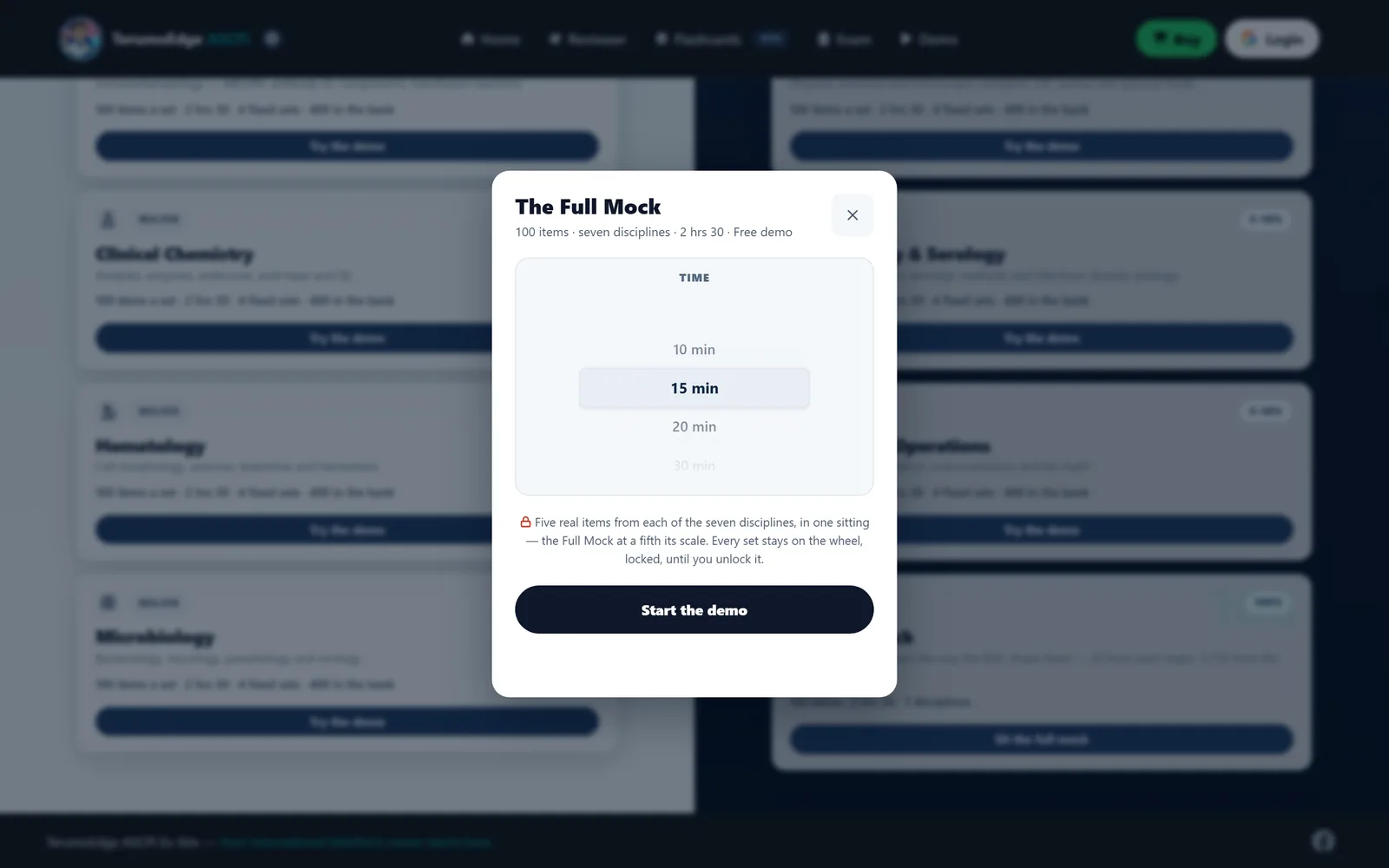
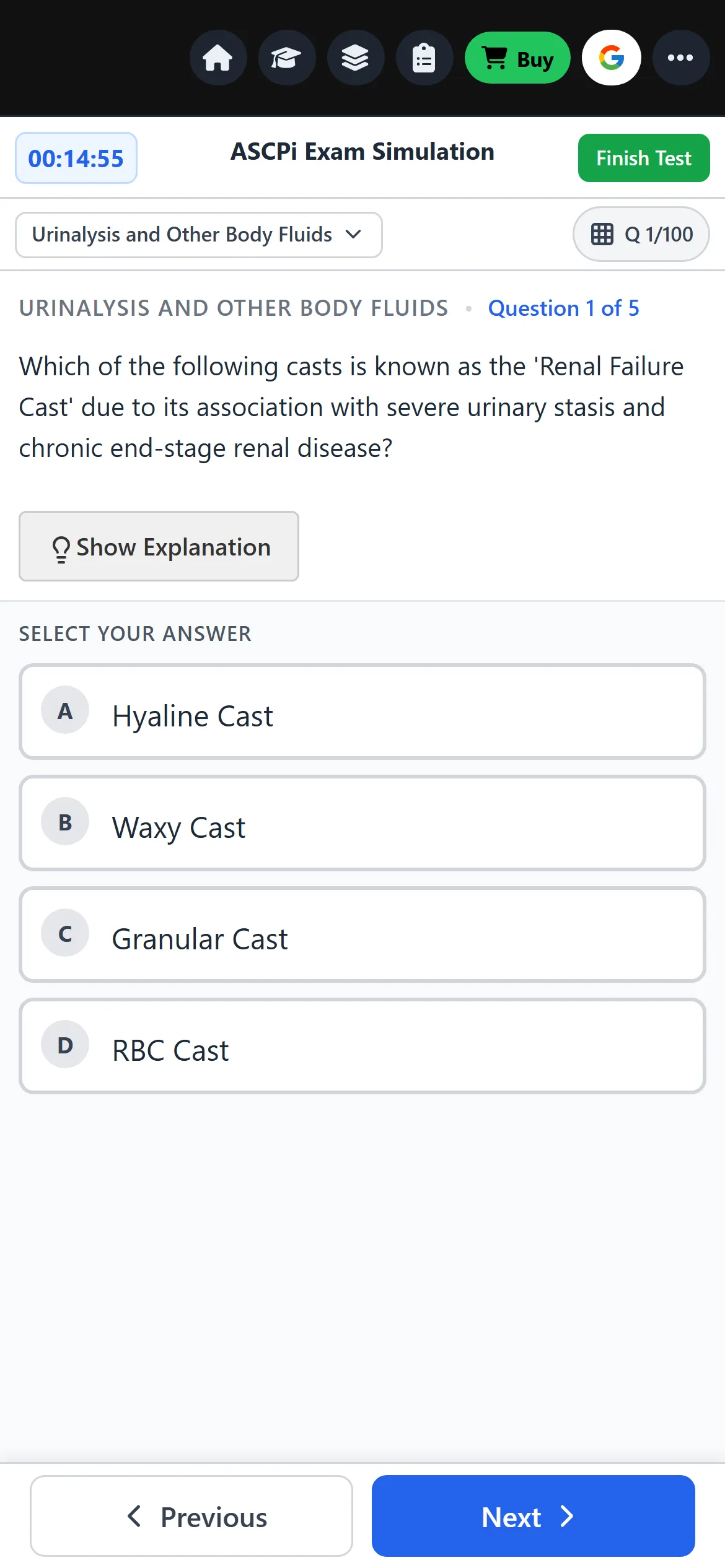
Use the 100-item mock in 150 minutes from the free demo launch page once your content is steady. Be clear about what it does. It is a fixed-length random draw with a Previous button, so it rehearses length, clock and format, but not the adaptive algorithm. On the real exam you cannot go back, so practise answering before moving on, and use flags the way the real test allows.
After each timed set, review two numbers: where you were at each checkpoint, and how many questions took you more than two minutes. The second number tells you which topics to drill. Our 12-week study plan schedules timed mocks in the final weeks.
Frequently asked questions
How long is the ASCPi?
The ASCP BOC content guideline describes MLS(ASCP) and MLS(ASCPi) as 100 questions given in a 2-hour 30-minute time frame. All questions are multiple choice with one best answer, and the exam is administered as a computer adaptive test.
How many seconds do I get per question?
On average, 90 seconds. The exam is 150 minutes, or 9,000 seconds, for 100 questions. That is an average across the whole sitting, not a limit per item, so quick questions give time to harder ones.
Should I spend longer on hard questions?
Not by skipping, because ASCP BOC does not allow skipped questions. Use the answer-flag-move rule instead. We claim nothing about item weights, since ASCP BOC says not all questions contribute equally but does not say which ones. Give each question a sensible time.
Can I take a break during the exam?
ASCP BOC and Pearson VUE procedures say the exam clock does not stop while you are away from the testing workstation. Those procedures are dated 2021, so confirm the current rules before exam day. Any break you take comes out of your 150 minutes.
Sources
From the publisher
Meet the ASCPi format here first.
TerumoEdge ASCPi is an ASCPi practice simulator: board-length sets and a timed 100-item mock across all seven content areas, with an English explanation for every item instead of a bare answer key. It is a fixed-length practice draw, not ASCP's adaptive test.
- 2,800 items across seven content areas, 400 in each
- Four fixed sets of 100 items per area, and a 100-item full mock in 150 minutes
- An English explanation for every item, not a bare answer key
- A laboratory science reviewer and flashcards beside the question bank
Try the free ASCPi simulator demo Five real items in each of the seven content areas. No account needed.
About this article
Written by the TerumoEdge ASCPi editorial team, who build the TerumoEdge ASCPi Exam Simulator. Exam facts are checked against the ASCP Board of Certification content guideline, its eligibility and exam pages, and the ASCP BOC and Pearson VUE test center procedures, and every article lists its sources. How we write and check our articles.
First published .