
Study strategy7-minute readFor Philippine-trained medtechs facing US-based regulatory questions
ASCPi US regulations: how a Philippine-trained medtech studies AABB, FDA and CLIA questions
How to study ASCPi US regulations if you trained in the Philippines: spot the regulatory frame, build a US-basis habit and verify against primary sources.
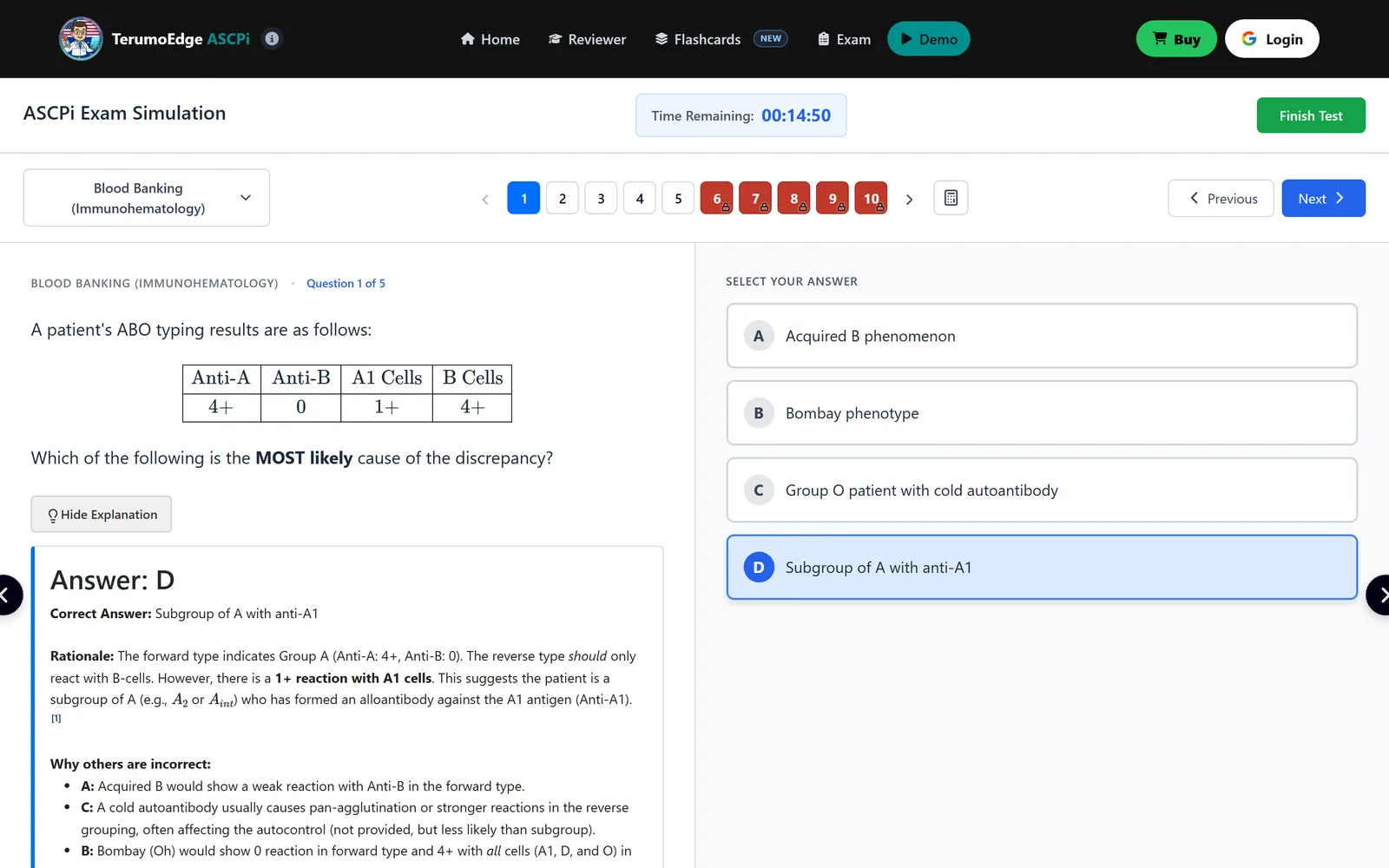
You know how your laboratory works. You trained under Philippine rules, you work under them every shift, and the ASCPi will still ask you to answer on a US basis. This guide shows how to study ASCPi US regulations without confusing them with local practice, using a repeatable habit instead of a pile of memorised rules.
It deliberately gives no numbers: no deferral periods, volumes, temperatures or categories. Those belong to the current source documents, and a number copied from a blog is exactly how outdated rules reach the exam room.
What does the content guideline say about ASCPi US regulations?
The ASCP BOC content guideline says regulatory questions on the examination are based on U.S. sources, for example AABB, FDA and CLIA. It also says blood banking donor-eligibility questions are based on current regulations as of June 2023. The same guideline covers both MLS(ASCP) and MLS(ASCPi), and was revised on September 25, 2025.
That is the whole official statement, and it is short. It names the kinds of bodies, not a list of rules. It tells you the basis (US) and gives one date anchor (June 2023, for donor eligibility).
Broadly, and without detail: AABB is the association whose standards are associated with blood banking and transfusion services. The FDA is the US federal agency whose regulations apply to, among other things, blood and blood products. CLIA is the US federal framework for laboratory testing. Treat those descriptions as orientation only. The rules themselves you must read from the sources.
Why does this trip up Philippine-trained medtechs?
It trips up Philippine-trained medtechs because habit answers faster than the question does. After years of following your own laboratory's procedures, the choice that "feels normal" is often the one your workplace uses, and the exam is not asking about your workplace.
The risk is highest in two places. In Blood Banking, donor-eligibility and transfusion-service items are framed on the US basis. In Laboratory Operations, items about how a laboratory is regulated, run and kept in compliance are framed the same way. We discuss both areas in our guides to the major subjects and the smaller areas.
None of this means your local training is wrong. It means a question stem is a statement about a system, and you need to know which system. When a stem reads like a regulation question and you catch yourself thinking "in our lab we do this", stop. That sentence is the warning sign.
Where do regulatory questions tend to sit?
Regulatory questions tend to sit where a laboratory's work meets a rule: donor eligibility in Blood Banking, and quality, compliance and management topics in Laboratory Operations. The guideline lists Blood Banking at 17 to 22% and Laboratory Operations at 5 to 10%, but it does not say how many regulatory questions each holds.
So treat this as a map of where to look, not a count. Because the adaptive test mixes content areas throughout, as ASCP BOC describes, a regulatory item can appear at any point in your 100 questions. You cannot save the "rules section" for later.
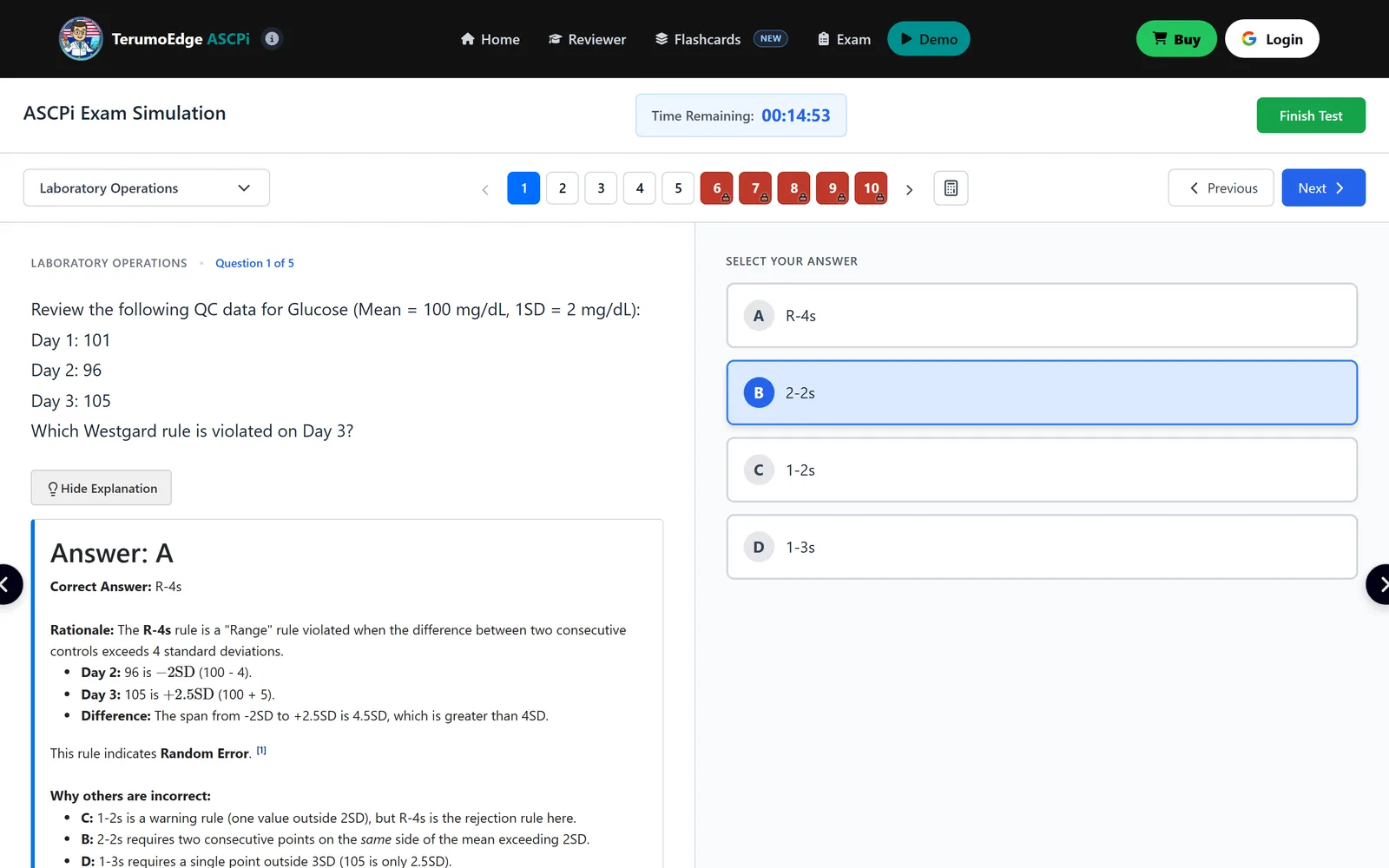
Other areas can borrow a regulatory frame too, since laboratory work touches regulation everywhere. Specimen handling, safety and quality control all have a compliance side. We make no claim about how often that happens. The safe approach is to read each stem for a regulatory cue, whatever the area.
How do you build a US-basis habit?
You build a US-basis habit by turning one question into a routine: what is the frame, what is the source, and what does my local habit say. Do this on every regulatory-flavoured item during practice until it is automatic.
The table maps common question types to their trap and the habit that defuses it. It stays general on purpose.
| Question type | The trap | The habit |
|---|---|---|
| Donor eligibility in Blood Banking | Answering from local donor-screening practice | Ask "which US source and which date?" before reading the options |
| Transfusion service responsibilities | Assuming your hospital's workflow is the standard | Separate "what my workplace does" from "what the framework requires" |
| Laboratory compliance and quality | Treating all accreditation schemes as interchangeable | Name the framework in the stem (CLIA, for example) and answer inside it |
| Product and process regulation | Remembering an old rule that has since changed | Check the date of your notes against the guideline's stated basis |
| A question with no named body | Defaulting to local custom | Assume the US basis, as the guideline states |
After each practice block, write one line per regulatory miss: the frame, the correct source and what you assumed instead. That page becomes your note set. Keep it short enough to reread in twenty minutes.
How do you verify rules without trusting summaries?
You verify rules by reading the current primary document, not a summary of it. Summaries drift. A reviewer written before the guideline's revision, a forum post or a chatbot's confident paragraph can each be out of date, and none will tell you.
For donor eligibility, the guideline pins its basis to June 2023. Anything in your notes should be compatible with the regulations as they stood then. For everything else, use the current official publication from the body in question, and write the document name and date in your notes.
This is also why a chatbot is risky as a rules reference. We explain the pitfalls in ChatGPT for ASCPi review. In short, a fluent answer is not a verified one.
Remember too that your notes stay at home. ASCP BOC and Pearson VUE procedures say no personal items or studying are allowed at the centre, and items go in a locker. Those procedures date from 2021, so confirm the current rules, but the point stands: the US basis has to live in your head, not on a page you can consult.
What does a one-week regulatory block look like?
A one-week regulatory block gives each day one job, and takes about forty-five minutes on a work day. It is a template; adjust it to your shifts.
- Day 1: Reread the content guideline's regulatory statement and the June 2023 anchor. Start your note page.
- Day 2: Do a Blood Banking set. For every donor-eligibility item, write the frame and source before checking the explanation.
- Day 3: Read the primary source summary pages for the bodies you listed. Note document names and dates only.
- Day 4: Do a Laboratory Operations set. Mark every item that uses a named framework.
- Day 5: Redo this week's misses cold, without notes.
- Day 6: Mixed set across all areas. Circle every stem with a regulatory cue.
- Day 7: Rest, then reread your note page once.
The free demo has five items in each content area, which is enough to test the habit before you commit to a longer block. The full bank includes items and explanations framed on AABB, FDA and CLIA.
Frequently asked questions
Are ASCPi regulatory questions based on Philippine rules?
No. The ASCP BOC content guideline says regulatory questions on the examination are based on U.S. sources, for example AABB, FDA and CLIA. Your Philippine training helps with the science, but when a question turns on a rule, answer on the US basis.
Which date do donor-eligibility questions follow?
The content guideline says blood banking donor-eligibility questions are based on current regulations as of June 2023. Check any reviewer, note set or summary you use against that date, and prefer a primary source over a secondary one.
How deep should I go into CLIA?
ASCP BOC publishes no depth guide, so we make no claim about how much CLIA content you will see. Learn the frame: what kind of framework it is, what it governs in a laboratory, and how its vocabulary appears in Laboratory Operations stems. Then verify details against the current source.
Can I memorise a list of US rules from a blog?
We advise against it, including from this blog. Rules change, summaries drift and a memorised number with no source behind it is the easiest way to lose a point. Learn the frame here, then read the current primary document for the specifics.
Sources
From the publisher
Meet the ASCPi format here first.
TerumoEdge ASCPi is an ASCPi practice simulator: board-length sets and a timed 100-item mock across all seven content areas, with an English explanation for every item instead of a bare answer key. It is a fixed-length practice draw, not ASCP's adaptive test.
- 2,800 items across seven content areas, 400 in each
- Four fixed sets of 100 items per area, and a 100-item full mock in 150 minutes
- An English explanation for every item, not a bare answer key
- A laboratory science reviewer and flashcards beside the question bank
Try the free ASCPi simulator demo Five real items in each of the seven content areas. No account needed.
About this article
Written by the TerumoEdge ASCPi editorial team, who build the TerumoEdge ASCPi Exam Simulator. Exam facts are checked against the ASCP Board of Certification content guideline, its eligibility and exam pages, and the ASCP BOC and Pearson VUE test center procedures, and every article lists its sources. How we write and check our articles.
First published .