Comparisons7-minute readFor medtechs studying with ChatGPT
ChatGPT for ASCPi review: where chatbots help and where they mislead
ChatGPT for ASCPi review can explain mechanisms and quiz you, but it can mislead on US regulation. Here is a safe workflow for medtechs.
If you are using ChatGPT for ASCPi review, you have probably noticed that it answers fast, explains patiently and sounds sure of itself. All three are useful, and the third can hurt you.
This post is a fair look at what a general chatbot does well and badly for the MLS(ASCPi). We do not name or rank any product. TerumoEdge, which publishes this blog, makes a curated simulator that does not use generated answers, so we have an interest, and we state it so you can weigh what follows.
What is the honest answer on ChatGPT for ASCPi review?
The honest answer is that a chatbot is a good tutor and an unreliable authority. It can help you understand why a Coombs reaction behaves as it does, and it can fail on the exact point an exam question turns on.
The risk is not that it is always wrong. The risk is that you cannot tell from the tone when it is. A wrong explanation reads exactly as smoothly as a right one.
So treat its output as a draft to check, never as a source. For content that decides questions, such as US regulation, go to the primary source. For practice that mirrors the exam's length and format, use a tool whose items were written and checked beforehand. The rest of this post shows where each fits.
Where do chatbots help?
Chatbots help in four places: explaining mechanisms, quizzing you, rewording notes and playing the examiner on your weak points. All four are about understanding, not authority.
Mechanisms. Ask why a postzone effect gives a false negative, or how a delta check works, and ask for an analogy. Follow-up questions cost nothing.
Quizzing. Paste your own notes on hematology morphology and ask for ten recall questions. Answer them out loud before reading its answers.
Rewording. Turn a dense paragraph into a table or a mnemonic, then check the content against your reviewer.
Probing. Explain a concept back to the chatbot and ask where your explanation is wrong. Then verify the correction.
Every use above starts from material you can check. That is the safe pattern: you supply the facts, and the chatbot helps you process them.
How can chatbots mislead you?
Chatbots mislead in four ways that matter for the ASCPi: regulatory drift, number and unit slips, confident invention and no calibration to the guideline.
Regulatory drift. The ASCP guideline says regulatory questions are based on US sources such as AABB, FDA and CLIA, and that donor-eligibility questions follow regulations as of June 2023. A chatbot may blend older rules, newer rules and local practice without saying which it is using. It may even apply Philippine law, such as RA 5527, which governs registration of medical technologists in the Philippines, to a question about a US certification.
Numbers and units. As a general caution, a chatbot can swap a unit, shift a decimal or round a reference value. In a calculation-based question, one slip changes the answer.
Confident invention. A chatbot may produce a plausible rationale for a wrong option, or a citation that does not exist. If it cannot show you a primary source, assume it cannot.
No calibration. It does not know the weights in the content guideline, so questions it writes may over-represent the topics you mention and skip Immunology or Laboratory Operations.
How do curated explanations differ from generated ones?
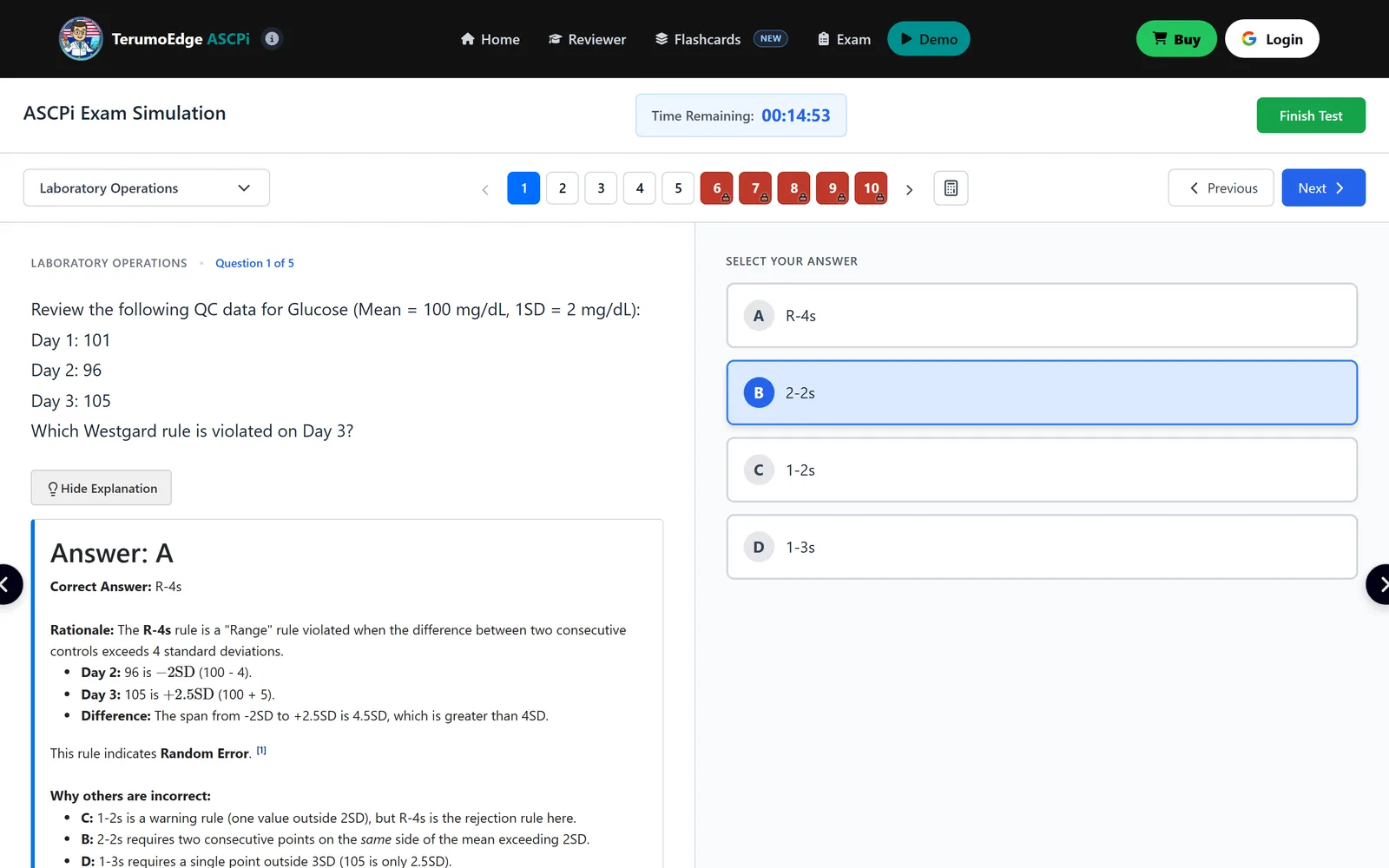
Curated explanations differ in that someone fixed the answer, checked the reasoning and wrote the explanation once, so every reader sees the same checked text. A generated explanation is produced fresh each time and can change if you ask again.
| Feature | General chatbot | Curated practice |
|---|---|---|
| Fixed, checked answer key | No | Yes |
| Same explanation every time | No | Yes |
| Follows the seven content areas | Only if you prompt it | Built in |
| US regulatory basis | Varies, so verify | Stated by the publisher |
| Timed 100-question mode | No | In a mock mode |
| Answers your own follow-up | Yes | Limited |
| Fits your own notes | Yes | No |
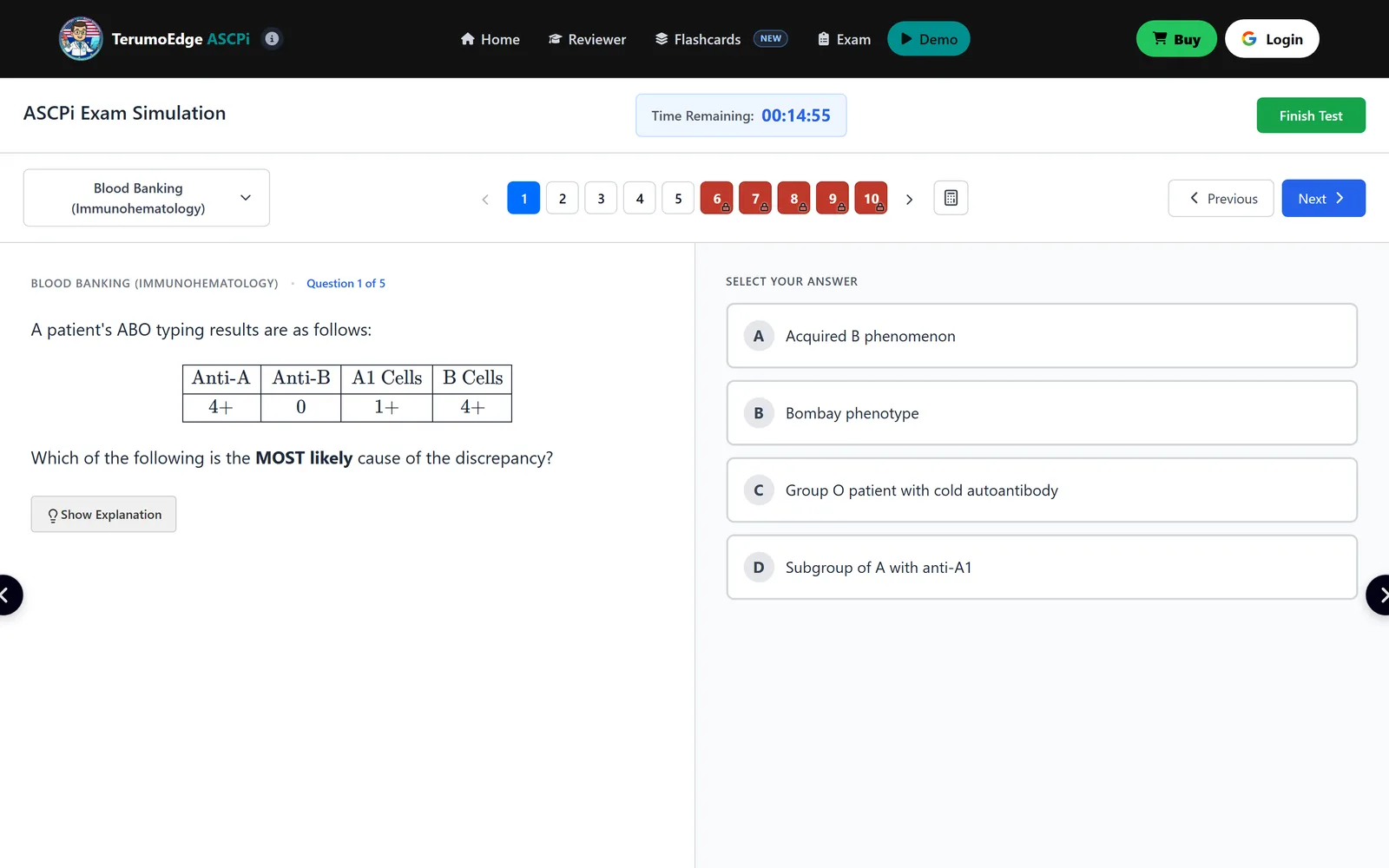
Neither side wins everywhere. TerumoEdge items have 400 per content area and an English explanation for each, but our mock is a fixed draw and not adaptive, and it cannot answer a custom follow-up the way a chatbot can. See how to choose an ASCPi reviewer app for criteria that apply to both.
Which prompts work, and which should you avoid?
Prompts that ask for understanding work well, and prompts that ask for authority do not. The difference is whether you can check the answer.
Good prompts give the chatbot your material and a job:
- "Here are my notes on hemolytic transfusion reactions. Quiz me with eight recall questions, one at a time, and wait for my answer."
- "Explain the prozone effect in three sentences, then give me a one-line check I can use at the bench."
- "I think this reasoning is right: [your reasoning]. Where could it be wrong?"
Poor prompts ask it to be the source:
- "What are the current donor deferral rules?" The guideline ties these questions to regulations as of June 2023, and a chatbot may not know which version it is quoting.
- "Give me 100 ASCPi questions with the real exam's difficulty." No chatbot holds ASCP's calibrated bank, and a list it writes has no weights.
- "Is this the right answer?" with no source. It will usually agree with you.
If you want fixed practice with a keyed answer, the free demo lets you try items from each area without an account. If you want to improve the questions a chatbot writes, tell it the four-option, one-best-answer format and ask it to name the source of every fact.
What is a safe workflow?
A safe workflow uses the chatbot for understanding and a fixed source for checking. Follow these steps.
- Read the content from your reviewer or the guideline first.
- Ask the chatbot to explain only what confused you, and ask it to say when it is unsure.
- For any rule, number or unit, check a primary source, not a second chatbot.
- Keep a short "US basis" note for regulation. Studying AABB, FDA and CLIA questions explains the habit.
- Do timed practice from a fixed bank, such as the free demo, and compare your weak areas with your reviewer.
Remember the test centre. ASCP and Pearson VUE's candidate procedures, dated 2021, say no personal items or studying are allowed and items go in a locker, so confirm the current rules. Your phone cannot help on exam day, and unaided reasoning is the skill to train. For the content-heavy subjects, the guide to reviewing the four biggest ASCPi areas shows where to spend time.
Frequently asked questions
Can ChatGPT write ASCPi-style questions?
It can write four-option items in the right shape, and this is useful for drilling your own notes. The risk is accuracy and coverage: the keyed answer may be wrong, and the topics may not follow the seven-area guideline. Verify each question's key against a reviewer before you trust it.
Is a chatbot reliable on AABB or CLIA rules?
Not on its own. The ASCP guideline bases regulatory questions on US sources, and a chatbot may mix versions or local practice. Verify every rule against the current primary source from the issuing body, and note that donor-eligibility questions follow regulations as of June 2023.
Can I bring my phone to the exam?
No. The ASCP BOC and Pearson VUE candidate procedures say no personal items or studying are allowed and your belongings go in a locker. That document is dated 2021, so check the current rules when you schedule your exam.
Should I trust a chatbot's explanation of a wrong answer?
Only after checking it. A chatbot can write a convincing reason for either the right or the wrong option, and it may give a different reason if you ask twice. Compare its explanation with your reviewer or with a curated explanation that has one fixed answer, and treat any disagreement as a prompt to look up the primary source.
Sources
From the publisher
Meet the ASCPi format here first.
TerumoEdge ASCPi is an ASCPi practice simulator: board-length sets and a timed 100-item mock across all seven content areas, with an English explanation for every item instead of a bare answer key. It is a fixed-length practice draw, not ASCP's adaptive test.
- 2,800 items across seven content areas, 400 in each
- Four fixed sets of 100 items per area, and a 100-item full mock in 150 minutes
- An English explanation for every item, not a bare answer key
- A laboratory science reviewer and flashcards beside the question bank
Try the free ASCPi simulator demo Five real items in each of the seven content areas. No account needed.
About this article
Written by the TerumoEdge ASCPi editorial team, who build the TerumoEdge ASCPi Exam Simulator. Exam facts are checked against the ASCP Board of Certification content guideline, its eligibility and exam pages, and the ASCP BOC and Pearson VUE test center procedures, and every article lists its sources. How we write and check our articles.
First published .