
Study strategy7-minute readFor medtechs reviewing the ASCPi's four biggest areas
ASCPi major subjects: reviewing Blood Banking, Chemistry, Hematology and Microbiology, the four 17–22% areas
How to review the ASCPi major subjects: Blood Banking, Chemistry, Hematology and Microbiology, with a method and drill for each of the four 17–22% areas.
Four areas decide most of your result, and a review that treats them like four separate textbooks wastes time. This guide shows how to review the ASCPi major subjects as a set: what each area asks of you, a textbook-correct example of the kind of thinking it rewards, and a rotation that keeps all four fresh.
Our examples are deliberately basic and classical. They show how to reason, not what the exam will contain, because ASCP BOC publishes no item lists.
Why do these four areas carry most of the exam?
These four areas carry most of the exam because the ASCP BOC content guideline gives each of Blood Banking, Chemistry, Hematology and Microbiology 17 to 22%. Added together, that is 68 to 88% of the 100 questions. The other three areas share the remaining 15 to 30%.
Those are ranges, not counts. The adaptive test selects questions by the guideline percentages and your estimated ability, and it does not present one content area at a time. So you cannot predict a number per area, and you should not bank on a subject being "light" this time.
ASCP BOC also lists three question levels: application or analysis, comprehension, and knowledge. Questions may be theoretical, procedural or both. For the major four, that means a good review moves past definitions into "here is a result, what now". Our guide to the seven areas and their weights lays out the full set.
How do you review Blood Banking?
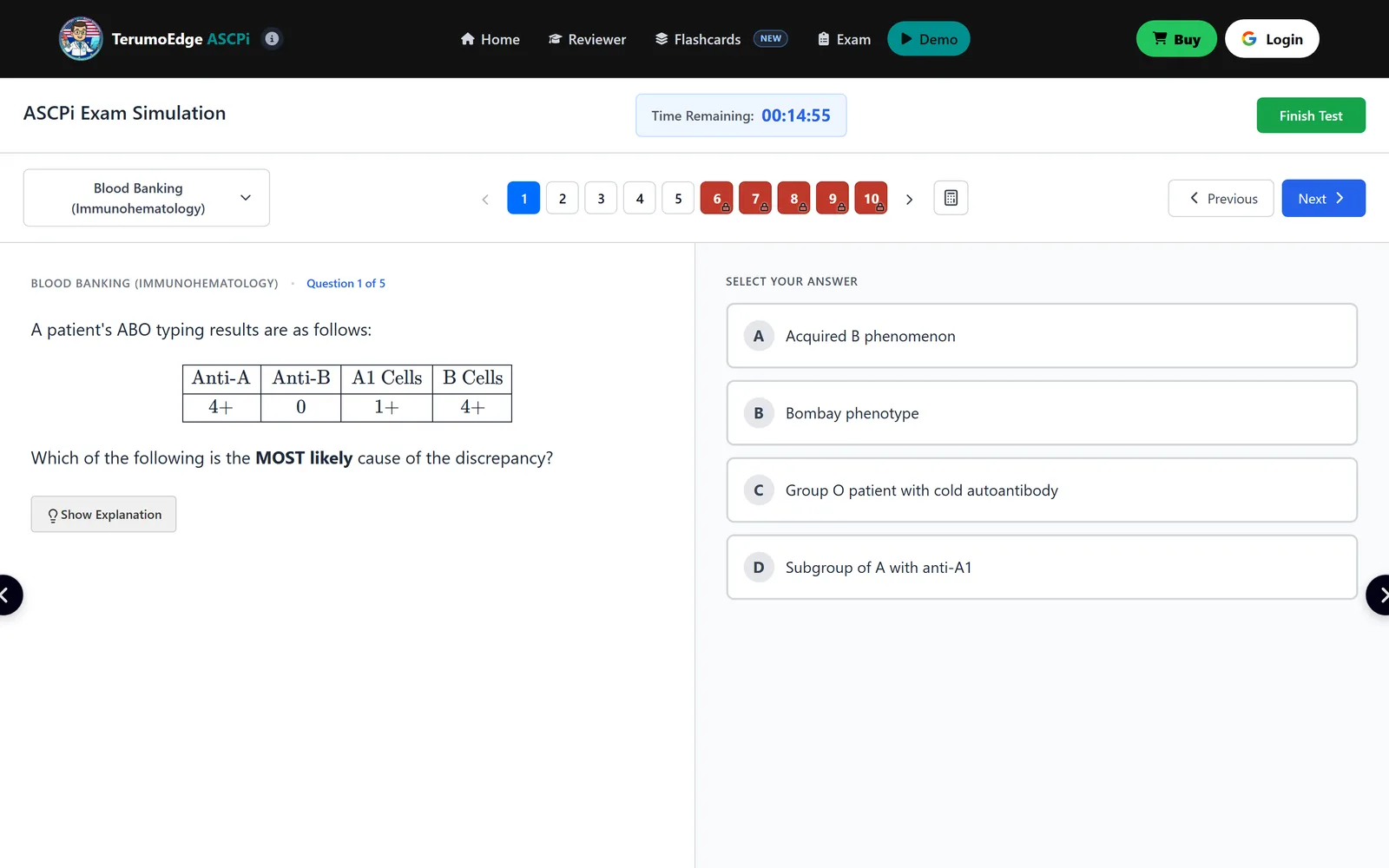
Review Blood Banking as problem solving: gather the pattern, rule things in and out, and name the next test. A classic example is a forward and reverse ABO discrepancy. The forward type shows a group A pattern: anti-A reactive and anti-B negative. The reverse type shows B cells reacting as expected, but also an unexpected reaction with A1 cells. That mismatch points you to a cause, such as a subgroup of A with anti-A1, and then to a way to resolve it.
Build the same chain for other topics: antibody identification by exclusion, the workup of a suspected transfusion reaction, and the logic of compatibility testing. For each, practise stating the first check, the follow-up test and why.
Donor eligibility is the one place where the guideline is explicit that questions follow US regulations as of June 2023. Study it on that basis, and keep it separate from local donor practice. We cover the method in studying US regulations on the ASCPi.
How do you review Chemistry?
Review Chemistry through three lenses: method principles, quality control and interpretation. For each analyte, know what is measured, how the method works and what interferes. Then practise reading a result in clinical context.
A good textbook-correct example is acid-base interpretation. Start with the pH to name the acidaemia or alkalaemia, then look at the PCO2 and bicarbonate to find which is the primary change, then ask whether compensation fits. Practise it on short data lines until the sequence is automatic.
Quality control is the second thread. Know what a Levey-Jennings chart shows, what a shift and a trend look like, and what a multirule scheme is trying to catch. We avoid numbers here on purpose; learn the rule definitions from your textbook and check them in practice.
The third lens is the pairing of analytes: which result should move with which. Enzyme patterns, glucose-ketone relationships and electrolyte gaps all reward asking "does this set of values hang together".
How do you review Hematology?
Review Hematology as pattern recognition across two families: cells and clotting. For cells, link morphology to the likely cause. A microcytic, hypochromic picture sends you to the differential of iron deficiency, thalassaemia trait and chronic disease, and the indices and iron studies separate them.
Practise this with a standard three-step habit. Read the indices first, then the smear description, then the supporting tests. State the leading diagnosis and the one result that would change your mind.
For hemostasis, keep the pathway map clear. The PT reflects the extrinsic and common pathways, while the aPTT reflects the intrinsic and common pathways. A prolonged result that corrects on mixing points to a factor deficiency, and one that does not correct points to an inhibitor. Drill the logic with the mixing study until you can run it without notes.
How do you review Microbiology?
Review Microbiology as flowcharts. Identification is a sequence: stain, morphology, a few decisive biochemical tests, then the organism. Practise writing the flow, not the list. A Gram-positive coccus in clusters, for instance, goes to catalase and then coagulase to separate staphylococci, and each branch has a next step.
Do the same for Gram-negative rods, starting with fermentation and oxidase and branching from there. The goal is to be able to say "I would do this test next, and here is what a positive means".
Susceptibility testing is the second pillar. Know the principle of disk diffusion, where zone size is read against interpretive categories, and of dilution methods, where the MIC is the lowest concentration that inhibits growth. Be ready to interpret, not only define, and to recognise when a result calls for a confirmation step.
Add the less glamorous topics too: specimen handling, culture media purpose and safe technique. They are classic comprehension-level items.
How do you train at the right question level?
Train at the level ASCP BOC lists: application or analysis, comprehension and knowledge. Knowledge items check that you remember a fact. Comprehension items check that you understand why. Application or analysis items hand you data and ask what to do with it.
Most reviewees over-train the first level because it is easy to measure. A better routine for each practice item is to answer, then ask which level it tested. If you missed it, decide whether you lacked the fact, the reason or the method. That diagnosis tells you whether to reread, reason it through or do more cases.
Use the explanations as your teacher. The TerumoEdge bank gives an English explanation for every item, and nearly all also say why the other options are wrong. Reading the distractor reasoning is where application skill grows, because it shows the pattern that separated the right answer from a near miss. Our plan for the smaller areas uses the same habit.
How do you rotate the ASCPi major subjects?
Rotate the ASCPi major subjects weekly, not sequentially. The adaptive test mixes content areas throughout, so practise in the mix you will face. A simple rotation uses one area per day on weekdays, then a mixed set at the weekend. The 12-week plan shows where this block sits.
| Area | ASCP range | What to master | Drill |
|---|---|---|---|
| Blood Banking | 17 to 22% | ABO/Rh logic, antibody identification, reaction workup, donor eligibility on the US basis | Solve one discrepancy case a day, naming the next test |
| Chemistry | 17 to 22% | Method principles, QC patterns, acid-base and analyte pairings | Read a data line and state the pattern before the options |
| Hematology | 17 to 22% | Indices and smear patterns, hemostasis pathways, mixing studies | Three-step read: indices, smear, confirmatory test |
| Microbiology | 17 to 22% | Identification flowcharts, susceptibility methods, media and handling | Write the flow for one organism group from memory |
Each evening, spend ten minutes on flashcards in the area you did that day. Then do a timed set once a week to feel the pace.
Frequently asked questions
Which ASCPi area is the heaviest?
None is singled out. Blood Banking, Chemistry, Hematology and Microbiology each share the 17 to 22% range in the ASCP BOC content guideline. Together they are 68 to 88% of the exam, which is why a review needs all four, not a favourite.
Should I start with Blood Banking?
Start where your reasoning is weakest, not where the list begins. Blood Banking is a good first area if you want problem-solving practice and need to learn the US basis for donor eligibility. But the exam mixes areas, so begin rotating all four early.
Are calculations tested?
An onscreen calculator is available on the exam, according to ASCP BOC, but we cannot say how often calculations appear. Practise common laboratory calculations until they are routine, and include units and sanity checks. Confirm current calculator rules with the testing centre.
Do I need to learn every organism and every antibody?
ASCP BOC publishes no item list, so we cannot promise coverage of any specific organism or antibody. Learn the frameworks first: identification flow, exclusion logic and pattern recognition. Then fill detail by weak area, guided by your practice results.
Sources
From the publisher
Meet the ASCPi format here first.
TerumoEdge ASCPi is an ASCPi practice simulator: board-length sets and a timed 100-item mock across all seven content areas, with an English explanation for every item instead of a bare answer key. It is a fixed-length practice draw, not ASCP's adaptive test.
- 2,800 items across seven content areas, 400 in each
- Four fixed sets of 100 items per area, and a 100-item full mock in 150 minutes
- An English explanation for every item, not a bare answer key
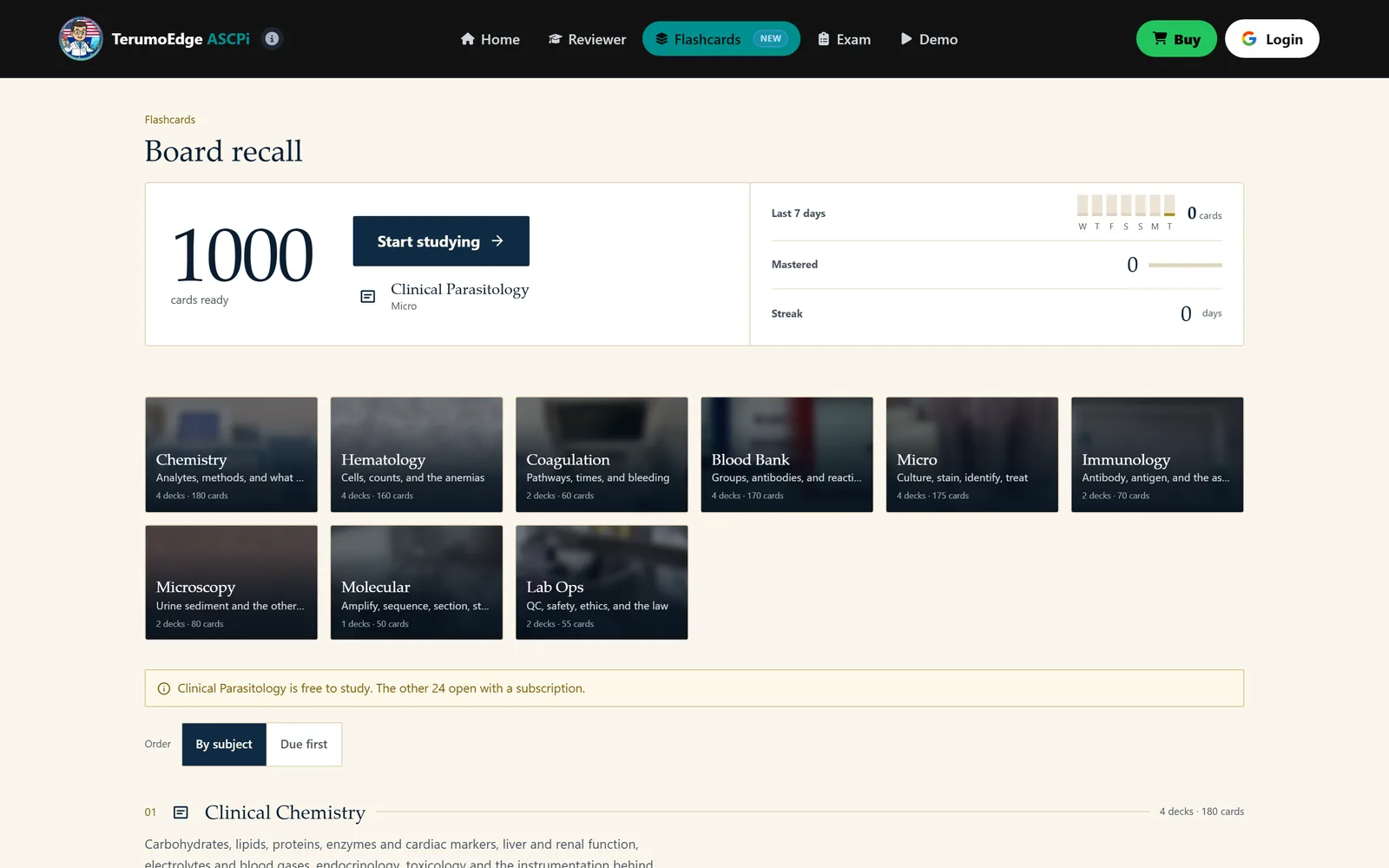
- A laboratory science reviewer and flashcards beside the question bank
Try the free ASCPi simulator demo Five real items in each of the seven content areas. No account needed.
About this article
Written by the TerumoEdge ASCPi editorial team, who build the TerumoEdge ASCPi Exam Simulator. Exam facts are checked against the ASCP Board of Certification content guideline, its eligibility and exam pages, and the ASCP BOC and Pearson VUE test center procedures, and every article lists its sources. How we write and check our articles.
First published .