
Study strategy7-minute readFor medtechs tempted to skip the ASCPi's smaller areas
ASCPi minor subjects: why Immunology, Urinalysis and Laboratory Operations still matter at 5–10%
ASCPi minor subjects explained: Immunology, Urinalysis and Other Body Fluids, and Laboratory Operations carry 15 to 30% together. Here is how to review them.
The ASCPi minor subjects are the ones many reviewees quietly drop: Immunology, Urinalysis and Other Body Fluids, and Laboratory Operations. Each is smaller than the big four, so skipping looks efficient. It is not, and this guide explains why, then gives an efficient way to review all three in two weeks.
We keep the examples classical and the claims sourced. ASCP BOC publishes ranges, never counts, so we do not tell you how many questions to expect from any area.
Why do the ASCPi minor subjects still matter?
Small weights still matter because three areas of 5 to 10% each add up to 15 to 30% of the exam. That is a real share. You cannot treat that as spare change.
Two more reasons apply. First, ASCP BOC says the adaptive algorithm does not administer questions one content area at a time, so questions from all areas may appear throughout. A gap in a minor area can meet you early, when you are fresh and the pace is easy to lose.
Second, ASCP BOC says a failing score report breaks the score down by subtest area. A weak minor area becomes visible there, and fixing it would mean a retake. Our guide to the seven areas and weights explains how the ranges fit together.
How do you review Immunology?
Review Immunology as patterns and mechanisms: what is being measured, what the principle is, and what a given pattern of results means. The ASCP BOC guideline names the area "Immunology". Our bank labels its area "Immunology & Serology", but the guideline name is the one to remember.
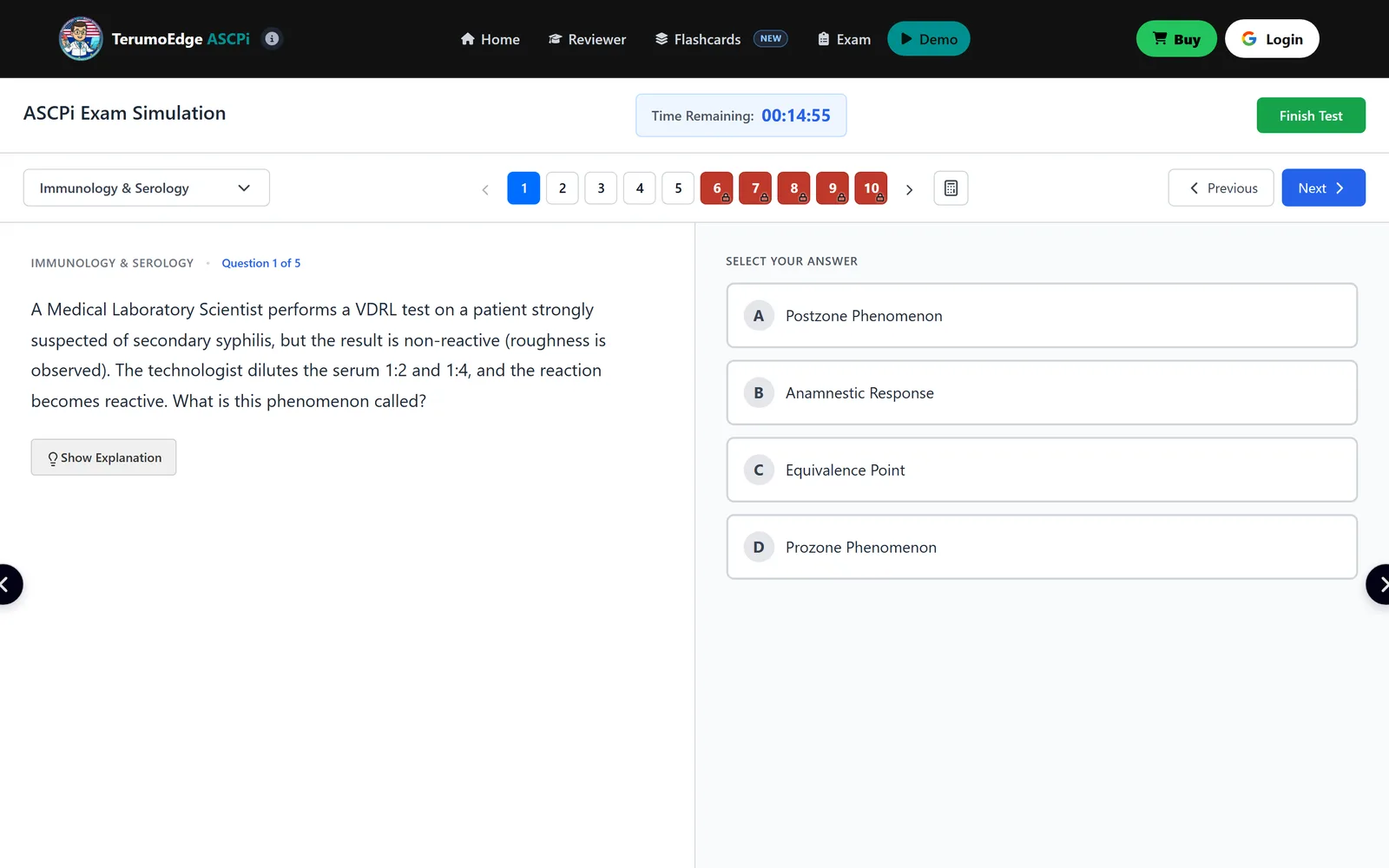
A textbook-correct example is the prozone effect. In a flocculation test such as VDRL, very high antibody concentration can produce a falsely weak or negative result, and diluting the serum reveals true reactivity. Know the term, the reason and the fix. The postzone effect is the mirror problem of antigen excess.
Other reliable themes include hypersensitivity types, the logic of immunoassay formats, and reading a hepatitis B serology pattern by marker. For each, practise the same question: what does this pattern tell me, and what would I check next.
How do you review Urinalysis and Other Body Fluids?
Review Urinalysis and Other Body Fluids by linking three things: the physical and chemical findings, the microscopy, and the clinical meaning. This area rewards a tidy routine and sharp recall of what belongs with what.
Classic pairings are a good place to start. Red cell casts point to glomerular bleeding. White cell casts suggest renal inflammation or infection. Waxy casts are associated with prolonged stasis in the tubules, often in advanced kidney disease. For the chemical strip, know what each pad detects, its common interferences and why a positive result may need confirmation.
Do not forget the body fluids half of the title. Cerebrospinal, serous and synovial fluids each have their own cell counts, appearance and typical findings. Build one summary page per fluid: collection, appearance, what you count and what an abnormal result suggests. Short daily recall rounds work well here.
How do you review Laboratory Operations?
Review Laboratory Operations as the frame that holds the bench together: quality, safety, specimen handling and management. It is the area where regulatory frames meet daily work, and the content guideline says regulatory questions are based on US sources such as AABB, FDA and CLIA. Read our guide to US regulations on the ASCPi alongside this area.
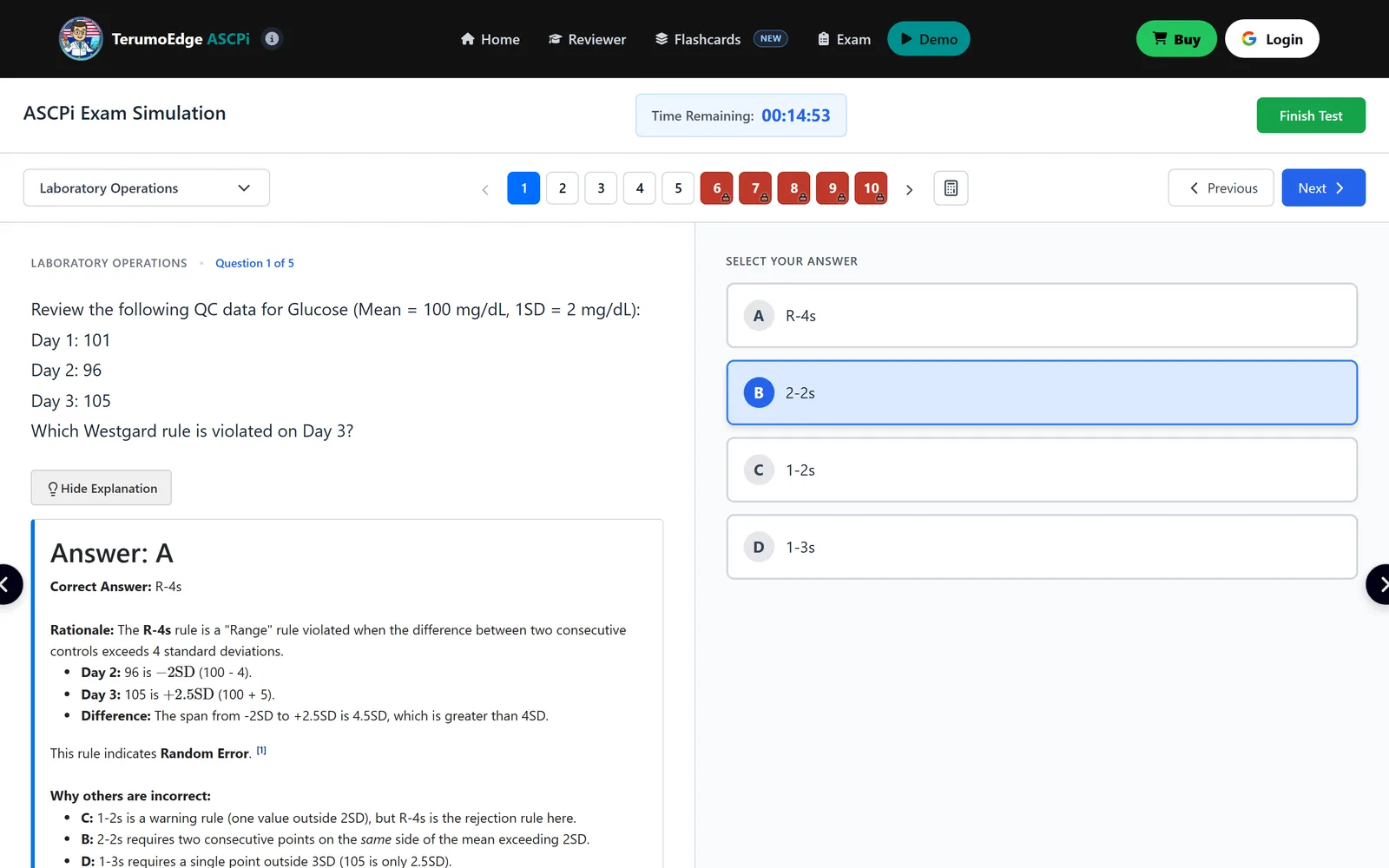
A textbook-correct drill is quality control. Given a short run of control values with a stated mean and standard deviation, practise spotting which multirule has been broken. For example, one control above plus two standard deviations and another below minus two standard deviations in the same run is a range error, known as the R-4s rule. Learn the rule names from your textbook and practise on data, not on definitions.
Add safety principles, specimen identification and integrity, competency and documentation. These are comprehension-level topics that reward steady habits. You can see a worked example in the demo.
How should you think about the ASCPi minor subjects together?
Think of the ASCPi minor subjects as three short, specific jobs rather than one vague leftover. ASCP BOC publishes one content guideline for both MLS(ASCP) and MLS(ASCPi), so the same seven areas apply whichever credential you pursue.
Each minor area has a different character. Immunology is pattern and mechanism, so it rewards cards and short cases. Urinalysis and Other Body Fluids is visual and routine, so it rewards pictures and checklists. Laboratory Operations is rules and judgement, so it rewards data drills and scenario reading.
That difference should shape the method, not just the hours. A common mistake is to read three chapters in a row and hope they stick. The questions are not chapter-shaped, because the test draws on all content areas throughout. After every reading session, close the book and answer ten questions on what you read. Retrieval beats rereading, and it matches how the exam asks. The major subjects guide applies the same habit to the big four.
What is an efficient two-week block?
An efficient two-week block gives each minor area two focused days, then closes with mixed recall. Spend about forty-five minutes a day, away from your heaviest study hours.
| Area | ASCP range | What to master | Efficient method |
|---|---|---|---|
| Immunology | 5 to 10% | Mechanisms, assay principles, serology patterns, interferences like the prozone effect | Pattern cards: result pattern on the front, meaning and next step on the back |
| Urinalysis and Other Body Fluids | 5 to 10% | Strip chemistry, sediment and casts, fluid findings | One summary page per fluid; sediment picture recall |
| Laboratory Operations | 5 to 10% | QC rules, safety, specimens, compliance frames | Data-line QC drills; rewrite each missed item as a rule |
A workable week looks like this:
- Monday and Tuesday: Immunology set, then pattern cards.
- Wednesday and Thursday: Urinalysis and Other Body Fluids.
- Friday and Saturday: Laboratory Operations, with a QC drill each day.
- Sunday: rest.
In the second week, repeat the order with timed 100-item sets from the bank. Our free demo lets you try each of these areas first. The major subjects guide covers the other four.
What mistakes do reviewees make with smaller areas?
Reviewees make three predictable mistakes with smaller areas: leaving them to the last week, studying them only by reading, and assuming they are easy because they are familiar from the bench.
Leaving them last is risky because a short cram cannot build pattern recognition. Studying only by reading leaves you unable to apply a rule to a fresh data set. Assuming familiarity is the subtlest. You may run urine strips and QC every day, but the exam asks you to explain the principle, the interference and the next step, which routine work rarely makes you say aloud.
The fix is the same for all three. Put the smaller areas into your plan from the start, learn them by answering questions, and test the principle behind each routine task. When you miss an item, rewrite it as a one-line rule in your own words. After two weeks you will have a page of rules for each area, small enough to reread in the final days. Keep that page next to your regulatory notes, because Laboratory Operations and the US basis overlap.
Frequently asked questions
Can I skip Laboratory Operations?
No. Laboratory Operations is 5 to 10% of the ASCP BOC content guideline, and the adaptive test draws on all content areas throughout the exam. A failing score report also shows results by subtest area, so a skipped area costs you twice if you must retake.
Is serology part of Immunology?
ASCP BOC names the content area "Immunology". TerumoEdge labels its own area "Immunology & Serology", which is a product label, not the guideline's name. Study the guideline's Immunology scope, and treat serologic methods as part of understanding immune reactions.
How long should I spend on these three areas?
There is no official figure. A reasonable proportion is a share of your total hours that matches their combined 15 to 30% range, adjusted for your own weak spots. Two focused weeks early in your plan, then regular mixed practice, is a sensible start.
Do the minor areas have fewer difficult questions?
ASCP BOC does not say. Questions are chosen to give about a 50% chance of a correct answer, and they are not delivered one area at a time. Prepare each area to the same standard of reasoning rather than assuming the small ones are easy.
Sources
From the publisher
Meet the ASCPi format here first.
TerumoEdge ASCPi is an ASCPi practice simulator: board-length sets and a timed 100-item mock across all seven content areas, with an English explanation for every item instead of a bare answer key. It is a fixed-length practice draw, not ASCP's adaptive test.
- 2,800 items across seven content areas, 400 in each
- Four fixed sets of 100 items per area, and a 100-item full mock in 150 minutes
- An English explanation for every item, not a bare answer key
- A laboratory science reviewer and flashcards beside the question bank
Try the free ASCPi simulator demo Five real items in each of the seven content areas. No account needed.
About this article
Written by the TerumoEdge ASCPi editorial team, who build the TerumoEdge ASCPi Exam Simulator. Exam facts are checked against the ASCP Board of Certification content guideline, its eligibility and exam pages, and the ASCP BOC and Pearson VUE test center procedures, and every article lists its sources. How we write and check our articles.
First published .