The ASCPi explained7-minute readFor medtechs mapping their ASCPi review
The ASCPi content guideline: seven areas, their weights, and what they mean for your hours
The ASCPi content guideline lists seven areas with percentage ranges. See each range, the arithmetic behind them and how to split your review hours.
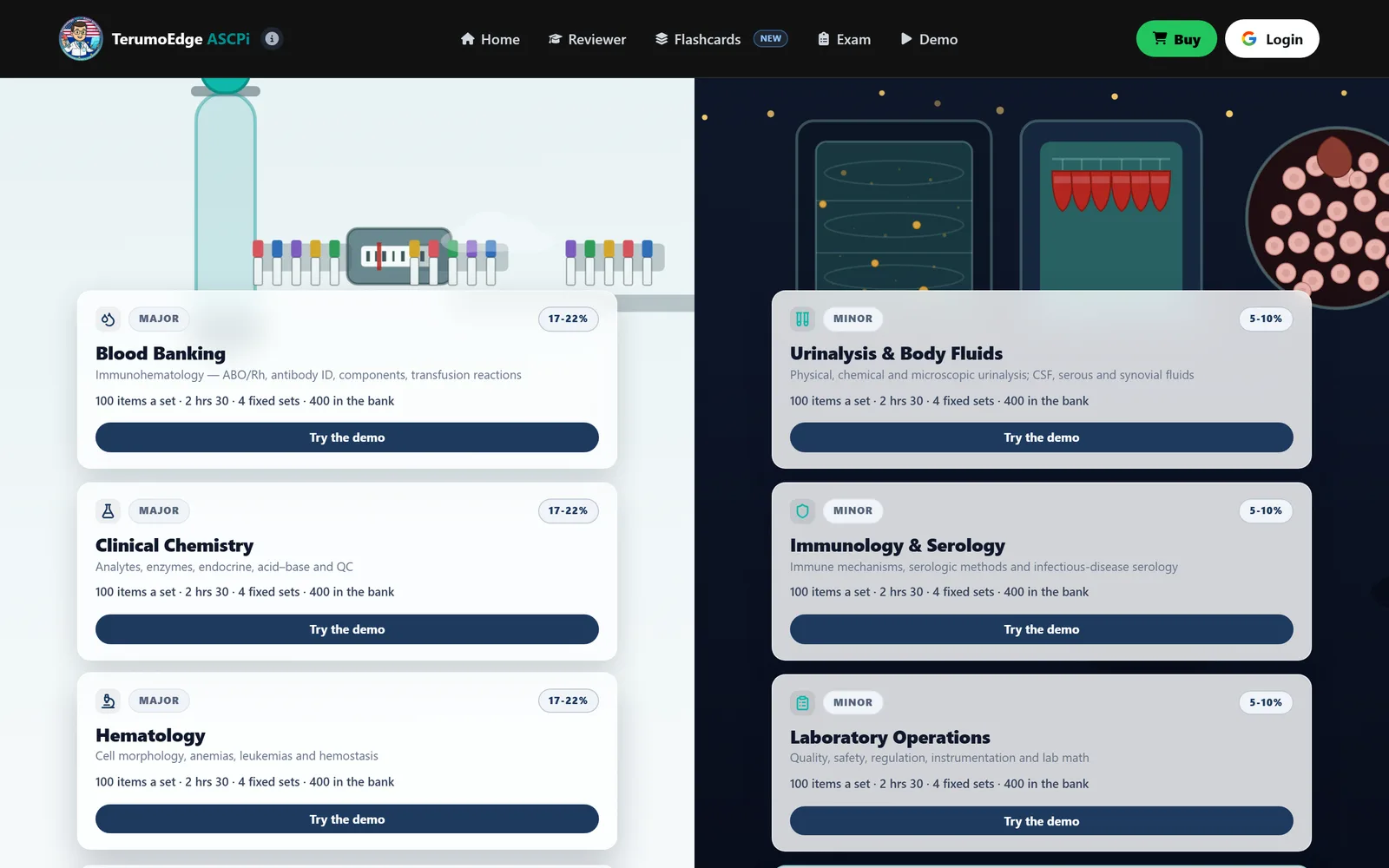
Before you plan a single review week, you need the ASCPi content guideline in front of you. It tells you what the exam covers, how heavily each area is weighted and what kind of questions to expect. This post lays out the seven areas of the MLS(ASCPi) with their exact ranges, then shows how we would turn those ranges into study hours.
All the exam facts here come from the ASCP Board of Certification's Examination Content Guideline, revised September 25, 2025. One guideline covers both MLS(ASCP) and MLS(ASCPi), and the BOC says the two credentials use the same question pool for each credential category.
What does the ASCPi content guideline list?
The guideline names seven content areas, each with a percentage range. The ranges are the ASCP BOC's own, and we have not rounded or merged them.
| Content area | ASCP range |
|---|---|
| Blood Banking | 17-22% |
| Urinalysis and Other Body Fluids | 5-10% |
| Chemistry | 17-22% |
| Hematology | 17-22% |
| Immunology | 5-10% |
| Microbiology | 17-22% |
| Laboratory Operations | 5-10% |
The exam has 100 questions in 2 hours 30 minutes, all multiple choice with one best answer. Questions may be both theoretical and procedural.
Notice that these are ranges, never single figures. ASCP does not say "exactly 20 Chemistry questions", and a reviewer that claims a single percentage per area is giving you its own estimate, not ASCP's.
What do the four 17-22% areas add up to?
Blood Banking, Chemistry, Hematology and Microbiology each carry 17-22%, so together they make up 68-88% of the exam. That is the arithmetic from the guideline's ranges: four times 17 is 68, and four times 22 is 88.
This is why most reviewers spend most of their weeks on these four. It is a sound instinct. A weak spot in one of them costs more than a weak spot in a small area.
But the range is wide, and the guideline does not say which of the four will be heaviest on your sitting. Do not bet your plan on a favourite. We look at each area's study method in the major subjects review.
Why are the three 5-10% areas not optional?
Urinalysis and Other Body Fluids, Immunology and Laboratory Operations are each 5-10%, so together they are 15-30% of the exam. That is the sum of the three lower bounds and the three upper bounds. At the top of the range, almost a third of the test sits in areas many candidates skim.
This is the trap for anyone who studied from a list of five subjects. Immunology and Laboratory Operations are official areas of the guideline. A five-subject review leaves real weight uncovered.
There is a second reason. According to the ASCP BOC, the adaptive algorithm does not give you one content area at a time, so questions from every area can appear throughout the exam. A failing score report also breaks the result down by subtest area. We cover the small areas in the minor subjects review.
What does "theoretical and procedural" mean for your practice?
Questions may be both theoretical and procedural, so you need to know why a result happens and how a test is done. A theory question might ask what causes a result. A procedural question might ask what you do next, or what a step in a method is for.
The ASCP BOC's examination page also lists three taxonomy levels for questions: application or analysis, comprehension, and knowledge. Practice that stops at recall is practising one level out of three.
The guideline adds a point that catches Philippine-trained candidates: regulatory questions on the examination are based on U.S. sources, for example AABB, FDA and CLIA. Blood bank donor-eligibility questions are based on current regulations as of June 2023. When a question asks about a rule, the U.S. basis is the answer key, not your hospital's policy. We write more on this in US regulations on the ASCPi.
How should you split review hours by weight?
Split your hours roughly by weight, then adjust for your own weak spots. Here is one way to do it, and it is our suggestion, not an ASCP rule.
Take a review block of 100 hours. Give each of the four big areas about 18 to 20 hours, which is 72 to 80 in all. That keeps them inside the 68-88% span. Give each of the three small areas about 8 to 9 hours, 24 to 27 in all. The totals run slightly over 100, so trim from your strongest areas.
Then add an adjustment: move 10 to 15 hours from the areas where your practice results are best to the areas where they are worst. If you are a hospital medtech who works the blood bank daily, you may need fewer Blood Banking hours and more Laboratory Operations hours.
| Area group | ASCP range | Suggested share of a 100-hour block (our suggestion) |
|---|---|---|
| Each of Blood Banking, Chemistry, Hematology, Microbiology | 17-22% | 18 to 20 hours |
| Each of Urinalysis and Other Body Fluids, Immunology, Laboratory Operations | 5-10% | 8 to 9 hours |
| Flexible hours moved to weak areas | not applicable | 10 to 15 hours |
Re-check the split every two weeks. Your timed practice results will show which areas deserve the flexible hours, and they will change as you improve. Do not leave a weak small area for the last week, because there it can only be skimmed.
For a week-by-week version, see our 12-week ASCPi study plan.
Why can nobody promise an exact count per area?
Nobody can promise an exact count because the exam picks questions by ability as well as by percentage. According to the ASCP BOC, the computer adaptive test selects questions using the content guideline percentages and your estimated ability. It aims for about a 50% chance of a correct answer and mixes content areas throughout.
So two candidates can sit the same 100-question exam and meet slightly different mixes. Both mixes stay inside the guideline, but neither is a fixed recipe. This is why we give ranges and why you should be wary of any reviewer that says "expect 22 Hematology questions".
What you can do is prepare for the whole range. If an area can reach 22% on your sitting, a half-reviewed Hematology is a risk. If a small area can reach 10%, skipping it is a risk too. Read how the computer adaptive test works for the selection mechanics.
Also check the age of anything you study from. The guideline was revised on September 25, 2025, and donor-eligibility questions follow regulations as of June 2023. A reviewer that predates the revision may be organised differently.
How does TerumoEdge map to the guideline?
TerumoEdge covers all seven areas with 400 items each, 2,800 in all. That means the bank includes Immunology and Laboratory Operations, which some review materials leave out. We do not claim it reproduces every topic in the guideline. We publish this blog, so weigh that accordingly.
The full mock draws 100 items in 150 minutes at fixed counts. These counts are our design, set roughly at the midpoint of each ASCP range. They are not ASCP's counts.
| Content area | ASCP range | TerumoEdge mock items (product design) |
|---|---|---|
| Blood Banking | 17-22% | 20 |
| Chemistry | 17-22% | 20 |
| Hematology | 17-22% | 20 |
| Microbiology | 17-22% | 20 |
| Urinalysis and Other Body Fluids | 5-10% | 7 |
| Immunology | 5-10% | 7 |
| Laboratory Operations | 5-10% | 6 |
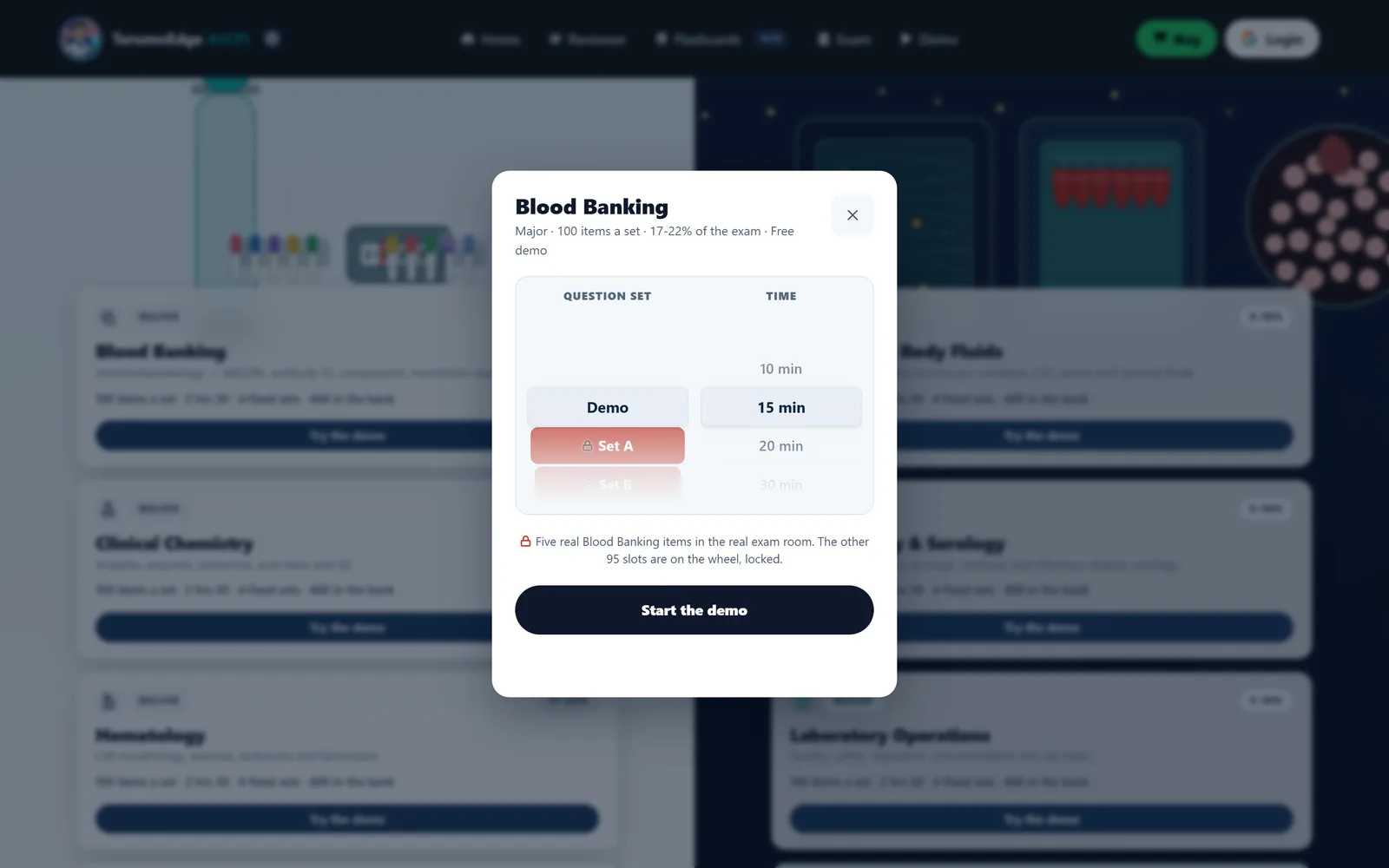
The real exam is adaptive and ours is not, so its area mix will differ from any single mock. You can see all seven areas in the free demo, which has five items per area.
Frequently asked questions
How many subjects are on the ASCPi?
The ASCP BOC content guideline lists seven content areas: Blood Banking, Urinalysis and Other Body Fluids, Chemistry, Hematology, Immunology, Microbiology and Laboratory Operations. The same guideline covers both MLS(ASCP) and MLS(ASCPi).
Is Immunology on the MLS(ASCPi)?
Yes. Immunology is one of the seven content areas, with a range of 5-10%. Laboratory Operations has the same range, so a review that covers only five subjects leaves both uncovered.
How many questions will I get per area?
ASCP publishes percentage ranges, not counts. The ASCP BOC says questions are selected using the content guideline percentages and your estimated ability, so no one can promise an exact number per area on your sitting.
When was the guideline last revised?
The guideline we use is marked "Revised: September 25, 2025". If a reviewer or book was written before that, check it against the current guideline. Donor-eligibility questions follow regulations as of June 2023.
Sources
From the publisher
Meet the ASCPi format here first.
TerumoEdge ASCPi is an ASCPi practice simulator: board-length sets and a timed 100-item mock across all seven content areas, with an English explanation for every item instead of a bare answer key. It is a fixed-length practice draw, not ASCP's adaptive test.
- 2,800 items across seven content areas, 400 in each
- Four fixed sets of 100 items per area, and a 100-item full mock in 150 minutes
- An English explanation for every item, not a bare answer key
- A laboratory science reviewer and flashcards beside the question bank
Try the free ASCPi simulator demo Five real items in each of the seven content areas. No account needed.
About this article
Written by the TerumoEdge ASCPi editorial team, who build the TerumoEdge ASCPi Exam Simulator. Exam facts are checked against the ASCP Board of Certification content guideline, its eligibility and exam pages, and the ASCP BOC and Pearson VUE test center procedures, and every article lists its sources. How we write and check our articles.
First published .