
Comparisons7-minute readFor medtechs comparing ASCPi apps
How to choose an ASCPi reviewer app: nine criteria that matter
Nine checkable criteria for choosing an ASCPi reviewer app, a 10-minute demo test, the red flags to avoid and an honest look at our own limits.
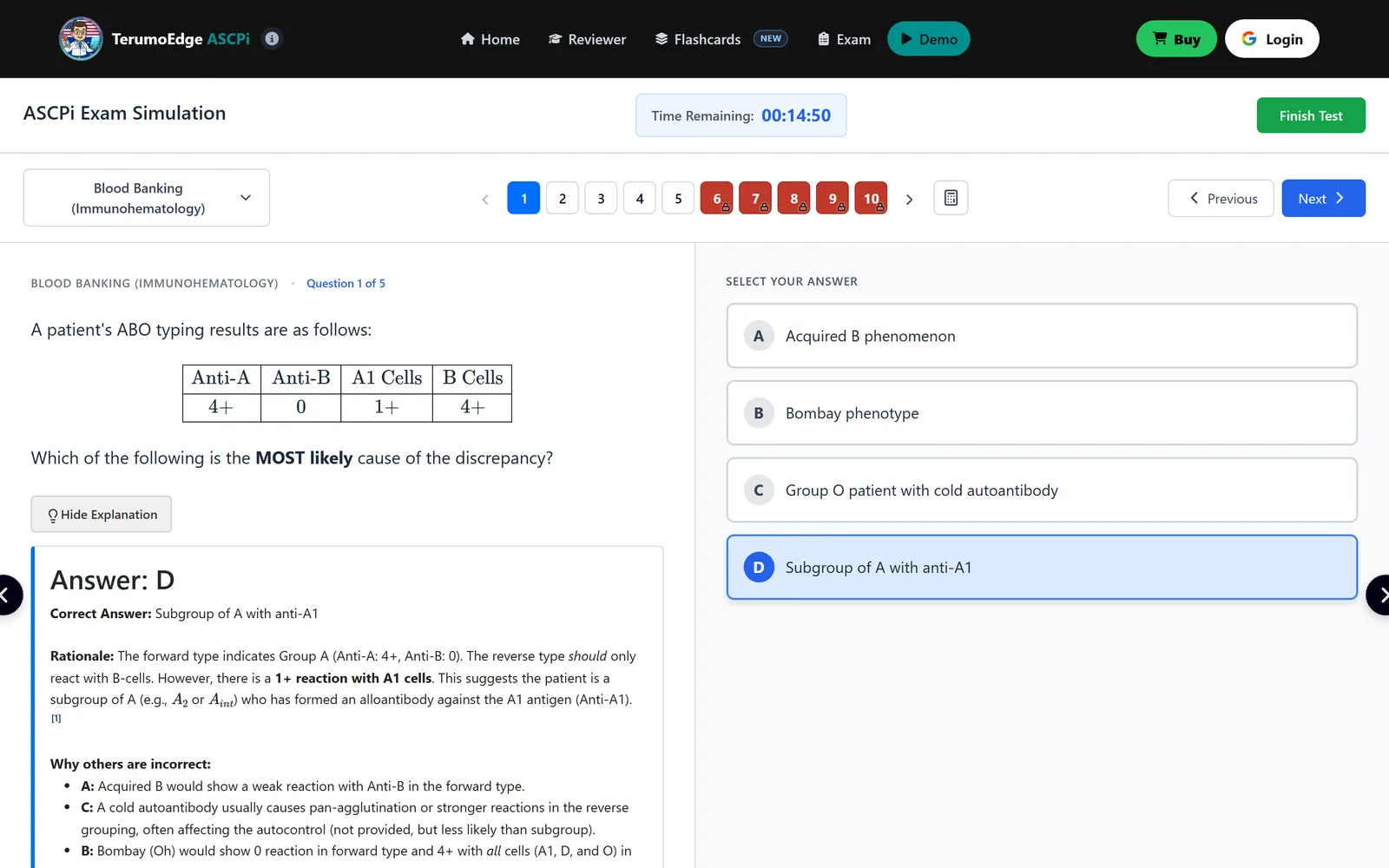
You are choosing an ASCPi reviewer app, and the store pages all sound the same. This guide gives you nine criteria you can check yourself, a ten-minute test for any demo and the red flags that should make you close the tab.
TerumoEdge, which publishes this blog, makes a simulator, so we end with an honest self-assessment, including what ours does not do. We rank no apps and name none.
Why do apps miss the ASCPi?
Many apps miss the ASCPi because they were built for a different exam and relabelled. A store listing will not show it, so you need the guideline in hand. The MLS(ASCPi) has its own guideline: 100 questions in 2 hours 30 minutes, four options each, delivered by computer adaptive testing, across seven content areas with a US regulatory basis.
An app built around the Philippine licensure exam under RA 5527 can look similar and still miss the points that matter. It may omit Immunology or Laboratory Operations. It may frame regulation around local rules. It may have no timed mode at all.
The ASCP content guideline is the checklist. Every criterion below traces to it or to ASCP's About the Examination page, so you can verify each yourself.
What are the nine criteria for an ASCPi reviewer app?
The nine criteria are coverage, item format, a timed mode, explanations, the US regulatory basis, honesty about adaptivity, currency, demo depth and the absence of promised results. The table gives each one with its reason and a quick check.
| Criterion | Why it matters | How to check |
|---|---|---|
| 1. All seven content areas | The guideline lists seven, including Immunology and Laboratory Operations | Find each area by name in the app |
| 2. Four options, one best answer | The real format, per ASCP | Open ten items and count options |
| 3. Timed 100 questions in 150 minutes | The real length and clock | Look for a full-length mode |
| 4. Explanations for the key and the distractors | Learning happens after the answer | Open an explanation on a wrong answer |
| 5. US regulatory basis | Regulatory questions use US sources such as AABB, FDA and CLIA | Open a blood bank or lab operations item |
| 6. Honesty about adaptivity | Only ASCP holds the calibrated bank | Read the app's claims about CAT and scoring |
| 7. Currency | The guideline was revised September 25, 2025 | Look for a stated date or version |
| 8. Demo depth and mobile use | You will study in short gaps | Run the demo on your phone |
| 9. No promised outcome | No tool can promise a result | Search the page for "pass" and read each claim |
Criteria 1 to 5 test whether the content matches the exam. Criteria 6 to 9 test whether the seller is honest about it.
A few of these deserve a closer look, because they are where apps most often fall down.
Coverage (1). The guideline names seven areas: Blood Banking, Urinalysis and Other Body Fluids, Chemistry, Hematology, Immunology, Microbiology and Laboratory Operations. The four larger areas are 17–22% each, and the three smaller ones 5–10% each. An app that lists only five subjects leaves a real share of the exam unpractised.
Explanations (4). An answer key tells you that you were wrong. An explanation tells you why, and a good one tells you why each other option fails. That second part is what trains you to eliminate options on exam day, a strategy ASCP itself recommends.
Currency (7). A reviewer or app that never states a date may predate the September 25, 2025 revision of the guideline. It may also frame donor eligibility on rules older than the June 2023 basis the guideline names.
Mobile practicality (8). You will do most of your practice in gaps between shifts. If the exam room is unusable on a phone, you will not use it. An app is for study only: the 2021 candidate procedures say no personal items or studying are allowed at the centre.
How do you run a 10-minute demo test?
Run the demo test as five short steps, and stop at the first failure that matters to you.
- Minutes 1–2: list the content areas on offer. Count them against the seven in the guideline.
- Minutes 3–5: answer three items from different areas. Check each has four options and one best answer.
- Minutes 6–7: answer one wrongly on purpose and open the explanation. Does it give the key, a rationale and a reason each other option fails?
- Minutes 8–9: open a blood bank or lab operations item and read how the regulation is framed. Is it a US source, or local practice?
- Minute 10: look for a full-length timed mode and for what the app says about scoring.
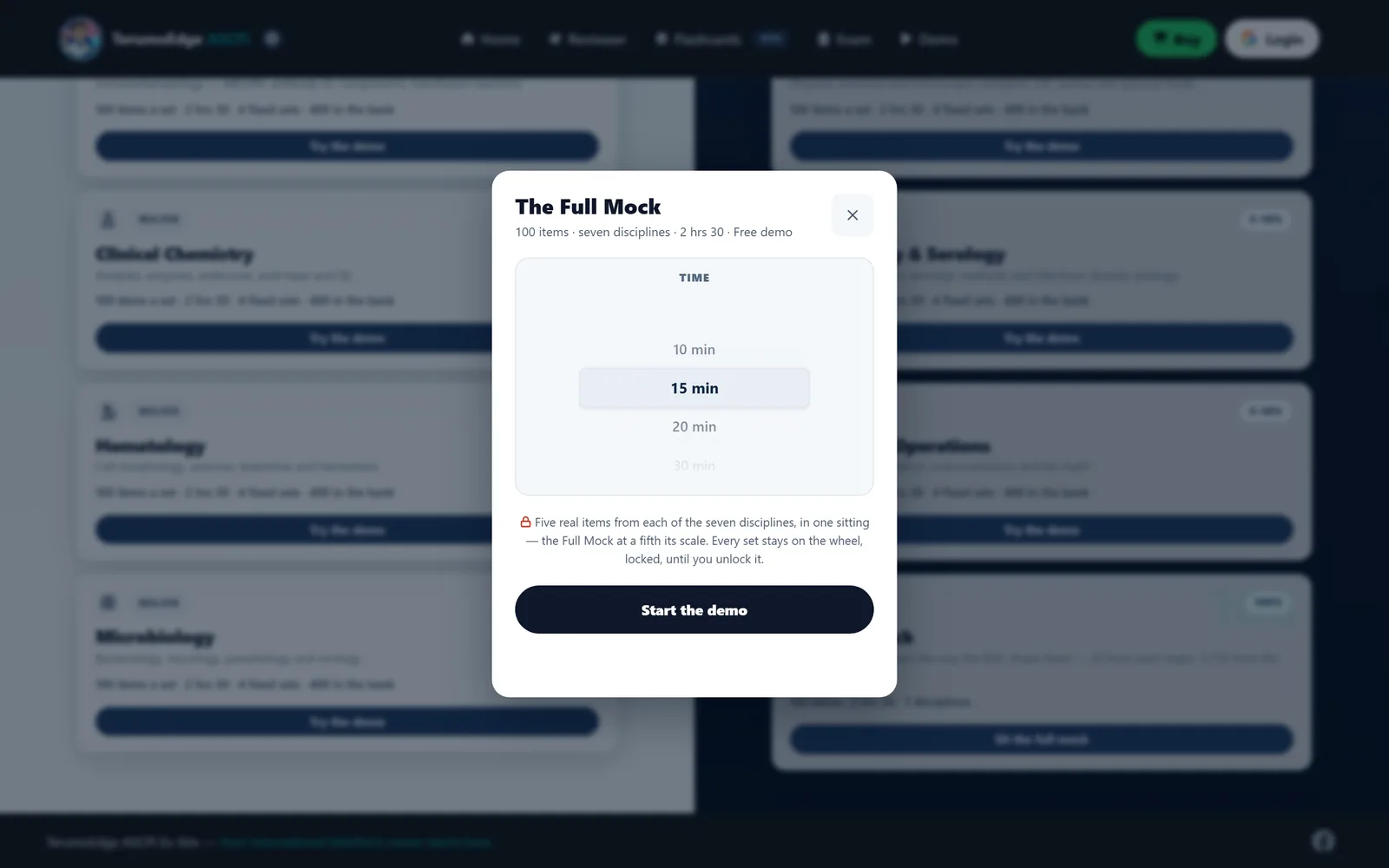
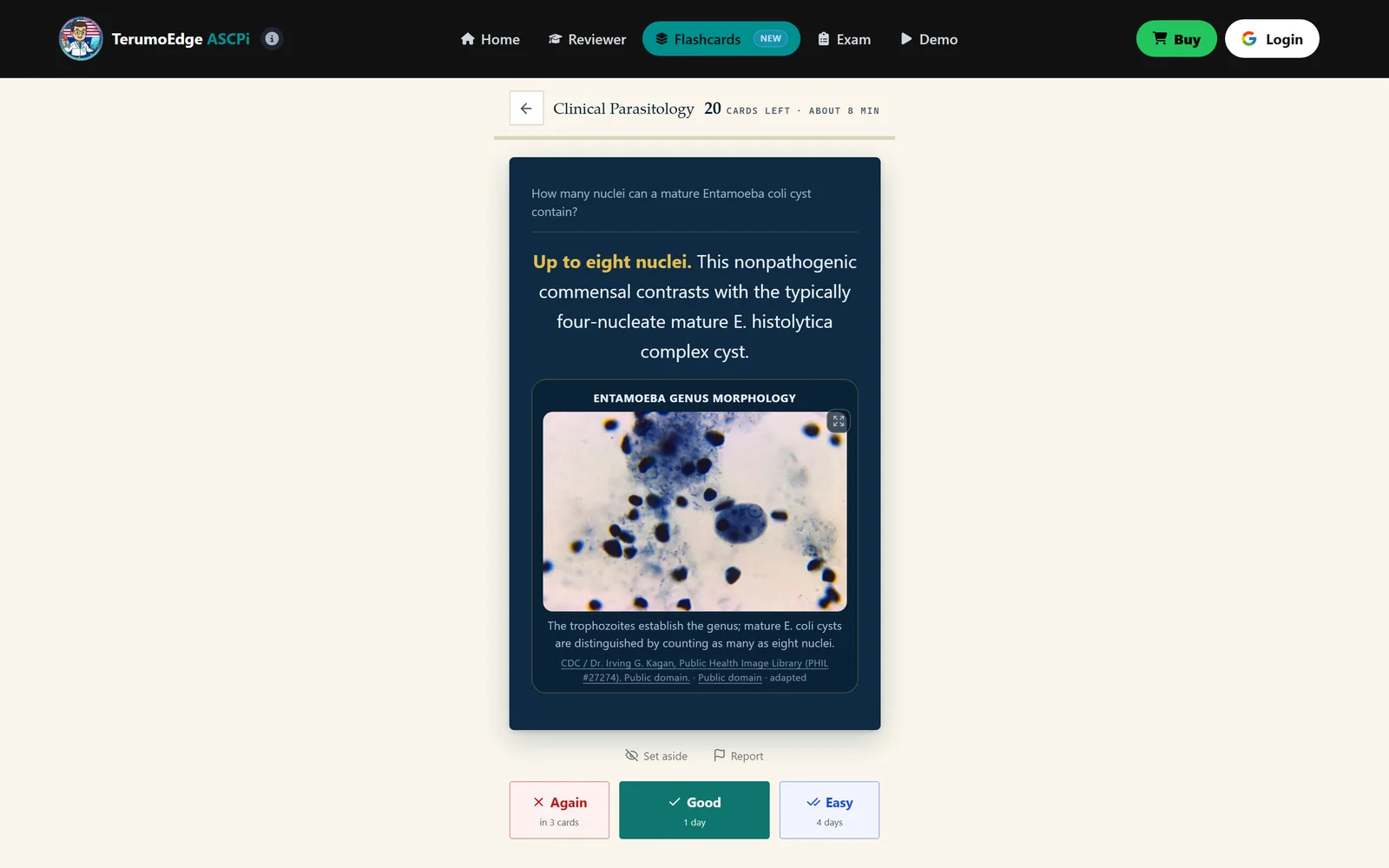
If the demo hides all of this behind a signup, treat that as information. A free demo that lets you open an explanation is a strong sign of confidence.
What are the red flags?
The main red flags are claims that no practice tool can support. Close the tab when you see one.
- A claim to match the real exam, or to be "the real CAT". ASCP says questions come from a bank of statistically calibrated items and are selected to give you about a 50% chance of answering correctly. A third-party app cannot hold that calibration.
- A predicted scaled score. ASCP says scoring uses the overall pattern of responses and there is no set number or percentage correct. A practice percentage is not a 100–999 score, and 400 is not a percentage.
- A promise that you will pass. No source supports one, and no tool controls what ASCP scores.
- Only five subjects. The guideline has seven.
- No date. An undated app may predate the September 2025 revision.
For why a practice tool cannot copy the real mechanism, read what an ASCPi simulator can and cannot rehearse.
How does TerumoEdge measure up?
Against the nine criteria, TerumoEdge meets some and falls short on others, and you should know both before the demo.
It covers all seven content areas at 400 items each, 2,800 in all, with four options and one keyed answer per item. It has a 100-item mock on a 150-minute clock. Every item has an English explanation, and nearly all say why the other options are wrong. The bank includes items framed on AABB, FDA and CLIA. The free demo offers five items per area, 35 in all.
Where it falls short: the mock is not adaptive. It is a fixed random draw and lets you go back, so it does not rehearse ASCP's algorithm. It gives no scaled-score estimate. It cannot confirm how any one item compares with ASCP's calibrated bank.
Use the criteria on us as you would on anyone, and compare the result with reviewer PDFs and with chatbots.
Frequently asked questions
Is a free app enough for ASCPi review?
A free app can be enough for early practice and for judging quality, but check it against the nine criteria. The usual gaps are missing content areas, no timed full-length mode and thin explanations. If a free tool covers all seven areas and explains answers well, it may be enough for a part of your review.
Do any apps use ASCP's real CAT?
We make no claims about other apps. What we can say is how ASCP describes its own system: questions come from a bank of statistically calibrated items, and selection uses the content guideline percentages and your estimated ability. A practice app does not have that bank, so its adaptivity, if any, is a different thing.
Can an app forecast my ASCP score?
No. ASCP's scaled score runs from 100 to 999, with 400 as the minimum passing score, and it comes from a psychometric estimate across your whole pattern of responses. An app can show practice results by area, which is useful, but it cannot convert them into your scaled score.
Sources
- MLS(ASCP) and MLS(ASCPi) Examination Content Guideline — ASCP Board of Certification
- About the Examination — ASCP Board of Certification
- Understanding the Similarities and Differences Between ASCP & ASCPi Certification — ASCP Board of Certification
- ASCP BOC/Pearson VUE Candidate Test Center Procedures — ASCP BOC and Pearson VUE, August 2021
- Republic Act No. 5527 (Philippine Medical Technology Act) — Lawphil
From the publisher
Meet the ASCPi format here first.
TerumoEdge ASCPi is an ASCPi practice simulator: board-length sets and a timed 100-item mock across all seven content areas, with an English explanation for every item instead of a bare answer key. It is a fixed-length practice draw, not ASCP's adaptive test.
- 2,800 items across seven content areas, 400 in each
- Four fixed sets of 100 items per area, and a 100-item full mock in 150 minutes
- An English explanation for every item, not a bare answer key
- A laboratory science reviewer and flashcards beside the question bank
Try the free ASCPi simulator demo Five real items in each of the seven content areas. No account needed.
About this article
Written by the TerumoEdge ASCPi editorial team, who build the TerumoEdge ASCPi Exam Simulator. Exam facts are checked against the ASCP Board of Certification content guideline, its eligibility and exam pages, and the ASCP BOC and Pearson VUE test center procedures, and every article lists its sources. How we write and check our articles.
First published .