Comparisons6-minute readFor registered medtechs adding the ASCPi
ASCPi vs MTLE: what changes when you study for a US-style exam
ASCPi vs MTLE: two credentials from two bodies. See what is new on the ASCPi, the habits to rebuild and what your board-exam review can still do.
You are a registered medtech who has already passed the Philippine board exam, and now you are weighing the ASCPi. The two are easy to blur, so this ASCPi vs MTLE guide separates them and shows what actually changes in how you study.
We do not claim one is harder; no source supports that. TerumoEdge, which publishes this blog, also publishes a separate MTLE simulator for a different exam run by a different body. This post is about the ASCPi side, so weigh our view accordingly.
Are these two credentials from two bodies?
Yes. The MTLE is the Philippine licensure route under Republic Act No. 5527, the Philippine Medical Technology Act. The MLS(ASCPi) is a certification awarded by the ASCP Board of Certification (ASCP BOC). Different bodies set, give and grade them.
Neither replaces the other. Passing one does not stand in for the other. Each credential answers a different question: the Philippine licence concerns practice under Philippine law, while the ASCPi is a certification from a US body.
ASCP also says the ASCPi credential "does not replace or override U.S. state or federal work regulations". Each country, state and employer sets its own requirements, so confirm them with ASCP BOC and the employer you have in mind. We make no claims about jobs or migration here.
What do we know about the MTLE?
We describe the MTLE only through its law. RA 5527, approved on June 21, 1969, is titled "An Act Requiring the Registration of Medical Technologists, Defining Their Practice, and for Other Purposes." Section 16 requires an applicant to have completed a course of at least four years leading to the degree of Bachelor of Science in Medical Technology or Bachelor of Science in Hygiene.
That is the 1969 text as hosted by Lawphil. Later amendments were not checked for this post, so we give no current format, subjects, weights, schedule or pass mark for the MTLE. For those, use the Professional Regulation Commission's current announcements.
Treat this limit as part of the comparison, and keep your own up-to-date MTLE notes separate from your ASCPi notes so that the two sets of rules do not blend. The honest position is that you already know the MTLE better than we can describe it, and the useful question is what the ASCPi adds. The table below answers that.
ASCPi vs MTLE: what is new on the ASCPi side?
Eight things are new, and each one changes how you practise.
| ASCPi feature (sourced) | What changes in how an RMT studies |
|---|---|
| 100 questions in 2 h 30, four options, one best answer | Practise a 90-second average per question |
| Computer adaptive testing | Questions come one at a time, with difficulty tied to your answers |
| You must answer before moving on; no skipping | Train "answer, flag, move" instead of "skip and return" |
| Scores from 100 to 999, with 400 to pass | Do not convert 400 into a percentage |
| Regulatory questions based on US sources (AABB, FDA, CLIA) | Learn the US basis, not local practice |
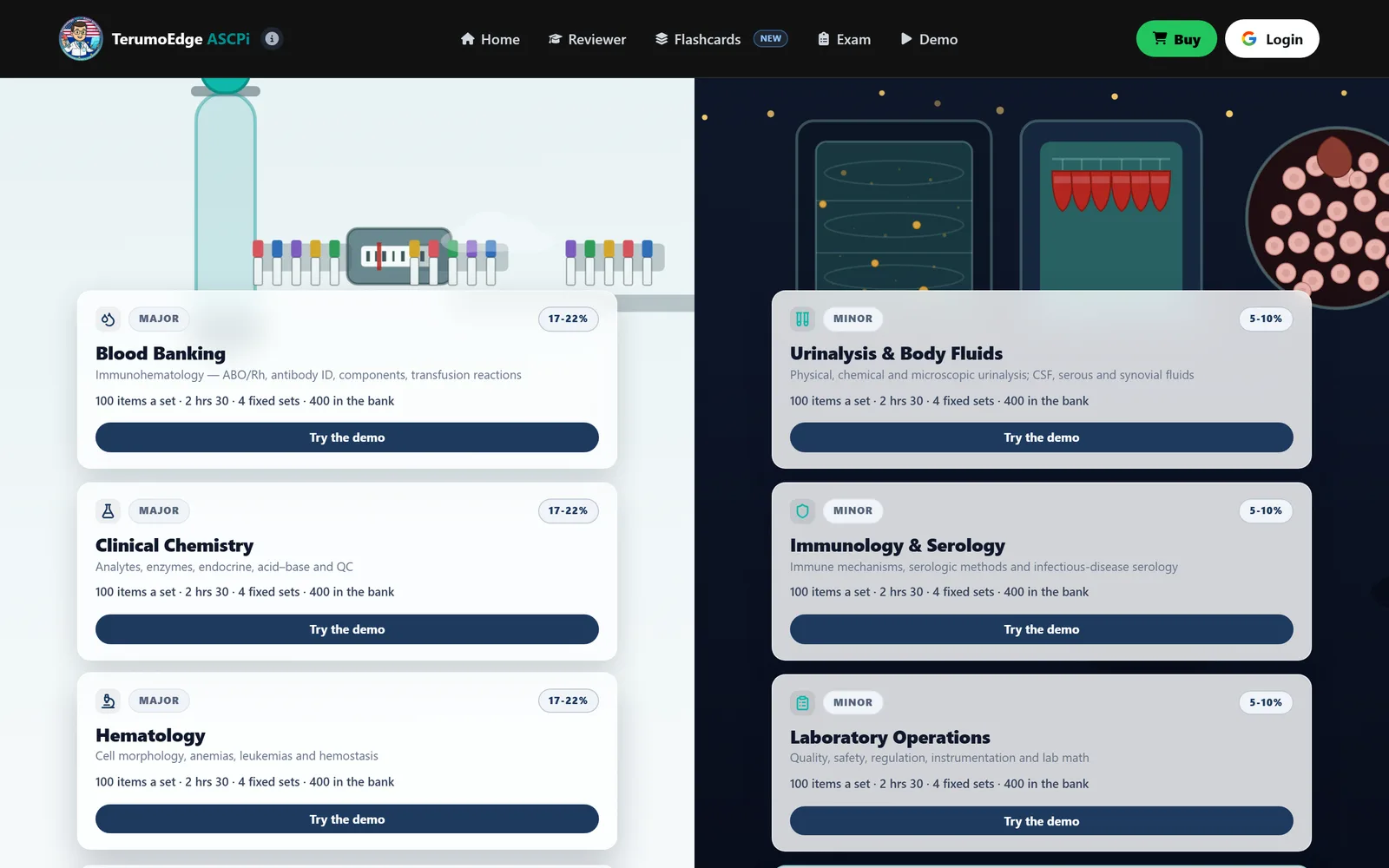
| Seven named areas, including Immunology and Laboratory Operations | Give the two 5–10% areas deliberate time |
| Eligibility by transcript evaluation and four routes | Start paperwork early and confirm your route |
| Up to five attempts under one route | Plan each attempt; the wait is no earlier than 30 days |
The first seven rows come from the ASCP content guideline and ASCP's About the Examination page. On eligibility, ASCP lists four MLS(ASCPi) routes on its credential page, and the After the Examination page sets out the five-attempt rule.
How do eligibility and attempts differ?
The ASCPi decides eligibility through a transcript evaluation and one of four routes, then limits you to five attempts under one route. Neither idea comes from a Philippine board exam, so plan for both early.
ASCP lists four MLS(ASCPi) routes. Each starts from a baccalaureate and adds either an MLS training program, years of acceptable clinical experience, or a two-year MLS program, depending on the degree. An acceptable laboratory is accredited by JCI, CAP or ISO 15189, or authorized by a governing regulatory association or a Ministry of Health. Education from outside the US or Canada needs an evaluation from an acceptable foreign transcript evaluation agency, sent directly and including a US equivalency statement.
We give no agency names, fees or timelines, and we cannot tell you whether your internship or your hospital laboratory qualifies. That is ASCP BOC's decision, so confirm with ASCP BOC before you plan around it. The failure rule is simpler: you may sit up to five times under one route, with your next eligibility period starting no earlier than 30 days after the previous exam date.
Which habits should you rebuild?
Rebuild four habits: answer-before-moving, a US regulatory frame, equal respect for small areas and attempt planning.
Answer before moving. On the real exam, questions cannot be skipped. You can flag and review only after all are answered, if time remains. If your board-exam habit was to skip and return, train the opposite on timed sets.
A US regulatory frame. When a question involves donors, quality or regulation, answer from the US source. Blood bank donor-eligibility questions follow regulations as of June 2023, per the guideline.
Small areas count. Immunology, Urinalysis and Other Body Fluids and Laboratory Operations are each 5–10%, and together 15–30%.
Attempt planning. Five attempts under one route is generous, but each application carries a non-refundable fee and the wait runs no earlier than 30 days after the previous exam date. Prepare as if you have one.
Can one review serve both exams?
Partly. The laboratory science underneath overlaps heavily: ABO typing, enzyme kinetics, morphology and culture identification do not change at the border. A solid board-exam review is a real head start on that content.
What does not carry over automatically is the regulatory basis, the exam mechanics and Laboratory Operations coverage. Check each of your old reviewers against the seven ASCP areas, and add a US-basis note set for regulation.
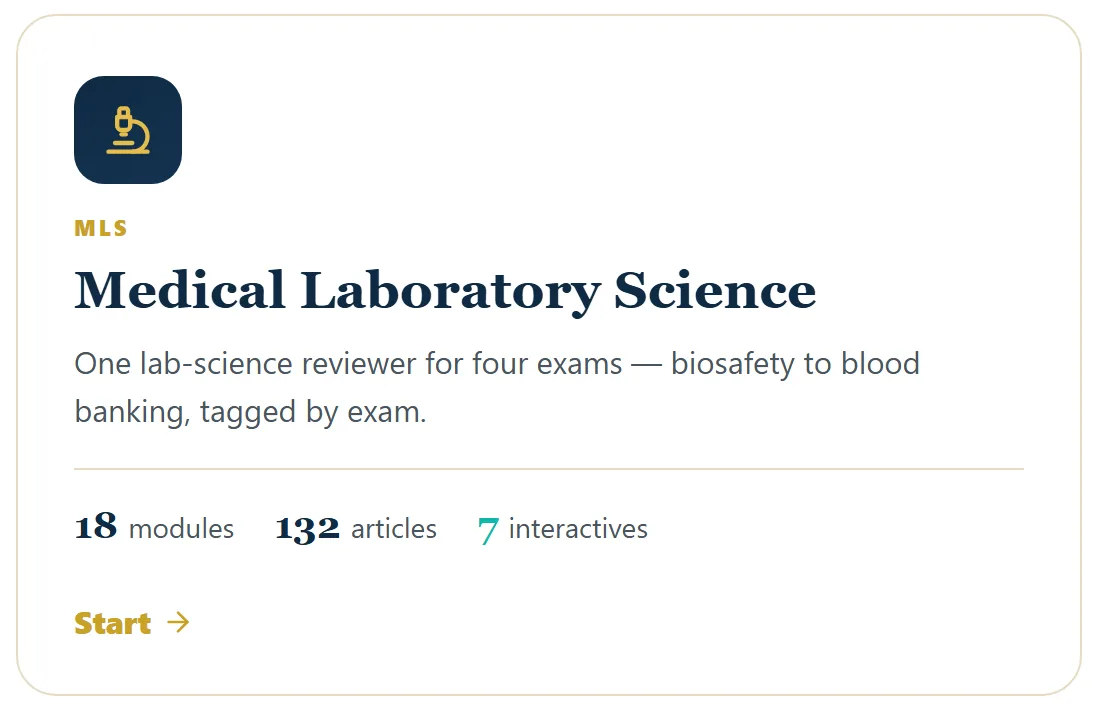
TerumoEdge keeps its simulators separate because the exams differ. The ASCPi bank has 400 items in each of seven areas, and a 100-item mock on a 150-minute clock, which is a fixed draw and not adaptive. A laboratory science reviewer and flashcards are shared across lab products. Try the free demo to see the question style.
For how the two ASCP credentials differ from each other, read ASCP vs ASCPi, and for the mechanics see how the computer adaptive test works. A step-by-step route is in the first-time ASCPi taker guide.
Frequently asked questions
Do I need the Philippine licence before the ASCPi?
We cannot say either way. ASCP's MLS(ASCPi) routes name education plus a training program or years of acceptable clinical experience, and eligibility is decided by a transcript evaluation. Confirm your exact situation with ASCP BOC before you apply.
Is the ASCPi harder than the MTLE?
We make no claim. The exams differ in format, scoring, regulatory basis and eligibility, and no source we can cite compares difficulty. Compare the differences in this post, then judge from your own timed practice.
Can I reuse my board-exam reviewers?
Partly. The science carries over, so reviewers remain useful for content. Check them against the US regulatory basis and against Laboratory Operations and Immunology, and treat anything about donor eligibility with care, since the guideline ties those questions to regulations as of June 2023.
How many times can I take the ASCPi?
ASCP allows five attempts under one eligibility route while you continue to meet the current requirements. After five unsuccessful attempts you must qualify under an alternate route. Each application carries a non-refundable fee, and the next eligibility period starts no earlier than 30 days after your previous exam date.
Sources
- Republic Act No. 5527 (Philippine Medical Technology Act) — Lawphil
- MLS(ASCP) and MLS(ASCPi) Examination Content Guideline — ASCP Board of Certification
- About the Examination — ASCP Board of Certification
- MLS Medical Laboratory Scientist credential page — ASCP Board of Certification
- Understanding the Similarities and Differences Between ASCP & ASCPi Certification — ASCP Board of Certification
- After the Examination — ASCP Board of Certification
- ASCP BOC/Pearson VUE Candidate Test Center Procedures — ASCP BOC and Pearson VUE, August 2021
From the publisher
Meet the ASCPi format here first.
TerumoEdge ASCPi is an ASCPi practice simulator: board-length sets and a timed 100-item mock across all seven content areas, with an English explanation for every item instead of a bare answer key. It is a fixed-length practice draw, not ASCP's adaptive test.
- 2,800 items across seven content areas, 400 in each
- Four fixed sets of 100 items per area, and a 100-item full mock in 150 minutes
- An English explanation for every item, not a bare answer key
- A laboratory science reviewer and flashcards beside the question bank
Try the free ASCPi simulator demo Five real items in each of the seven content areas. No account needed.
About this article
Written by the TerumoEdge ASCPi editorial team, who build the TerumoEdge ASCPi Exam Simulator. Exam facts are checked against the ASCP Board of Certification content guideline, its eligibility and exam pages, and the ASCP BOC and Pearson VUE test center procedures, and every article lists its sources. How we write and check our articles.
First published .