The ASCPi explained7-minute readFor medtechs weighing ASCP against ASCPi
ASCP vs ASCPi: the same exam pool, different eligibility, and the road from one to the other
ASCP vs ASCPi explained for medtechs: one question pool, different eligibility, the MLS(ASCPi)-to-MLS(ASCP) transition and credential maintenance.
If you are a registered medtech trying to understand ASCP vs ASCPi, the short version is reassuring: the exam is the same pool of questions. What changes is the door you walk through to be allowed to sit it. This guide settles what is shared, what differs, what the ASCPi credential does and does not do for work in the United States, and how a later move to MLS(ASCP) works.
We rely only on what ASCP Board of Certification (ASCP BOC) publishes. Where the Board does not say something, we do not guess, and we point you to ASCP BOC instead.
What is the difference between ASCP and ASCPi?
The difference between ASCP and ASCPi is eligibility, not the exam. ASCP BOC states that the two exams use the same question pool for each credential category. Both are given at Pearson Authorized Test Centers worldwide under Pearson proctoring. Education from outside the US or Canada needs an evaluation from an approved foreign transcript evaluation agency.
The Board also publishes one content guideline that covers both MLS(ASCP) and MLS(ASCPi). It describes 100 questions in 2 hours 30 minutes, with seven content areas. So the blueprint you study is identical, and so is the adaptive format described in our guide to the ASCPi computer adaptive test.
In practice this means a review plan built on the guideline works for either credential. The question to settle early is not "which exam is easier" but "which eligibility route fits my training and experience". We cover that in detail in MLS(ASCPi) eligibility: the four routes.
Where exactly does the difference lie?
The two credentials differ only in eligibility: the training programs accepted, and where and how clinical experience was obtained. ASCPi experience need not meet the US definition of "full time" and need not fall within a set timeframe. For a Filipino medtech this is the practical hinge. A hospital laboratory in the Philippines can be an acceptable clinical laboratory for ASCPi if it is accredited by JCI, CAP or ISO 15189, or authorized by a governing regulatory association or a Ministry of Health. Whether your own laboratory qualifies is ASCP BOC's decision, so confirm it with them before you plan around it.
The same goes for degrees. Education must come from an accredited US or Canadian institution, or be found equivalent to a US degree by an acceptable foreign transcript evaluation agency. That evaluation is sent directly from the agency and includes a US equivalency statement. Routes with coursework requirements need a course-by-course evaluation.
What does MLS(ASCPi) do, and not do, for US work?
The MLS(ASCPi) credential does not replace or override US state or federal work regulations. ASCP BOC says so directly. It also says that certain ASCPi certifications are recognized by employers and licensure agencies in select states, and that each country, state and employer sets its own requirements.
Read those three statements together. The credential is a certification from ASCP BOC. It is not a licence, and it is not a promise that a particular employer or licensing body will accept it. Whether it opens a particular door depends on that door's own rules, which can change.
So we make no claim here about any named state, any employer or any hiring outcome, because ASCP BOC does not. If US work is your goal, do two things before you spend months reviewing: ask the employers you have in mind what they require, and check any licensing body that applies where you would work. Then confirm the eligibility route with ASCP BOC. If you hold a Philippine licence, our comparison of ASCPi and your Philippine licence explains how the two credentials sit side by side.
How does the MLS(ASCPi)-to-MLS(ASCP) transition work?
You can move from MLS(ASCPi) to MLS(ASCP) without retaking the exam. ASCP BOC lists the transition as its own route. It requires your MLS(ASCPi) certification, a US-equivalent baccalaureate, and 5 years of full-time acceptable clinical experience in the required areas within the last 10 years.
Two details matter. First, there is no reverting to ASCPi afterwards, so treat the move as one-way. Second, the transition "does not circumvent federal work and state licensure regulations", which echoes the US-work wording above. Becoming MLS(ASCP) changes your credential, not the rules of the place you want to work.
Notice what the transition asks for that the ASCPi route did not: the "full time" and "within the last 10 years" conditions now apply. That is the other side of the ASCPi's flexibility on experience. If you expect to transition later, keep records of your employment dates and duties as you go. Confirm the exact requirements with ASCP BOC when you are ready, since routes can be revised.
If you are still at the beginning, the first-time ASCPi taker guide puts these steps in order.
How do you keep the credential valid?
You keep a time-limited credential valid through the Credential Maintenance Program (CMP), which requires continuing education every three years. When you complete CMP, a superscript "CM" marks it, as in MLS(ASCPi)CM.
An expired credential is not lost forever. ASCP BOC says it can be reinstated within ten years by completing CMP and paying the fees. After ten years, the exam must be retaken. We do not quote fees or point counts, because the Board's page is where those live and they change.
The practical advice is simple. Note your CMP cycle the day you certify, so the third year does not arrive as a surprise. If you later transition to MLS(ASCP), ask ASCP BOC how maintenance carries across. We have not seen that stated in the sources we use, so we will not say it.
ASCP vs ASCPi at a glance
The table below pulls each point back to its source. Where a cell says "confirm", it means ASCP BOC has not published a rule we can state.
| Topic | What ASCP BOC says | Source |
|---|---|---|
| Question pool | The same pool for each credential category | ASCP BOC, similarities and differences |
| Test centres | Pearson Authorized Test Centers worldwide | ASCP BOC, similarities and differences |
| What differs | Eligibility: training programs, and where and how experience was obtained | ASCP BOC, similarities and differences |
| ASCPi experience | Need not meet the US "full time" definition or a set timeframe | ASCP BOC, similarities and differences |
| Foreign education | Evaluated by an approved foreign transcript evaluation agency | ASCP BOC, acceptable education |
| US work | Does not replace or override US state or federal work regulations | ASCP BOC, similarities and differences |
| Transition to ASCP | ASCPi certification, US-equivalent baccalaureate, 5 years full-time experience in the last 10; no retake | ASCP BOC, MLS credential page |
| Maintenance | Continuing education every three years under CMP | ASCP BOC, maintain your credentials |
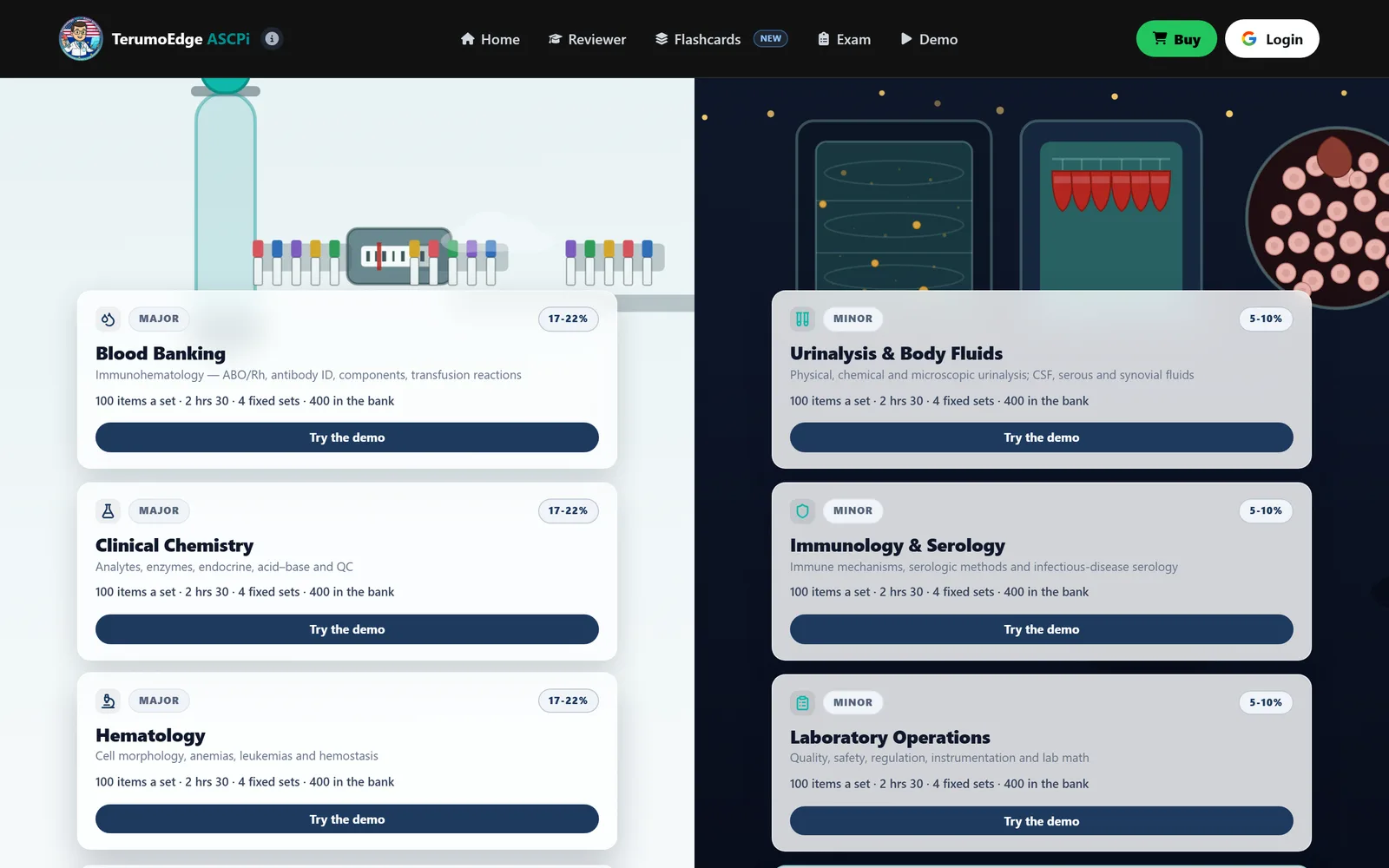
Preparing for either credential, you can try the real item format in the free ASCPi simulator demo, which has five items in each of seven content areas. It is a practice tool, so it does not replace the ASCP BOC pages above.
Frequently asked questions
Is the ASCPi exam easier than the ASCP exam?
No source says so. ASCP BOC states that the ASCP and ASCPi exams use the same question pool for each credential category. The two differ in eligibility, meaning the training programs accepted and where and how clinical experience was obtained, not in the questions you will face.
Can I work in the US with MLS(ASCPi)?
ASCP BOC says the ASCPi credential does not replace or override US state or federal work regulations. It adds that certain ASCPi certifications are recognized by employers and licensure agencies in select states, and that each country, state and employer sets its own requirements. Check those requirements directly.
Do I retake the exam to transition from MLS(ASCPi) to MLS(ASCP)?
No. ASCP BOC says the transition does not require retaking the exam. You need the MLS(ASCPi) certification, a US-equivalent baccalaureate, and 5 years of full-time acceptable clinical experience in the required areas within the last 10 years. There is no reverting to ASCPi afterwards.
How often must I maintain the credential?
A time-limited credential is kept valid through the Credential Maintenance Program, which requires continuing education every three years. An expired credential can be reinstated within ten years by completing CMP and paying fees. After ten years, you must retake the exam.
Sources
- Understanding the Similarities and Differences Between ASCP & ASCPi Certification — ASCP Board of Certification
- MLS - Medical Laboratory Scientist credential page — ASCP Board of Certification
- Acceptable Education — ASCP Board of Certification
- Maintain Your Credentials — ASCP Board of Certification
- MLS(ASCP) and MLS(ASCPi) Examination Content Guideline — ASCP Board of Certification
From the publisher
Meet the ASCPi format here first.
TerumoEdge ASCPi is an ASCPi practice simulator: board-length sets and a timed 100-item mock across all seven content areas, with an English explanation for every item instead of a bare answer key. It is a fixed-length practice draw, not ASCP's adaptive test.
- 2,800 items across seven content areas, 400 in each
- Four fixed sets of 100 items per area, and a 100-item full mock in 150 minutes
- An English explanation for every item, not a bare answer key
- A laboratory science reviewer and flashcards beside the question bank
Try the free ASCPi simulator demo Five real items in each of the seven content areas. No account needed.
About this article
Written by the TerumoEdge ASCPi editorial team, who build the TerumoEdge ASCPi Exam Simulator. Exam facts are checked against the ASCP Board of Certification content guideline, its eligibility and exam pages, and the ASCP BOC and Pearson VUE test center procedures, and every article lists its sources. How we write and check our articles.
First published .