Your situation6-minute readFor first-time ASCPi takers
First-time ASCPi taker? What to do from eligibility check to exam day
A first time ASCPi taker guide for Filipino medtechs: find your route, get the transcript evaluation, learn the adaptive format, review by weight, then sit.
If this is your first attempt at the MLS(ASCPi), the hardest part is often not the content. It is not knowing the order of things. This guide is for the first time ASCPi taker who is already a registered medtech and wants a clear sequence from eligibility check to exam day.
We give you five steps and a table of the traps first-timers fall into. We do not quote fees, processing times or pass rates, because none of those can be sourced here. Where the official pages leave something open, we say so and tell you to confirm with ASCP BOC.
What does a first time ASCPi taker underestimate?
First-timers underestimate three things: the paperwork, the format, and the width of the content. The paperwork runs on someone else's schedule, so starting late is the most common avoidable problem. The format is a computer adaptive test, which behaves very differently from a school exam. The content is seven areas, not the five that many casual lists mention.
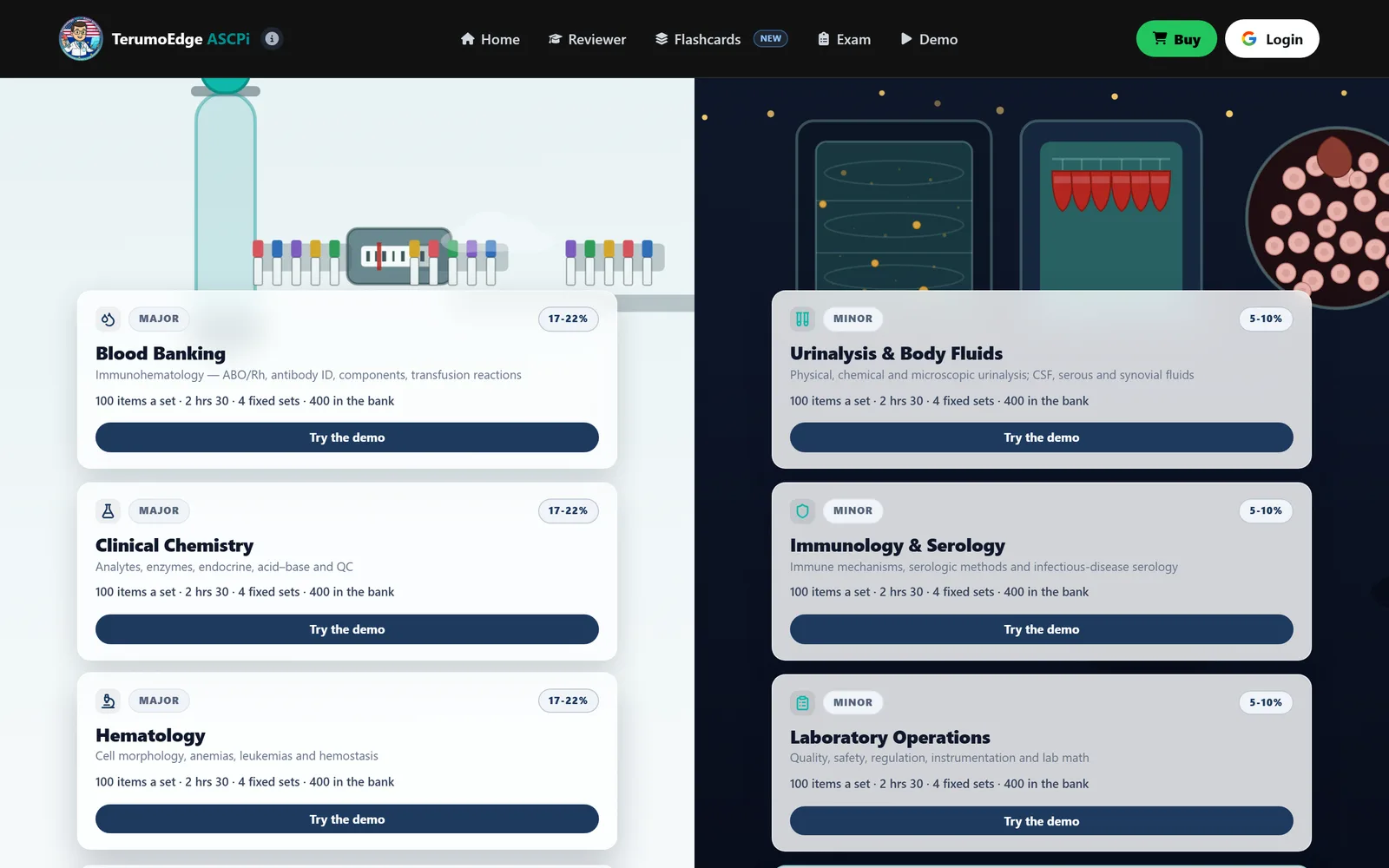
On the format, ASCP BOC says the exam is 100 multiple-choice questions in 2 hours 30 minutes, delivered by computer adaptive testing. On the content, the same guideline lists Blood Banking, Chemistry, Hematology, Microbiology, Urinalysis and Other Body Fluids, Immunology and Laboratory Operations.
The percentage ranges you rely on come from the guideline itself, which we cover in step 4.
Step 1: how do you find your eligibility route?
Find your route by matching your degree and your training or experience to the four MLS(ASCPi) routes that ASCP BOC lists. The asterisk in its list means "accredited or approved by a governing regulatory association or a Ministry of Health."
| Route | Degree | Plus |
|---|---|---|
| 1 | Baccalaureate in Medical Laboratory Science (includes Medical Technology), biological science or chemistry | A Medical Laboratory Science training program covering blood banking, chemistry, hematology and microbiology |
| 2 | Baccalaureate in Medical Laboratory Science/Medical Technology | 3 years of acceptable clinical experience in those four areas |
| 3 | A baccalaureate | A 2-year MLS program |
| 4 | Baccalaureate in biological science or chemistry | 5 years of clinical experience |
An acceptable clinical laboratory is one accredited by JCI, CAP or ISO 15189, or authorized by a governing regulatory association or a Ministry of Health. For ASCPi, experience need not meet the US definition of "full time" or fall within a set timeframe.
Several questions are not settled by the sources: whether your internship counts as a training program, whether your hospital counts as an acceptable laboratory, and whether the Philippine licence is needed. Confirm each with ASCP BOC. Our eligibility routes guide goes deeper.
Step 2: what is the transcript evaluation?
The transcript evaluation is an assessment of your foreign degree by an acceptable agency, and it is what establishes your eligibility. ASCP BOC explains that education must come from an accredited US or Canadian institution, or be found equivalent to a US degree by an acceptable foreign transcript evaluation agency.
Three points matter in practice. The evaluation is sent directly from the agency, not by you. It must include a US equivalency statement. Routes with coursework requirements need a course-by-course evaluation.
We name no agencies and quote no fees or processing times, because we cannot verify them. Read ASCP BOC's page for the current list and instructions. Begin early, because this step runs on someone else's timetable, and it can quietly set the date of your whole plan.
Also gather your records: your transcript of records, your diploma and any training or employment certificates your route needs. Ask the agency and ASCP BOC what they will accept before you pay for copies.
Step 3: what exam are you actually sitting?
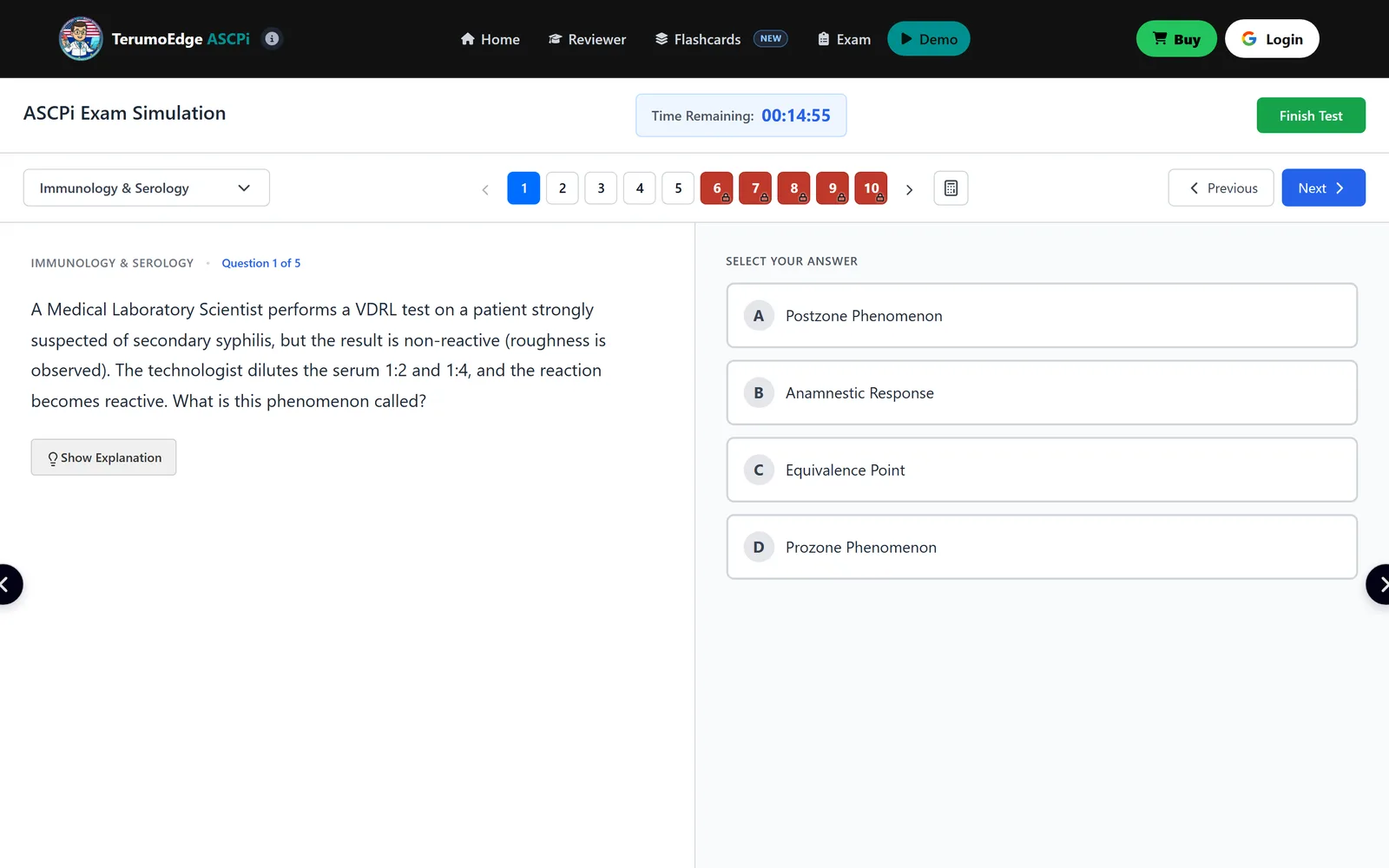
You are sitting a computer adaptive test with no skipping and a scaled score, so learn its rules before you start drilling. ASCP BOC says the exam starts near the minimum passing standard, a correct answer brings a slightly harder question, and a wrong answer brings a slightly easier one. Questions are chosen to give about a 50% chance of a correct answer.
You must answer each question before moving on. You can flag questions and review them if time remains after all are answered. An onscreen calculator is available.
Scores run from 100 to 999, with a minimum passing score of 400. That is a scaled score, not a percentage, and ASCP BOC states there is no set number or percentage of correct answers needed to pass. Do not turn 400 into a fraction of anything.
A preliminary pass or fail shows on screen at the end, and notice of the official score comes by email within four business days once transcripts are processed. Our guide to how the ASCPi computer adaptive test works covers the mechanics.
Step 4: how do you build the review?
Build the review by content-area weight, then add timed practice. ASCP BOC's weights are ranges: Blood Banking, Chemistry, Hematology and Microbiology each take 17 to 22%, and Urinalysis and Other Body Fluids, Immunology and Laboratory Operations each take 5 to 10%. Regulatory questions are based on US sources such as AABB, FDA and CLIA.
A simple structure for a first attempt:
- Cover the four large areas first, then the three smaller ones. Do not skip the small ones, since questions from every area can appear throughout.
- Study the US regulatory basis separately, because it differs from the Philippine setting you work in.
- Add timed sets early and full 100-item, 150-minute mocks later.
TerumoEdge gives you 2,800 practice items across all seven content areas, at 400 each, with an English explanation for every item. The free demo lets you try five items per area before you decide anything. The mock is a fixed-length draw and does not copy the adaptive algorithm.
See our 12-week study plan for a schedule and our comparison of a review center and self review if you are deciding how to study.
Which habits and traps matter most for a first attempt?
The most useful habits are small and boring: start paperwork early, practise under the clock, keep an error log, and rehearse the no-skip rule. This table turns the common traps into habits.
| Trap | Habit |
|---|---|
| Starting the transcript evaluation late | Begin it alongside the review; confirm requirements with ASCP BOC |
| Assuming the exam is five subjects | Cover all seven content areas |
| Practising only untimed | Add timed sets, then full 100-item runs in 150 minutes |
| Expecting to skip and come back | Answer every question in order; flag for the end |
| Answering regulatory questions from local practice | Learn the US basis (AABB, FDA, CLIA) as a separate topic |
| Reading a practice percentage as a score | Remember the real score is a scaled 100 to 999 result |
One more habit is worth building: ask. The sources leave several eligibility questions open, and a short, polite question to ASCP BOC is cheaper than a wrong assumption. Finally, plan your exam day from the Pearson centre guide, so that the locker, the ID and the clock hold no surprises.
Frequently asked questions
How long does preparation take?
We make no claim, because it depends on your starting point, your shifts and how quickly your paperwork moves. Plan backwards from your booking, keep the transcript evaluation running alongside your review, and build in time for full timed mocks. A 12-week structure is one workable template, not a rule.
How hard is the ASCPi?
We quote no pass rates because none could be verified. What we can say is that the format is demanding in a specific way: it is adaptive, questions are chosen to give about a 50% chance of a correct answer, you cannot skip, and seven content areas are tested. Prepare for the format as well as the content.
Do I need a review center?
Not as a requirement. ASCP BOC's eligibility routes list education plus a training program or experience, and a review course is not one of them. Whether a center suits you depends on your schedule and how much structure you want. Our comparison sets out both sides.
Can I take the exam without the Philippine licence?
The sources we use do not say either way, so we will not guess. The routes name degrees plus training or experience. Confirm with ASCP BOC before you apply.
Sources
From the publisher
Meet the ASCPi format here first.
TerumoEdge ASCPi is an ASCPi practice simulator: board-length sets and a timed 100-item mock across all seven content areas, with an English explanation for every item instead of a bare answer key. It is a fixed-length practice draw, not ASCP's adaptive test.
- 2,800 items across seven content areas, 400 in each
- Four fixed sets of 100 items per area, and a 100-item full mock in 150 minutes
- An English explanation for every item, not a bare answer key
- A laboratory science reviewer and flashcards beside the question bank
Try the free ASCPi simulator demo Five real items in each of the seven content areas. No account needed.
About this article
Written by the TerumoEdge ASCPi editorial team, who build the TerumoEdge ASCPi Exam Simulator. Exam facts are checked against the ASCP Board of Certification content guideline, its eligibility and exam pages, and the ASCP BOC and Pearson VUE test center procedures, and every article lists its sources. How we write and check our articles.
First published .