
Comparisons7-minute readFor registered medtechs choosing how to review for the ASCPi
ASCPi review center or self review? An honest comparison for working medtechs
An ASCPi review center gives structure and a cohort; self review gives flexibility around shifts. Compare both and see who should pick which.
If you are a registered medtech weighing an ASCPi review center against studying on your own, the honest answer is that both can work, and the choice is mostly about you. It depends on how you learn, how your shifts fall and how much you need someone else to keep you on schedule.
This comparison treats review centers and self review as categories, not named businesses, and it names no prices. TerumoEdge, which publishes this blog, makes a self-review tool, so we are not neutral. We try to be fair about what a review center does better.
What does an ASCPi review center give you?
A review center gives you structure: a fixed schedule, lectures, a cohort of fellow reviewees and a person to put questions to. For many Filipino medtechs, that structure is what makes review happen at all, especially after years away from classroom study.
Lectures can cover the whole content guideline in a planned order, so you do not wonder what to study next. A cohort creates gentle pressure; it is harder to quietly drop out when classmates are expecting you on Saturday. A lecturer can also answer the question that a book cannot: why a US-based regulatory question has a different answer from what your hospital does.
The costs are real too. Fixed sessions collide with rotating and night shifts. A live pace suits the average of the class, not you, and a lecture is not the same as practice. Sitting through content does not prove you can retrieve it under the clock.
What does self review give you?
Self review gives you control of time and pace. You review on the commute, between duties or on an off day, and you can spend three days on Blood Banking if that is where you are weak.
It fits a hospital schedule better than any fixed class. A reviewer, flashcards and a question bank can all run on a phone, so a twenty-minute gap becomes a study block. You also pay attention only to your weak areas instead of sitting through topics you already know.
The cost is discipline. Nobody notices if you skip a week, and there is no one to ask. Self reviewers also tend to over-study favourite subjects and avoid the ones that scare them. A written plan fixes most of this: see the 12-week ASCPi study plan for a template built around the content guideline.
How do the two compare side by side?
The two compare as a trade between structure and flexibility, with a shared gap in timed practice and US-regulatory study. The table sets out the main differences for working medtechs.
| Feature | Review center | Self review |
|---|---|---|
| Schedule | Fixed by the center | Set by you |
| Fit with night shifts | Often difficult | Usually easy |
| Accountability | Cohort and lecturer | Your own plan |
| Someone to ask | Yes | Only if you find a mentor |
| Coverage of the guideline | Planned for you | You must map it yourself |
| Timed 100-question practice | Varies, so ask | Depends on your tools |
| US regulatory basis | Varies, so ask | Depends on your sources |
"Varies, so ask" is deliberate. We cannot tell you what any specific center teaches, and you should not assume it either way. Ask directly, and ask to see sample materials before you commit.
Who should choose which?
Choose a review center if you learn best from a person, if you have been out of formal study for years, or if you know that you will not follow a plan alone. Choose self review if your shifts rotate, if you already know your weak areas or if you retake after a failed attempt and need targeted repair.
A useful test: look at the last time you finished a self-paced course. If you did, self review will probably suit you. If it sits half-done, you may need the appointment a review center creates.
Your situation also matters more than your preference. A medtech on a three-week night rotation cannot attend a Saturday-morning class after a night shift. A medtech with predictable day shifts can. A repeat taker may not need to re-hear the lectures; the failing score report breaks the score down by subtest area, and that tells you where to spend your time.
Is there a hybrid that works for hospital medtechs?
Yes, and many working medtechs end up there: a structured course for the first weeks, then self-paced practice for the rest. The course gives you the map and the habit; self review gives you the repetition around your rotation.
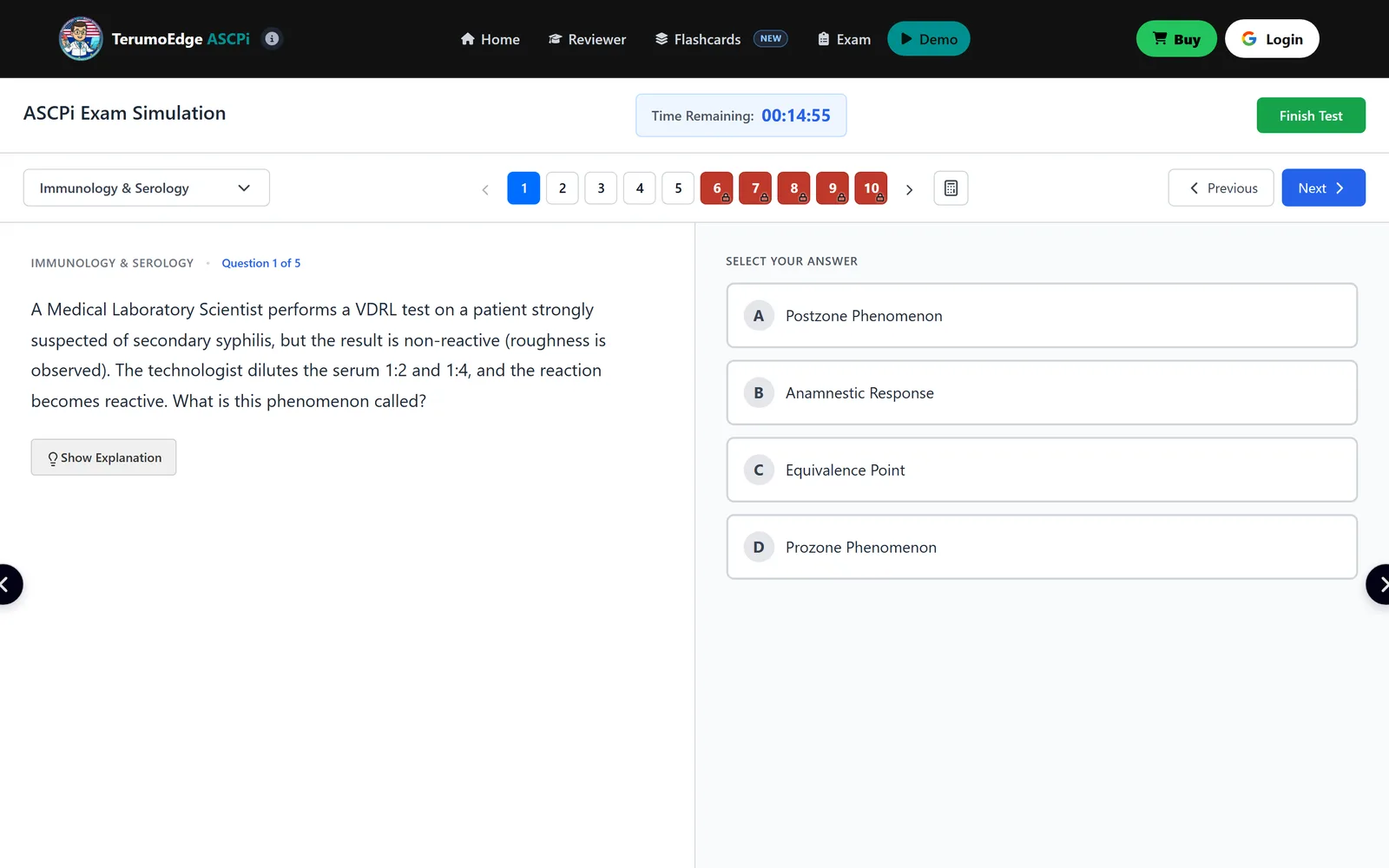
A practical split: use the first part of your review to cover content with a lecturer or a reviewer, then move to timed sets. A laboratory science reviewer at /learn/ and flashcards cover content and recall, while a simulator covers the clock. TerumoEdge has 28 fixed sets and a 100-item mock for that last stage, and you can try the free demo first.
If you work nights, the schedule matters more than the venue. Our guide to reviewing for the ASCPi on night shifts shows how to build short blocks around a rotation.
How should you judge a review center before you enrol?
Judge a review center by what it shows you, not by what it promises. Ask for five things before you commit, and walk away from vague answers.
- The schedule across your next rotation. If you work nights, a class you cannot attend is money and hours wasted.
- A sample of its practice questions. Check for four options, one best answer and explanations that cover the wrong options too.
- How it handles all seven content areas. The ASCP guideline names Immunology and Laboratory Operations as areas, so a center that skips them leaves 15–30% of the exam thin when combined with Urinalysis and Other Body Fluids.
- How it teaches the US regulatory basis, and who writes that material.
- Whether it offers timed 100-question practice, and how often.
Be wary of any center or course that tells you a review is required for eligibility. Your route depends on education plus a training program or acceptable experience, checked through a transcript evaluation, and your Philippine licence under RA 5527 is a separate matter. Confirm eligibility questions with ASCP BOC, not with a seller.
What gap does neither option fill by default?
Neither option automatically gives you two things the real exam demands: timed, answer-before-moving practice, and the US regulatory basis. You have to check for both, whichever route you take.
The ASCP content guideline says the examination is 100 questions in 2 hours 30 minutes. The About the Examination page says you must answer each question before moving on and that questions cannot be skipped. A lecture series or a book does not train that habit. Only repeated timed sets do.
The content guideline also states that regulatory questions are based on US sources such as AABB, FDA and CLIA. A Philippine-trained lecturer may teach local practice by habit, so ask how the US basis is covered. Whenever a regulatory item surprises you, note the US source behind it; our guide to studying US regulations on the ASCPi shows how to build that habit. The test centre has its own rules too: the 2021 candidate procedures say no studying is allowed there, and the exam clock does not stop for breaks.
Frequently asked questions
Can you pass the ASCPi through self review?
Yes, people can prepare on their own, but we have no statistics on how often it works and will not invent any. What matters is the structure of your review, not the venue: coverage of all seven content areas, timed practice and honest review of mistakes.
Is a review course part of ASCPi eligibility?
No. ASCP's MLS(ASCPi) routes list education plus a training program or years of clinical experience. A review course is not one of the listed requirements. Eligibility also depends on a transcript evaluation, so confirm your route with ASCP BOC before spending time or money.
When should I enrol in a review?
Choose a start date that leaves room for content, timed practice and a taper before your sitting. We cannot give a universal number of weeks. A 12-week frame is a reasonable template, and you should start the transcript evaluation alongside it because eligibility rests on that evaluation.
Do review centers cover US regulations?
Ask each center directly. The ASCP guideline says regulatory questions are based on US sources such as AABB, FDA and CLIA, so a review that skips them leaves a known gap. Request a sample of how the US basis is taught, not a general promise.
Sources
- MLS(ASCP) and MLS(ASCPi) Examination Content Guideline — ASCP Board of Certification
- About the Examination — ASCP Board of Certification
- MLS Medical Laboratory Scientist credential page — ASCP Board of Certification
- ASCP BOC/Pearson VUE Candidate Test Center Procedures — ASCP BOC and Pearson VUE, August 2021
- Republic Act No. 5527 (Philippine Medical Technology Act) — Lawphil
From the publisher
Meet the ASCPi format here first.
TerumoEdge ASCPi is an ASCPi practice simulator: board-length sets and a timed 100-item mock across all seven content areas, with an English explanation for every item instead of a bare answer key. It is a fixed-length practice draw, not ASCP's adaptive test.
- 2,800 items across seven content areas, 400 in each
- Four fixed sets of 100 items per area, and a 100-item full mock in 150 minutes
- An English explanation for every item, not a bare answer key
- A laboratory science reviewer and flashcards beside the question bank
Try the free ASCPi simulator demo Five real items in each of the seven content areas. No account needed.
About this article
Written by the TerumoEdge ASCPi editorial team, who build the TerumoEdge ASCPi Exam Simulator. Exam facts are checked against the ASCP Board of Certification content guideline, its eligibility and exam pages, and the ASCP BOC and Pearson VUE test center procedures, and every article lists its sources. How we write and check our articles.
First published .