The ASCPi explained6-minute readFor Filipino medtech graduates checking ASCPi eligibility
MLS ASCPi eligibility: the four routes and the transcript evaluation, explained for Filipino medtechs
MLS ASCPi eligibility explained: the four routes, what counts as an acceptable laboratory and the transcript evaluation, with questions to confirm.
If you are a Filipino medtech graduate wondering about MLS ASCPi eligibility, the question is not "am I smart enough" but "which route fits my papers". The ASCP Board of Certification (ASCP BOC) sets four routes for the MLS(ASCPi), and each combines your degree with either a training program or years of clinical experience.
This post lays out the routes as the ASCP BOC lists them, then maps them to common Filipino profiles as questions to settle, not verdicts. We cannot rule on your eligibility, and neither can any reviewer or blog. ASCP BOC decides.
What does MLS ASCPi eligibility look like: the four routes at a glance?
The MLS(ASCPi) has four routes, listed on the ASCP BOC credential page. Here they are as stated there.
| Route | Degree | Plus | Note |
|---|---|---|---|
| 1 | Baccalaureate in Medical Laboratory Science (which includes Medical Technology), biological science or chemistry | A Medical Laboratory Science training program covering blood banking, chemistry, hematology and microbiology | Program must cover all four areas; the BOC marks some items with an asterisk meaning accredited or approved by a governing regulatory association or a Ministry of Health |
| 2 | Baccalaureate in Medical Laboratory Science or Medical Technology | 3 years of acceptable clinical experience in those four areas | Experience is "acceptable clinical experience" in those four areas |
| 3 | A baccalaureate | A 2-year Medical Laboratory Science program | Check the BOC page for how the program must be accredited or approved |
| 4 | Baccalaureate in biological science or chemistry | 5 years of clinical experience | Confirm how the BOC counts your laboratory |
The "four areas" in the routes are blood banking, chemistry, hematology and microbiology. Notice what is absent: none of the routes mentions a review course. A review center or a simulator does not make you eligible.
What counts as an acceptable laboratory?
An acceptable clinical laboratory for the ASCPi is one accredited by JCI, CAP or ISO 15189, or authorized by a governing regulatory association or a Ministry of Health. That is the ASCP BOC's definition, and the last clause is what matters most to many hospital medtechs.
The wording "authorized by a governing regulatory association or a Ministry of Health" does not tell us how ASCP treats a laboratory licensed by the Philippine Department of Health. We will not say that a DOH licence makes your lab acceptable, because no source we hold says so. Confirm with ASCP BOC before you count your years.
If your hospital laboratory holds one of the named accreditations, find the certificate and the dates. Photos of a plaque are weaker than the accreditation body's record. Ask your laboratory manager what you can obtain.
What is the transcript evaluation?
The transcript evaluation is how ASCP BOC decides whether your Philippine degree equals a US degree. Education must come from an accredited US or Canadian institution, or be found equivalent to a US degree by an acceptable foreign transcript evaluation agency.
According to the ASCP BOC's Acceptable Education page, the evaluation is sent directly from the agency and must include a US equivalency statement. Routes with coursework requirements need a course-by-course evaluation. That matters for the routes that specify subjects.
The ASCP BOC also says education from outside the US or Canada needs an evaluation from an approved agency, in its comparison of ASCP and ASCPi. We name no agencies, fees or processing times here, because the approved list belongs to the BOC. Check it on the BOC's site, and do not take an agency's word that it is approved.
Ask what the evaluation will state before you pay. It should name your degree, the institution and a US equivalent. If you have more than one qualification, a course-by-course report is the safer request for routes that list coursework. Keep every page of your transcript, because the agency works only from what it receives.
How do the routes map to common Filipino profiles?
Treat each profile below as a question to confirm with ASCP BOC, not an answer.
- A BSMT graduate. The routes say a baccalaureate in Medical Laboratory Science "includes Medical Technology". So the degree itself looks like the right kind for Routes 1 and 2. What decides your route is your training or your experience.
- A BSMT graduate with 3 years in a hospital lab. This is the shape of Route 2: a Medical Technology baccalaureate plus 3 years of acceptable clinical experience in the four areas. Confirm that the laboratory is acceptable and that your rotations cover all four areas.
- A BSMT graduate who finished a hospital internship. Route 1 needs a Medical Laboratory Science training program. Whether your internship counts as that program is not something any source we hold says. Confirm with ASCP BOC.
- A graduate in biology or chemistry. Routes 1 and 4 name those degrees. Route 4 needs 5 years of clinical experience.
Do not rely on a friend's route. Two people with the same school can have different papers.
How does experience count for ASCPi?
For the ASCPi, experience need not meet the US definition of "full time" or fall within a set timeframe. The ASCP BOC says the two credentials use the same question pool and differ only in eligibility: training programs, and where and how clinical experience was obtained.
That is welcome news for a working medtech whose hours were part-time, split between posts or earlier in your career. But it does not mean every month counts. The experience still has to be in an acceptable laboratory and in the required areas.
Write down each laboratory you worked in, the dates, the sections you rotated through and your supervisor's name. If you are also planning your review, keep the paperwork running beside it. Our first-time ASCPi taker guide puts the steps in order, and ASCP vs ASCPi covers the difference between the two credentials.
What should you check before you apply?
Run through this list before you pay for anything.
- Match your degree to a route in the table above.
- Decide whether you rely on a training program or on experience.
- List the laboratories and check each against the acceptable-laboratory definition.
- Ask ASCP BOC whether a Philippine internship counts as the training program, and whether your laboratory is acceptable.
- Request a course-by-course transcript evaluation from an agency on the BOC's approved list, sent directly to ASCP BOC.
- Keep your own copies of everything.
Only after your eligibility is clear does it make sense to schedule the exam. Pay for nothing, and book nothing, until the ASCP BOC has confirmed the points you flagged. A wrong assumption about an internship or a laboratory can cost you months. If a first attempt does not pass, the BOC allows five attempts under one route while you continue to meet current requirements; see the retaker strategy.
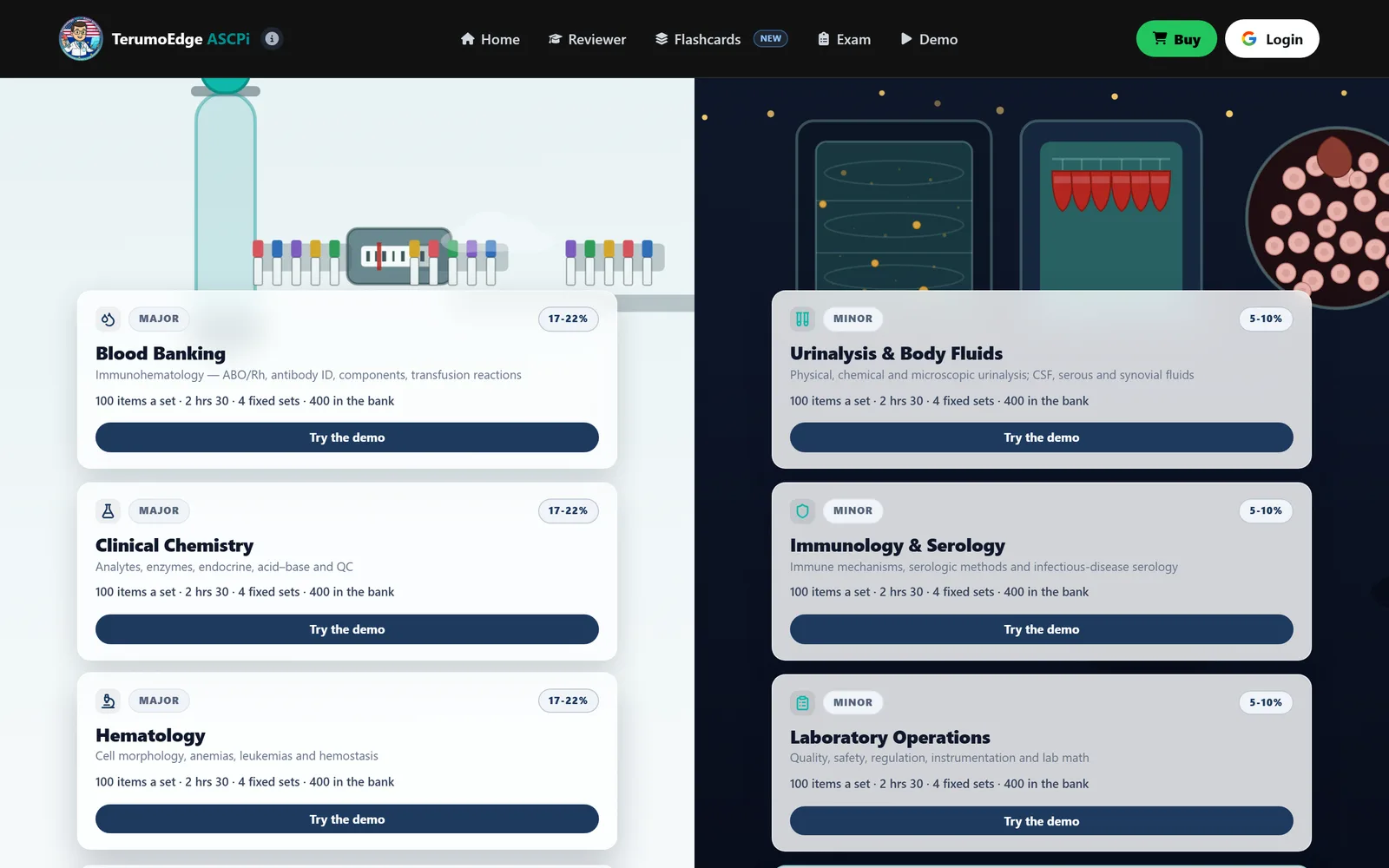
When you are ready to rehearse the exam itself, the free demo has five items in each area.
Frequently asked questions
Can a BSMT graduate take the MLS(ASCPi)?
The ASCP BOC counts Medical Technology as part of Medical Laboratory Science for its baccalaureate requirement. Which route applies depends on your training or experience, and eligibility depends on your transcript evaluation. Confirm your route with ASCP BOC.
Does my internship count as a training program?
No source we hold says. Route 1 requires a Medical Laboratory Science training program covering blood banking, chemistry, hematology and microbiology, and ASCP BOC decides what qualifies. Confirm with ASCP BOC before relying on your internship.
Do I need a transcript evaluation?
Yes, for education outside the US or Canada. The ASCP BOC requires an evaluation from an approved foreign transcript evaluation agency, sent directly and including a US equivalency statement. Routes with coursework requirements need a course-by-course evaluation.
Does my hospital lab count as acceptable?
The ASCP BOC accepts laboratories accredited by JCI, CAP or ISO 15189, or authorized by a governing regulatory association or a Ministry of Health. How a given Philippine licence or authorization is treated is a question to confirm with ASCP BOC.
Sources
From the publisher
Meet the ASCPi format here first.
TerumoEdge ASCPi is an ASCPi practice simulator: board-length sets and a timed 100-item mock across all seven content areas, with an English explanation for every item instead of a bare answer key. It is a fixed-length practice draw, not ASCP's adaptive test.
- 2,800 items across seven content areas, 400 in each
- Four fixed sets of 100 items per area, and a 100-item full mock in 150 minutes
- An English explanation for every item, not a bare answer key
- A laboratory science reviewer and flashcards beside the question bank
Try the free ASCPi simulator demo Five real items in each of the seven content areas. No account needed.
About this article
Written by the TerumoEdge ASCPi editorial team, who build the TerumoEdge ASCPi Exam Simulator. Exam facts are checked against the ASCP Board of Certification content guideline, its eligibility and exam pages, and the ASCP BOC and Pearson VUE test center procedures, and every article lists its sources. How we write and check our articles.
First published .