
Your situation7-minute readFor ASCPi retakers
Failed the ASCPi? The ASCPi retake rules, the 30-day wait, and a plan built on your score report
An ASCPi retake strategy for medtechs who did not pass: the five-attempt rule, the 30-day wait, how to read your failing report and a 10-week plan.
If you have just seen a fail on the screen, we are sorry. It is a hard moment, especially after months of studying around your shifts. This post is for the medtech who wants to know what the rules allow and what to do differently, which is the honest core of any ASCPi retake.
We cover the retake rules, how to read your failing score report, a way to diagnose what went wrong, and a 10-week plan. We quote no repeater statistics, because none could be verified, and we never quote the application fee. We also cannot promise a result next time. What we can give you is a method that starts from your own data.
What is the honest debrief after a fail?
The honest debrief is to separate what happened from what it means. A fail means that on that day, your estimated ability fell below the minimum passing standard on the scale. It does not mean you cannot pass, and it does not mean your years of work in the lab were wasted.
Write your debrief within a day or two, while you remember the sitting. Note how it felt, which areas felt shaky, whether time ran short, and how you slept and ate in the days before. Do not draw conclusions yet. Just capture facts.
The test itself will have felt hard. ASCP BOC explains that the adaptive system selects questions that give you about a 50% chance of answering correctly, so a hard-feeling exam is normal for everyone. Your feelings during the test are therefore a poor guide to your result, in either direction. Your score report is a far better guide.
Give yourself a few days of rest before you plan. Then use the sections below.
What are the ASCPi retake rules?
The retake rules are short. ASCP BOC's After the Examination page says you may take an examination five times under one eligibility route if you continue to meet the current eligibility requirements. After five unsuccessful attempts under one route, you must meet the requirements under an alternate route.
Your eligibility period begins no earlier than 30 days after your previous examination date. Each application incurs a non-refundable fee, and we do not quote it; check ASCP BOC for the current amount.
| Rule | What ASCP BOC says | What it means for you |
|---|---|---|
| Attempts | Five per eligibility route | You have room to correct course |
| After five | Qualify under an alternate route | Check which routes you might meet |
| Waiting period | Eligibility begins no earlier than 30 days after the previous exam date | Thirty days is a minimum, not a target |
| Application | New application, non-refundable fee | Apply when your plan says you are ready |
| Eligibility | You must continue to meet current requirements | Confirm yours with ASCP BOC |
The 30 days is the earliest possible date. Most retakers need longer to change a method, and nothing obliges you to book the first available slot. See the four eligibility routes for what each requires.
How do you read your failing score report?
Read your failing score report as a map of your subtest areas. ASCP BOC states that a failing score report breaks the score down by subtest area, and that passing reports do not. The official report shows the pass or fail result and the scaled score, which runs from 100 to 999 with a minimum passing score of 400.
Do not turn that scaled score into a percentage of questions correct. ASCP BOC says there is no set number or percentage of correct answers needed to pass, and scoring uses the overall pattern of responses. Our passing score guide explains the scale.
Then do three things with the breakdown:
- List the subtest areas in order of weakness, using the report's own wording.
- Set that list beside the guideline weights: Blood Banking, Chemistry, Hematology and Microbiology carry 17 to 22% each, and the other three areas 5 to 10% each.
- Mark the areas that are both weak and heavily weighted. Those come first.
Keep the report safe. It is direct evidence, from the exam itself, of which areas cost you the most.
How do you diagnose the cause of the miss?
Diagnose by asking why the weak areas were weak, because each cause needs a different fix. A knowledge gap, a habit problem and an exam-day problem can all look the same in a score report.
| Diagnosis | Sign | Fix |
|---|---|---|
| Content gap in one or two areas | Report shows clear weak subtests; practice misses cluster in the same areas | Targeted study from first principles, then timed sets in those areas |
| Surface learning | You recognise answers when you read them but cannot produce reasons | Explain each answer aloud; read every "why others are wrong" line |
| US regulatory basis | Misses on donor eligibility, standards and laboratory operations | Learn the US frame separately: AABB, FDA, CLIA |
| Pace and format | Last questions rushed, or time lost on early hard items | Full 100-item, 150-minute mocks; answer, flag, move |
| Nerves or sleep | Strong practice scores, weaker real sitting | Rehearsal ladder; sleep and routine; consider professional support |
| Reviewer age | Material predates the guideline revision | Check your sources against the September 25, 2025 revision |
Most retakers find that two or three rows apply, not one. Be wary of the temptation to pick the cause that hurts least. If you are not sure, treat the report as the tiebreaker.
The guideline also says donor-eligibility questions follow regulations as of June 2023, so check how current your notes are.
What does a 10-week retake plan look like?
A 10-week plan fits comfortably after the 30-day minimum, and it puts method before volume. Treat this as a template and adjust it to your shifts and the date you book.
| Weeks | Focus | Target |
|---|---|---|
| 1 | Debrief, read the report, rank weak areas, fix your sources | A one-page diagnosis |
| 2-4 | Rebuild the weakest heavy areas from principles; explain answers aloud | Fewer repeated mistakes in an error log |
| 5-6 | Rotate through the remaining areas with timed 100-item sets | Every content area touched again |
| 7 | US regulatory basis block; recheck notes against the guideline | A clean "US basis" note sheet |
| 8-9 | Two or three full 100-item mocks in 150 minutes, with the no-skip rule | Pace checkpoints met |
| 10 | Taper, logistics, sleep | Arrive rested |
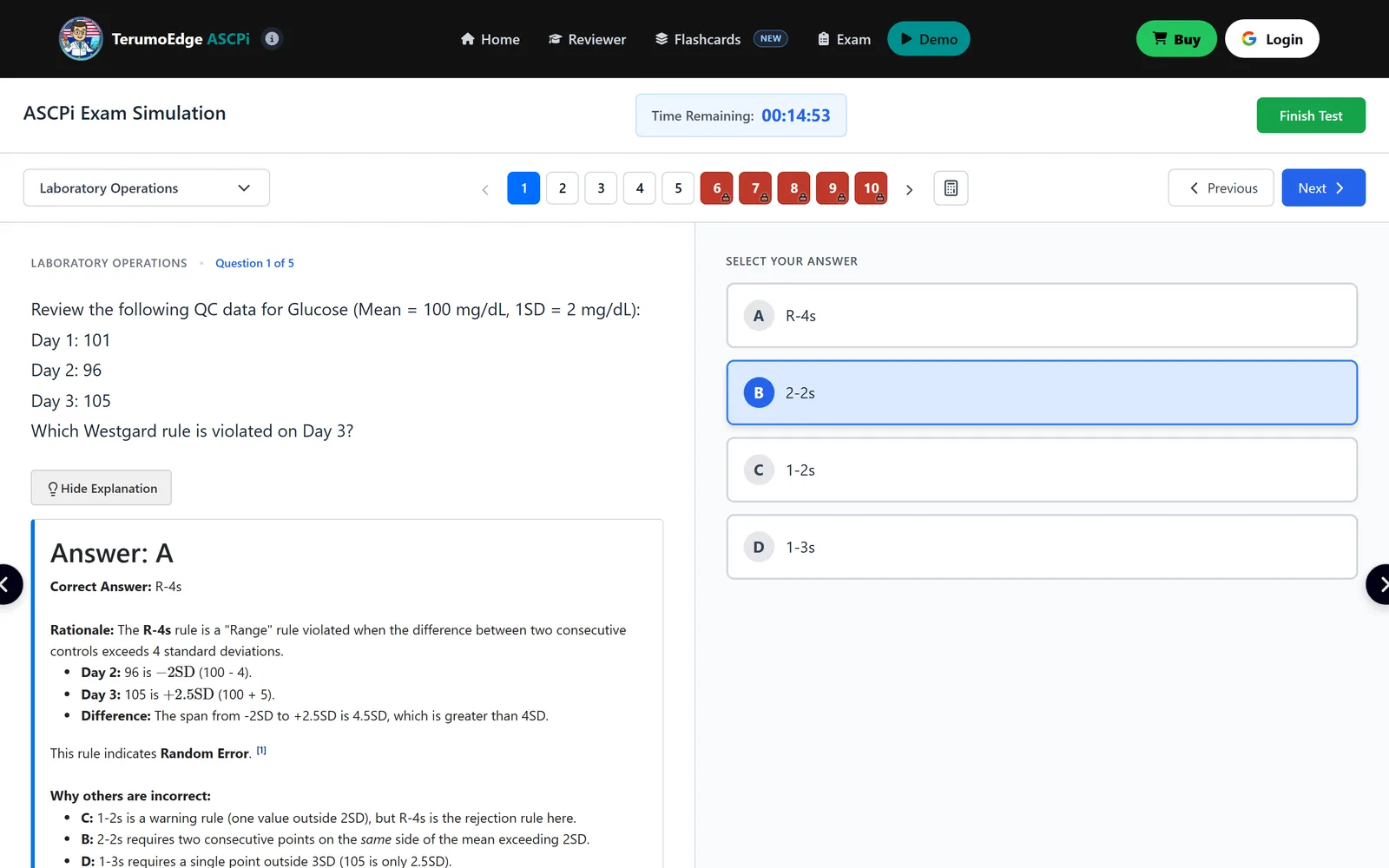
The change from last time matters more than the hours. If you read heavily and drilled lightly before, flip it. If you drilled without reading explanations, read them. The TerumoEdge simulator has 2,800 items with an English explanation for each, and a full mock built to the exam's length. It is a fixed-length practice draw and does not copy the adaptive algorithm, so a mock percentage is not a prediction of your scaled score.
Keep what worked, too. If your report shows a subtest area that was comfortably strong, give it light maintenance, such as one short set a week, so it does not slip while you repair the others. Retakers sometimes pour every hour into the weak areas and lose ground elsewhere, and a content-area mix across all seven areas is what the exam draws on throughout.
Add one new habit that rehearses the format. In every timed set, answer each item before moving on and note the numbers you would flag, then review only at the end. That mirrors how the real exam works, because ASCP BOC says questions cannot be skipped and flagged items can be reviewed only after all are answered, if time remains.
For wider scheduling, adapt our 12-week study plan. If nerves played a part, read the post on ASCPi anxiety.
Frequently asked questions
How soon can I retake the ASCPi?
Your eligibility period begins no earlier than 30 days after your previous examination date, according to ASCP BOC. That is the earliest possible start, not a recommendation. Book when your diagnosis and plan say you are ready, and confirm current scheduling details with ASCP BOC.
How many times can I take the ASCPi?
ASCP BOC allows five attempts under one eligibility route if you continue to meet the current eligibility requirements. After five unsuccessful attempts under one route, you must meet the requirements under an alternate route. Confirm which routes apply to you with ASCP BOC.
Do I have to reapply?
Yes. Each application incurs a non-refundable fee, which we do not quote. Check ASCP BOC for the current amount and process, and apply when your plan is ready, not simply when the 30 days have passed.
What should I do with my failing score report?
Use its subtest breakdown as the backbone of your plan. List the areas from weakest to strongest, compare them with the guideline weights, and start with the weak areas that carry the most weight. Pair that with your own error log from practice.
Sources
From the publisher
Meet the ASCPi format here first.
TerumoEdge ASCPi is an ASCPi practice simulator: board-length sets and a timed 100-item mock across all seven content areas, with an English explanation for every item instead of a bare answer key. It is a fixed-length practice draw, not ASCP's adaptive test.
- 2,800 items across seven content areas, 400 in each
- Four fixed sets of 100 items per area, and a 100-item full mock in 150 minutes
- An English explanation for every item, not a bare answer key
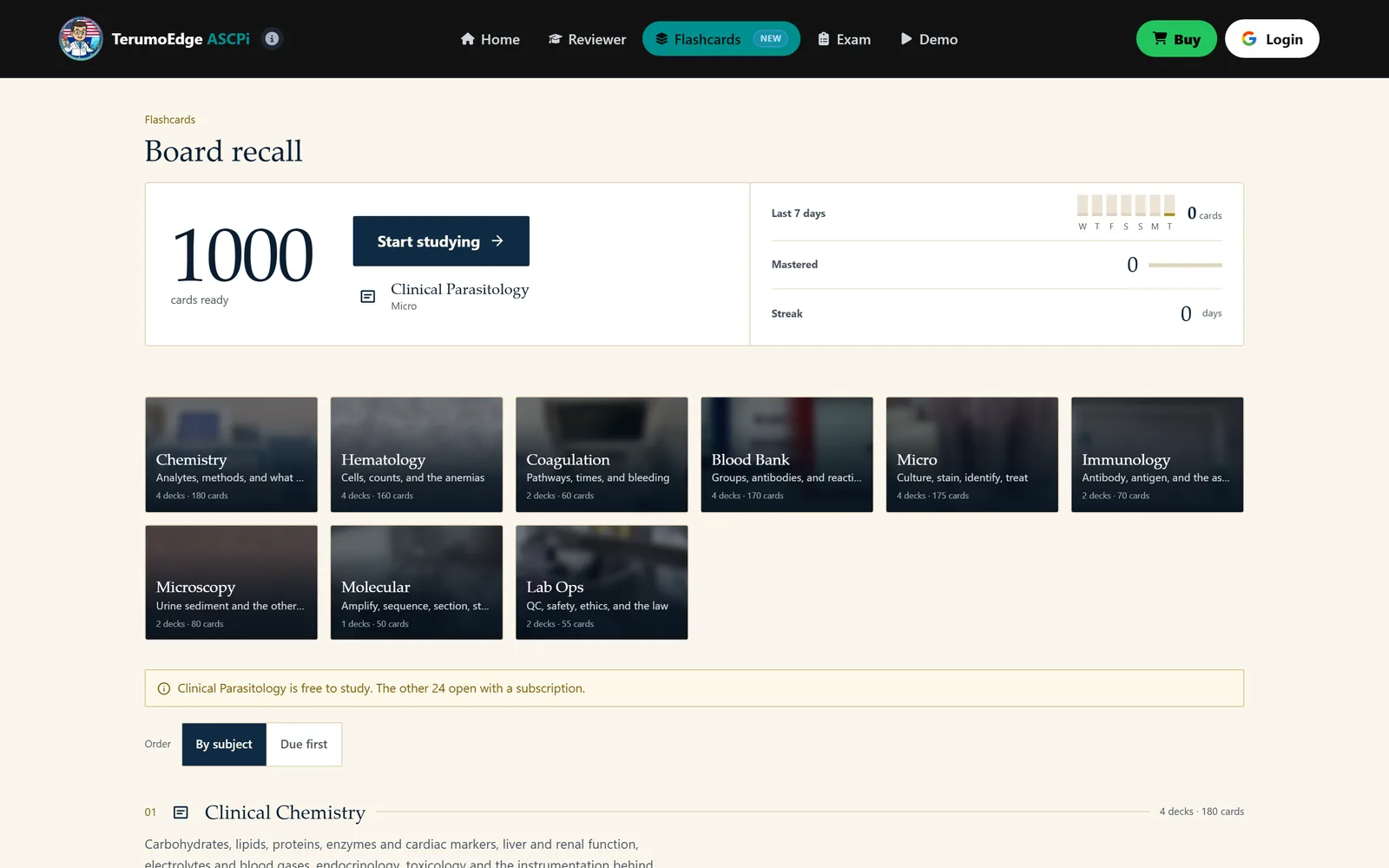
- A laboratory science reviewer and flashcards beside the question bank
Try the free ASCPi simulator demo Five real items in each of the seven content areas. No account needed.
About this article
Written by the TerumoEdge ASCPi editorial team, who build the TerumoEdge ASCPi Exam Simulator. Exam facts are checked against the ASCP Board of Certification content guideline, its eligibility and exam pages, and the ASCP BOC and Pearson VUE test center procedures, and every article lists its sources. How we write and check our articles.
First published .